The first complete mitochondrial DNA of Tenuidactylus dadunensis (Squamata: Gekkonidae) and its phylogeny
Qian-Ru Liang, Lei Shi

TL;DR
This paper reports the first complete mitochondrial DNA of a gecko species and its evolutionary relationships.
Contribution
The first complete mitochondrial DNA sequence for Tenuidactylus dadunensis and its phylogenetic placement in Gekkonidae.
Findings
The complete mtDNA of Tenuidactylus dadunensis is 16,893 bp long with standard mitochondrial gene content.
Phylogenetic analysis shows T. dadunensis is a sister taxon to Cyrtopodion scabrum within Gekkonidae.
The mtDNA data will aid in conservation and evolutionary studies of geckonids.
Abstract
The complete mitochondrial DNA (mtDNA) of Tenuidactylus dadunensis (Squamata: Gekkonidae) was described by using next-generation sequencing. The total length of mtDNA was 16,893 bp, which contained 13 PCGs (COX1-3, ND1-6, ND4L, ATP6, ATP8, and CYTB), 22 transfer RNA(tRNA) genes, 2 ribosomal RNA (rRNA) genes, and a control region (D-loop). The Bayesian inference tree showed that T. dadunensis was included in Gekkonidae and was a sister taxon to Cyrtopodion scabrum. The complete mtDNA of T. dadunensis will be an important genetic resource to the studies of conservation and research of geckonids.
Genes, proteins, chemicals, diseases, species, mutations and cell lines named across the full text — each resolved to its canonical identifier and authoritative record.
Click any figure to enlarge with its caption.
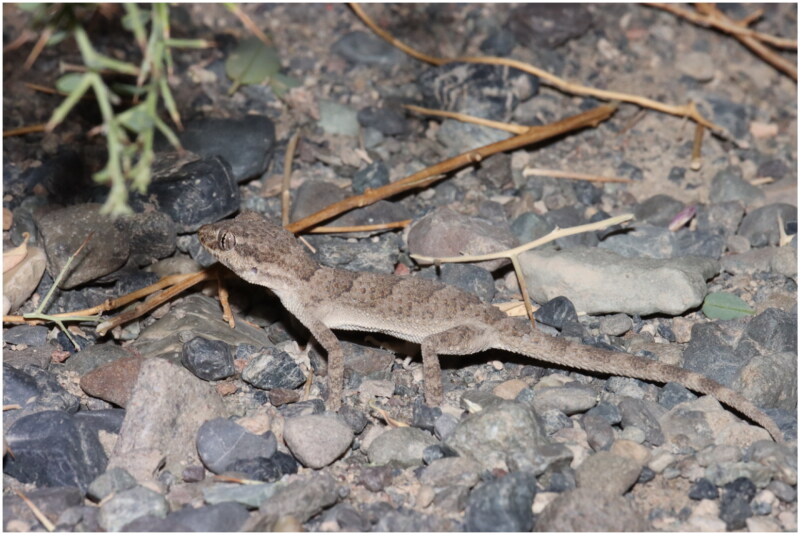 Figure 1
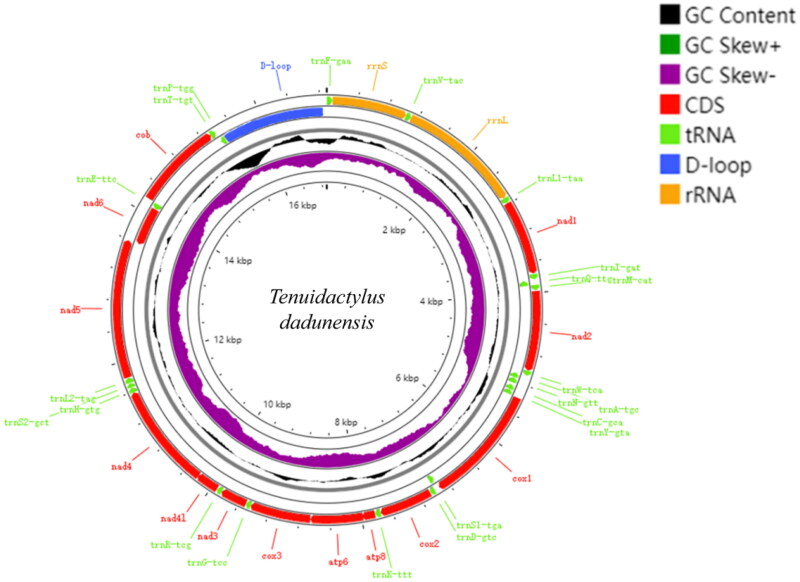 Figure 2
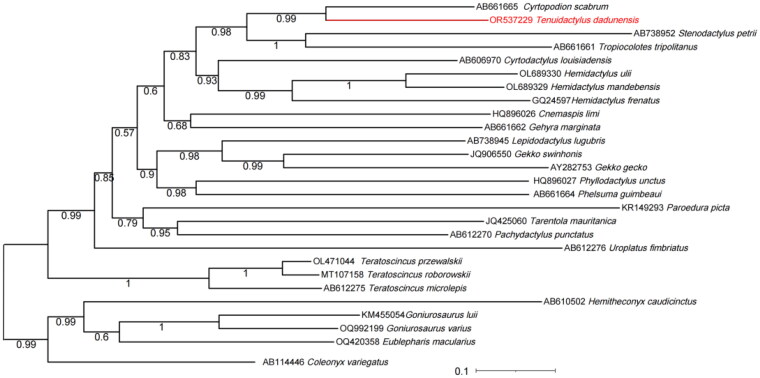 Figure 3
| Species | Size (bp) | GenBank NO. | source |
|---|---|---|---|
|
| 16.893 | this study | |
|
| 16.435 | Zhou et al. ( | |
|
| 16.818 | Li et al. ( | |
|
| 16.994 | – | |
|
| 17.594 | – | |
|
| 16.680 | Yan et al. ( | |
|
| 16.588 | – | |
|
| 16.762 | Kumazawa et al. ( | |
|
| 17.475 | – | |
|
| 17.220 | Starostová and Musilová ( | |
|
| 17.533 | Kumazawa et al. ( | |
|
| 20.248 | Kumazawa et al. ( | |
|
| 18.672 | Kumazawa et al. ( | |
|
| 16.780 | Kumazawa et al. ( | |
|
| 16.891 | Li et al. ( | |
|
| 16.901 | Šmíd et al. ( | |
|
| 16.830 | Šmíd et al. ( | |
|
| 16.881 | – | |
|
| 15.327 | Rato et al. ( | |
|
| 17.184 | – | |
|
| 16.693 | Ma et al. ( | |
|
| 16.995 | – | |
|
| 17.110 | Kumazawa ( | |
|
| 17.460 | Pinto et al. ( | |
|
| 17.778 | Zhou et al. ( | |
|
| 16.519 | – | |
|
| 17.043 | Jonniaux et al. ( |
- —the Third Xinjiang Scientific Expedition Program
- —the National Natural Science Foundation of China
Peer Reviews
No public reviews on file for this paper yet. If you reviewed it on a platform where reviews are public (OpenReview, ICLR, NeurIPS, ICML), you can paste yours below so the community can read it here.
Videos
No videos yet. Explain this paper in a talk, walkthrough, or lecture? Add one.
Taxonomy
TopicsGenomics and Phylogenetic Studies · Amphibian and Reptile Biology · Mosquito-borne diseases and control
Introduction
Tenuidactylus dadunensis (Shi and Zhao 2011) (ICUN: DD) (Figure 1) is a species of Tenuidactylus in the family Gekkoidea which is endemic to Xinjiang, China. Shi and Zhao (2011) were the first to discover this species in Turpan Basin, western China and named it Cyrtopodion dadunense. Based on morphological analysis, they concluded that this species was significantly different from two other species of the same genus (Cyrtopodion elongatum and Cyrtopodion russowi) distributed in Xinjiang. The phylogeny and classification of the Palearctic naked-toed geckos (Cyrtodactylus seso lato) was subsequently revised by Bauer et al. (2013), which supported that three subgenus of Cyrtopodion, including Cyrtopodion, Tenuidactylus and Mediodactylus should be arised to valid genus. Meanwhile, Bauer et al. (2013) tentatively place Cyrtopodion dadunense in this genus, as Tenuidactylus daduensis. Kai et al. (2020) followed Bauer et al. (2013) in their update of the Chinese amphibian and reptile list. Since then, no further studies on T. daduensis have been reported. Tenuidactylus is Palearctic thin-toed gecko, which has a total of eight species, including Tenuidactylus bogdanovi, T. caspius, T. dadunensis, T. elongatus, T. fedtschenkoi, T. longipes, T. turcmenicus, T. voraginosus (Uetz and Stylianou 2018), no more molecular infomation reported untill now. In this study, we used Illumina NovaSeq 6000 sequencing technology for paired-end sequencing of the sample DNA to obtain the complete mitochondrial genome of T. daduensis. This is the first complete mitochondrial sequence of T. daduensis and the first complete sequence of genus Tenuidactylus, which will provide data support for the phylogenetic studies of Gekkonidae in the future.
Photograph of Tenuidactylus dadunensis (photo credit: Lei Shi, used with permission). Specimen for our study were collected in Turpan by Weizheng Gao, Tao Wang and Bo Ma.
Materials and methods
Samples of T. dadunensis were collected on 28 June 2023 in Turpan City (42.85 N, 88.87E), Xinjiang UygurAutonomous Region, China. The specimen (NO: THAT5702-9) was identified by Lei Shi. We based our identification on the description of T. dadunensis by Shi and Zhao (2011): nostril bordered by rostral, first supralabial, one supranasal, and two subequal postnasals; back tubercles arranged in regular longitudinal rows; 23–26 ventral scales across midabdomen; 97–108 scales along the ventrum of body from postmental to cloaca; 18–22 subdigital lamellae beneath fourth toe; 8–10 precloacal pores in males; caudal tubercles broadly in contact laterally with each other; a single row of transversally enlarged subcaudals; dorsal bands in waving shape, much thinner than interspaces. We cut a portion of tissue from the tail, and the specimen was preserved in the Animal Herbarium of the College of Life Sciences, Xinjiang Agricultural University, Xinjiang, China (Lei Shi, [email protected]).
Total genomic DNA was extracted from the adductor muscle tissue using a DNeasy tissue kit (Qiagen, Beijing, China) following the manufacturer’s protocols. After DNA isolation, 1 μg of purified DNA was fragmented to ∼500 bp using the Covaris M220 system, used to construct short-insert libraries according to the manufacturer’s instructions (TruSeq™Nano DNA Sample Prep Kit, Illumina), and then sequenced on an Illumina NovaSeq 6000 platform (Modi et al. 2021) (BIOZERON Co., Ltd, Shanghai, China). The mitochondrial genome was reconstructed using a combination of denovo and reference-guided assemblies, and the following three steps were used to assemble the mitogenome. First, the filtered reads were assembled into contigs using GetOrganelle v1.7.5 (Jin et al. 2020), potential mitochondrial contigs were extracted by aligning against the NCBI mitogenome database. Second, the potential mitochondrial contigs were aligned to the reference mitogenomes using BLAST v 2.8.1+, and aligned contigs (>80% query coverage) were ordered and connected manually according to the reference mitogenomes. Finally, MUMmer 3.23 (Kurtz et al. 2004) was used to check whether these contigs were circular. Based on the above assembly steps, we obtained a circle of T. dadunensis mitogenome. We used GetOrganelle v1.7.5 software (https://github.com/Kinggerm/GetOrganelle) (Jin et al. 2020) for mitochondrial genome assembly. The software cycles through the target reads using the seed database and then calls SPAdes to assemble the genome. We performed reads mapping with Bowtie2 (Langdon 2015) and calculated the reads coverage of the mitochondrial region by SAMtools depth (Li et al. 2009). We compared the sequencing reads to the assembly results to get a depth of coverage map of the whole genome sequence (Supplementary Figure S1). The mitochondrion genes were annotated using the online MITOS tool (Bernt et al. 2013), using default parameters to predict protein coding genes, transfer RNA (tRNA) genes, and ribosome RNA (rRNA) genes.
DNA sequences were aligned using ClustalW (Thompson et al. 1994) implemented in MEGA7.0 (Kumar et al. 2016). In order to clarify the phylogenetic position of the entire mitochondrial sequence of T. dadunensis, we obtained 27 complete mitochondrial genome sequences from the GenBank database from Gekkonidae, Phyllodactylidae, Sphaerodactylidae and Eublepharidae, respectively (Table 1) (Ma et al. 2020). We selected all available mitogenomes under these taxonomic designation to determine a clear phylogenetic position for T. dadunensis with a relatively complete phylogenetic tree. We used Partitionfinder-2.1.1 (Lanfear et al. 2017) to estimate the best model for the molecular dataset using the Akaike information criterion. We used Bayesian Inference (BI) to construct phylogenetic relationships for T. dadunensis, with the species of Eublepharidae as the outgroup. We then used MrBayes 3.2.2 (Ronquist et al. 2012) to perform Bayesian inference (BI). We used the Markov chain Monte Carlo (MCMC) theory approach in BI, running 8,000,000 generations, drawing one sample every 1000, running four chains per analysis, and removing the top 25% of the data with the other parameters as the default. The final results were checked using Tracer 1.7.2 (Rambaut et al. 2018) and had effective sample size (ESS) values > 200 for all parameter values. Finally, a phylogenetic tree was plotted using ITOLV6 (Letunic and Bork 2021). We considered an a posteriori probability (BPP) value of > 0.95 as strong support for monophyly.
Results
The length of T. dadunensis complete mtDNA (GenBank accession: OR537229) was 16,893 bp, which contained 13 PCGs (COX1-3, ND1-6, ND4L, ATP6, ATP8, and CYTB), 22 tRNA genes, 2 rRNA genes, and a control region (D-loop) (Figure 2). Depth of coverage maps for whole genome sequences are shown in Supplementary Figure S1. The gene order was similar to the known mitogenomes of Gekkonidae (Zhou et al. 2006; Yan et al. 2009; Ma et al. 2020). The nucleotide composition of T. dadunensis was 32.68% A, 24.02% T, 28.78% C and 14.52% G. Based on the results of the Bayesian phylogenetic tree (Figure 3), we can know the location of our mitotic genome samples (T. dadunensis) in the the genomic dataset of Gekkonidae. The results of the Bayesian phylogenetic tree (Figure 3) show that T. dadunensis was clustered into the clade of genomic dataset of Gekkonidae, and was a close sister clade to C. scabrum, with strongly support (BI = 0.99). More mitogenomic data may be needed at a later stage to analyze and clarify the specific position of T. dadunensis within the Gekkonidae.
Mitochondrial genome maps for Tenuidactylus dadunensis (OR537229).
The Phylogenetic tree of Tenuidactylus dadunensis (OR537229) and other available mitogenomes under these taxonomic. The numbers showed between branches indicate the posteriori probabilities from Bayesian inference (BI). The GenBank accession numbers of all species are shown in the figure and the citations are in the Table 1.
Discussion and conclusion
In this study, mitochondrial genomes were sequenced and assembled for T. dadunensis. The structure of the whole mitochondrial sequence of T. dadunensis is similar to that of other species of the same family. The mitogenome of T. dadunensis was 16,893 bp in size, including 13 PCGs, 22 transfer RNA(tRNA) genes, 2 ribosomal RNA (rRNA) genes, and a control region (D-loop). The complete mtDNA of T. dadunensis reported in this study will play an important role in understanding the evolution and systematic biology of the family Gekkonidae. The phylogenetic results show that T. dadunensis is closely related to C. scabrum, and also show that the Gekkonidae are monophyletic. Furthermore, it will be an important genetic resource to the studies of conservation and restoration of T. dadunensis.
Supplementary Material
Supplemental Material
Supplemental Material
The reference list from the paper itself. Each links out to its DOI / PubMed record.
- 1Bauer AM, Masroor R, Titus-Mcquillan J, Heinicke MP, Daza JD, Jackman TR. 2013. A preliminary phylogeny of the Palearctic naked-toed geckos (Reptilia: Squamata: Gekkonidae) with taxonomic implications. Zootaxa. 3599(4):301–324. doi:10.11646/zootaxa.3599.4.1.24613954 · doi ↗ · pubmed ↗
- 2Bernt M, Bleidorn C, Braband A, Dambach J, Donath A, Fritzsch G, Golombek A, Hadrys H, Jühling F, Meusemann K, et al. 2013. A comprehensive analysis of bilaterian mitochondrial genomes and phylogeny. Mol Phylogenet Evol. 69(2):352–364. doi:10.1016/j.ympev.2013.05.002.23684911 · doi ↗ · pubmed ↗
- 3Jin JJ, Yu WB, Yang JB, Song Y, De Pamphilis CW, Yi TS, Li DZ. 2020. Get Organelle: a fast and versatile toolkit for accurate de novo assembly of organelle genomes. Genome Biol. 21(1):241. doi:10.1186/s 13059-020-02154-5.32912315 PMC 7488116 · doi ↗ · pubmed ↗
- 4Jonniaux P, Hashiguchi Y, Kumazawa Y. 2012. Mitochondrial genomes of two African geckos of genus Hemitheconyx (Squamata: Eublepharidae). Mitochondrial DNA. 23(4):278–279. doi:10.3109/19401736.2012.668898.22708855 · doi ↗ · pubmed ↗
- 5Kai W, Jinlong RE, Hongman C, Zhitong L, Xianguang G, He J, Jinming C, Jiatang L, Peng G, Yingyong W, et al. 2020. Updated list of amphibians and reptiles in China. Biodiversity. 28(2):189.
- 6Kumar S, Stecher G, Tamura K. 2016. MEGA 7: molecular evolutionary genetics analysis version 7.0 for bigger datasets. Mol Biol Evol. 33(7):1870–1874. doi:10.1093/molbev/msw 054.27004904 PMC 8210823 · doi ↗ · pubmed ↗
- 7Kumazawa Y. 2007. Mitochondrial genomes from major lizard families suggest their phylogenetic relationships and ancient radiations. Gene. 388(1–2):19–26. doi:10.1016/j.gene.2006.09.026.17118581 · doi ↗ · pubmed ↗
- 8Kumazawa Y, Miura S, Yamada C, Hashiguchi Y. 2014. Gene rearrangements in gekkonid mitochondrial genomes with shuffling, loss, and reassignment of t RNA genes. BMC Genomics. 15(1):930. doi:10.1186/1471-2164-15-930.25344428 PMC 4223735 · doi ↗ · pubmed ↗