A new technique to ATTACK the silent pandemic of antimicrobial resistance
Yong‐Guan Zhu

Abstract
Genes, proteins, chemicals, diseases, species, mutations and cell lines named across the full text — each resolved to its canonical identifier and authoritative record.
Click any figure to enlarge with its caption.
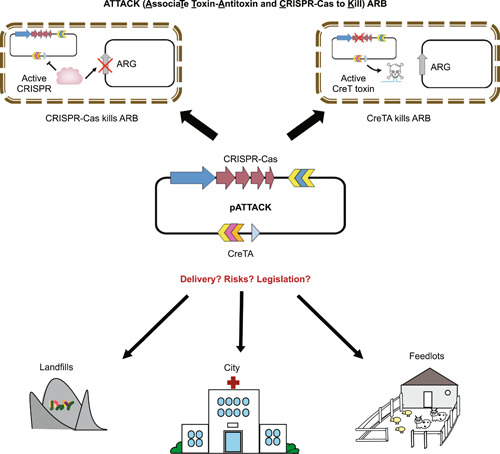 Figure 1
Peer Reviews
No public reviews on file for this paper yet. If you reviewed it on a platform where reviews are public (OpenReview, ICLR, NeurIPS, ICML), you can paste yours below so the community can read it here.
Videos
No videos yet. Explain this paper in a talk, walkthrough, or lecture? Add one.
Taxonomy
TopicsCRISPR and Genetic Engineering · Pharmaceutical and Antibiotic Environmental Impacts · Antibiotic Resistance in Bacteria
Due to the global proliferation of antibiotic‐resistant bacteria (ARB) and antibiotic resistance genes (ARGs) in humans, animals, and the environment, antibiotic resistance has become a silent pandemic threatening public health across the globe1. Anthropogenic activities, including clinical antibiotic use, intensive animal farming, and landfill waste, have been identified as the greatest risk factors for the dissemination of antibiotic resistance2, 3. Additionally, the rise in disinfectant use during the COVID‐19 pandemic has exacerbated the situation by facilitating the spread of ARB4. Therefore, it is imperative to develop safe and effective strategies to combat this silent pandemic. These strategies must focus on reducing the presence of ARB and ARGs in the environment while also accelerating the implementation of the “ONE EARTH, ONE HEALTH” action plan.
The CRISPR‐Cas immune system found in prokaryotes has been developed into precise antimicrobials capable of selectively eradicating ARB or ARGs within complex bacterial communities5, 6. However, these antimicrobials are not foolproof, as bacteria can develop resistance to them through various mechanisms such as the inactivation of Cas nucleases with anti‐CRISPR proteins or breaking down their encoding genes via genomic rearrangements or transposition events7, 8. This results in the failure of ARB eradication or ARG reduction.
A recent study published in Nature Communications by Wang et al.9 introduced an advanced antimicrobial strategy that combines CRISPR‐Cas with the newly discovered Type VIII toxin‐antitoxin CreTA10, which, in prokaryotic genomes, tightly associates with CRISPR‐Cas and protects it from inactivation. If the CRISPR‐Cas system remains active after the antimicrobial being delivered into the antibiotic‐resistant (AR) pathogens, DNA breakage will occur, resulting in the death of the pathogen or its increased sensitivity to antibiotics upon the loss or mutation of target AR genes. In the event of the pathogens deactivating CRISPR‐Cas through various anti‐CRISPR mechanisms, CreTA acts as a backup system by inducing cellular death, creating a dilemma for the target pathogen9 (Figure 1). The authors named this innovative approach “ATTACK” (AssociaTe Toxin‐Antitoxin and CRISPR‐Cas to Kill Pathogens). The study has demonstrated that ATTACK outperforms the use of CRISPR alone by showing higher efficacy in eliminating targeted AR pathogens (in cases where the targeted ARG is located on the chromosome) and a more comprehensive reduction of ARG (in cases where it is situated on a plasmid)9.
I believe that ATTACK is an advanced and precise antimicrobial technique against ARB. While the authors have demonstrated its efficacy in targeting the carbapenem‐resistant pathogenic bacterium Acinetobacter baumannii, potentially, it could also prove to be a valuable tool for combating the diverse range of ARB and ARGs found in the environment. In conjunction with efficient delivery vectors that may be developed in the future, for example, engineered phages, conjugative plasmids, or bacteria‐targeting nanoparticles, ATTACK has the potential to help “attack” the silent, yet perilous pandemic of antimicrobial resistance. Moreover, it will be crucial to conduct a thorough evaluation of the potential risks associated with introducing this novel technique in the environment (Figure 1). This will require the formulation of appropriate guidelines and legal frameworks to ensure safe and responsible implementation. Given the widespread of antimicrobial resistance in medical and general environments, we must act swiftly to curtail its further dissemination. Therefore, ATTACK, when fully developed, will be instrumental in mitigating the health impacts of antimicrobial resistance, particularly under the One Health framework.
The reference list from the paper itself. Each links out to its DOI / PubMed record.
- 1Larsson DGJ , Flach CF . Antibiotic resistance in the environment. Nat Rev Microbiol. 2022;20:257–69.34737424 10.1038/s 41579-021-00649-x PMC 8567979 · doi ↗ · pubmed ↗
- 2Zhu YG , Johnson TA , Su JQ , Qiao M , Guo GX , Stedtfeld RD , et al. Diverse and abundant antibiotic resistance genes in Chinese swine farms. Proc Natl Acad Sci USA. 2013;110:3435–40.23401528 10.1073/pnas.1222743110 PMC 3587239 · doi ↗ · pubmed ↗
- 3Zhu YG , Zhao Y , Li B , Huang CL , Zhang SY , Yu S , et al. Continental‐scale pollution of estuaries with antibiotic resistance genes. Nat Microbiol. 2017;2:16270.28134918 10.1038/nmicrobiol.2016.270 · doi ↗ · pubmed ↗
- 4Lu J , Guo J . Disinfection spreads antimicrobial resistance. Science. 2021;371:474.10.1126/science.abg 438033510019 · doi ↗ · pubmed ↗
- 5Bikard D , Euler CW , Jiang W , Nussenzweig PM , Goldberg GW , Duportet X , et al. Exploiting CRISPR‐Cas nucleases to produce sequence‐specific antimicrobials. Nat Biotechnol. 2014;32:1146–50.25282355 10.1038/nbt.3043 PMC 4317352 · doi ↗ · pubmed ↗
- 6Citorik RJ , Mimee M , Lu TK . Sequence‐specific antimicrobials using efficiently delivered RNA‐guided nucleases. Nat Biotechnol. 2014;32:1141–5.25240928 10.1038/nbt.3011 PMC 4237163 · doi ↗ · pubmed ↗
- 7Uribe RV , Rathmer C , Jahn LJ , Ellabaan MMH , Li SS , Sommer MOA . Bacterial resistance to CRISPR‐Cas antimicrobials. Sci Rep. 2021;11:17267.34446818 10.1038/s 41598-021-96735-4PMC 8390487 · doi ↗ · pubmed ↗
- 8Pawluk A , Davidson AR , Maxwell KL . Anti‐CRISPR: discovery, mechanism and function. Nat Rev Microbiol. 2018;16:12–7.29062071 10.1038/nrmicro.2017.120 · doi ↗ · pubmed ↗