Psychometric properties of the Chinese version of the Quick Delay Questionnaire (C-QDQ) and ecological characteristics of reward-delay impulsivity of adults with ADHD
Caili Chen, Shiyu Zhang, Haiheng Hong, Sunwei Qiu, Yi Zhou, Mengjie Zhao, Meirong Pan, Feifei Si, Min Dong, Haimei Li, Yufeng Wang, Lu Liu, Edmund J. S. Sonuga-Barke, Qiujin Qian

TL;DR
This study validates a Chinese version of a questionnaire that measures delay-related impulsivity in adults with ADHD and finds that ADHD patients show higher impulsivity than healthy controls.
Contribution
The study provides psychometric validation of the Chinese version of the QDQ and explores its ecological relevance in Chinese adults with ADHD.
Findings
The C-QDQ showed good reliability with Cronbach’s α between 0.83 and 0.89.
ADHD participants had higher C-QDQ scores than healthy controls, indicating greater delay-related impulsivity.
Female ADHD participants reported higher delay discounting than males, and ADHD-combined type showed higher delay aversion.
Abstract
The Quick Delay Questionnaire (QDQ) is a short questionnaire designed to assess delay-related difficulties in adults. This study aimed to examine the reliability and validity of the Chinese version of the QDQ (C-QDQ) in Chinese adults, and explore the ecological characteristics of delay-related impulsivity in Chinese adults with attention-deficit/hyperactivity disorder (ADHD). Data was collected from 302 adults, including ADHD (n = 209) and healthy controls (HCs) (n = 93). All participants completed the C-QDQ. The convergent validity, internal consistency, retest reliability and confirmatory factor analysis (CFA) of the C-QDQ were analyzed. The correlations between C-QDQ and two laboratory measures of delay-related difficulties and Barratt Impulsiveness Scale-11 (BIS-11), the comparison of C-QDQ scores between ADHD subgroups and HCs were also analyzed. The Cronbach’s α of C-QDQ was…
Genes, proteins, chemicals, diseases, species, mutations and cell lines named across the full text — each resolved to its canonical identifier and authoritative record.
Click any figure to enlarge with its caption.
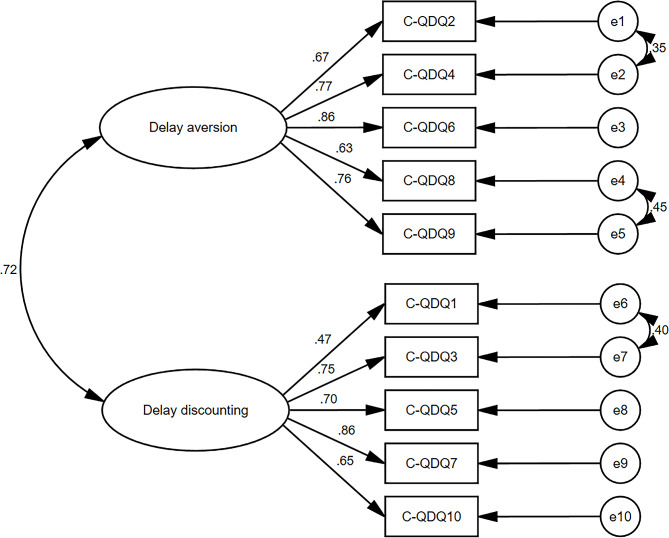 Figure 1
Peer Reviews
No public reviews on file for this paper yet. If you reviewed it on a platform where reviews are public (OpenReview, ICLR, NeurIPS, ICML), you can paste yours below so the community can read it here.
Videos
No videos yet. Explain this paper in a talk, walkthrough, or lecture? Add one.
Taxonomy
TopicsAttention Deficit Hyperactivity Disorder · Neural and Behavioral Psychology Studies · Anxiety, Depression, Psychometrics, Treatment, Cognitive Processes