SAMS-1 is required for the normal defecation motor program in Caenorhabditis elegans
Keiko Hirota, Masato Matsuoka

TL;DR
This study shows that the SAMS-1 gene is important for normal defecation in C. elegans, and its function is linked to phosphatidylcholine production.
Contribution
The study identifies a novel role for SAMS-1 in regulating the defecation motor program and its connection to phosphatidylcholine levels.
Findings
sams-1 mutants have longer defecation cycles compared to wild-type worms.
Choline supplementation restores the Exp step in sams-1 mutants during aging.
Phosphatidylcholine levels are linked to the regulation of the Exp step in sams-1 mutants.
Abstract
Defecation is an ultradian rhythmic behavior in Caenorhabditis elegans . We investigated the involvement of sams family genes in regulating the defecation motor program. We found that sams-1 mutants exhibited longer cycles than wild-type animals. With aging, the sams-1 mutants also frequently skipped the expulsion (Exp) step of defecation behavior. The sams-1 knockdown is known to reduce phosphatidylcholine (PC) levels, which are reversed by choline supplementation. We examined the effect of choline supplementation on defecation cycle times and Exp steps from adult days 1–4. Although choline supplementation did not alter the longer defecation cycle times of sams-1 mutants, it restored the loss of the Exp step in sams-1 mutants on adult days 3 and 4, suggesting a link between the regulation of the Exp step in sams-1 mutants and PC production.
Genes, proteins, chemicals, diseases, species, mutations and cell lines named across the full text — each resolved to its canonical identifier and authoritative record.
Click any figure to enlarge with its caption.
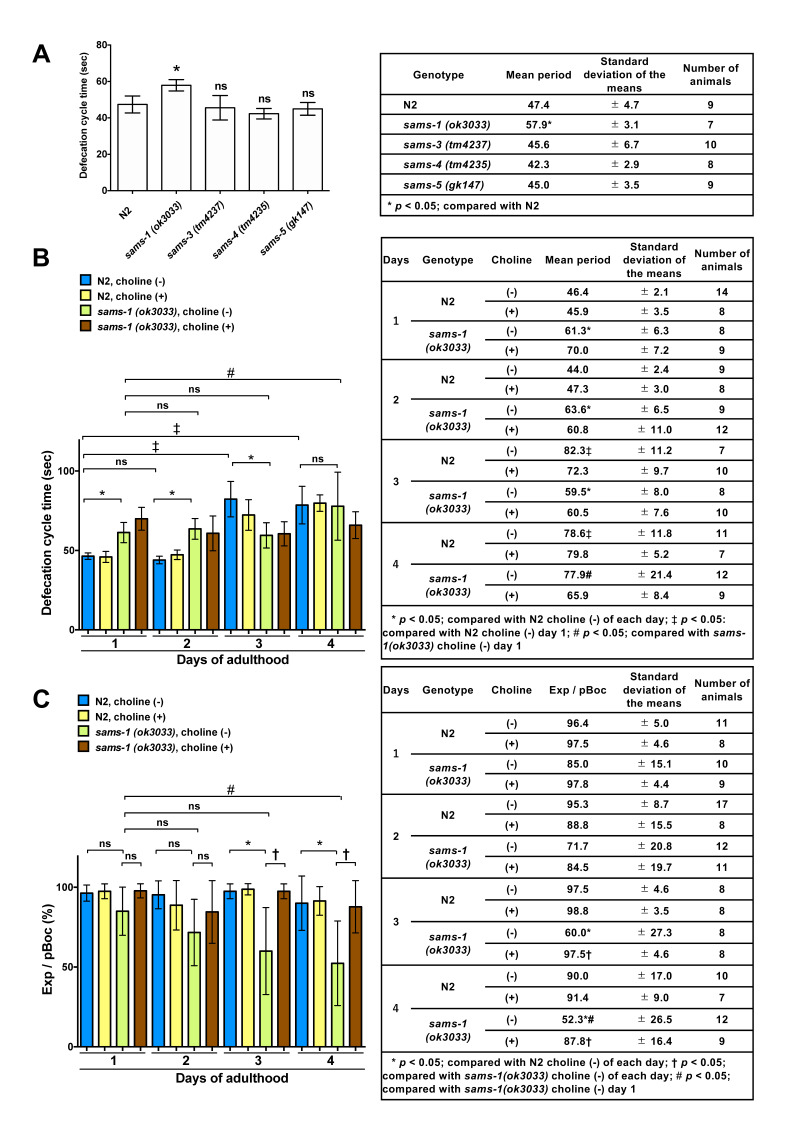 Figure 1
Peer Reviews
No public reviews on file for this paper yet. If you reviewed it on a platform where reviews are public (OpenReview, ICLR, NeurIPS, ICML), you can paste yours below so the community can read it here.
Videos
No videos yet. Explain this paper in a talk, walkthrough, or lecture? Add one.
Taxonomy
TopicsGenetics, Aging, and Longevity in Model Organisms · Spaceflight effects on biology · Circadian rhythm and melatonin