Static glabellar lines treated with the Endolift laser (1470 nm diode laser): A case report
Mohammad Ali Nilforoushzadeh, Niloufar Najar Nobari, Nazila Heidari, Amirhossein Heidari, Yekta Ghane, Hanieh Azizi, Shohreh Rafiee

Abstract
Genes, proteins, chemicals, diseases, species, mutations and cell lines named across the full text — each resolved to its canonical identifier and authoritative record.
Click any figure to enlarge with its caption.
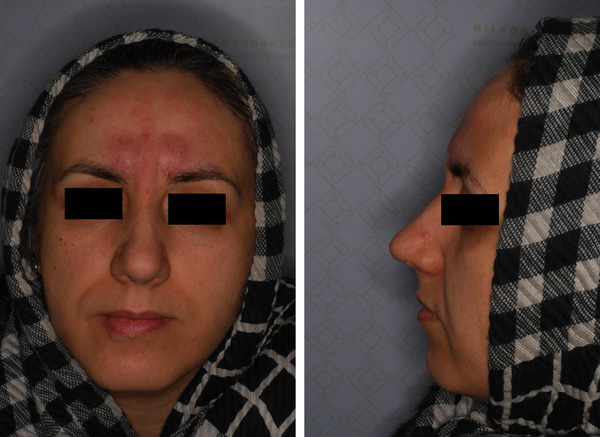 Figure 1
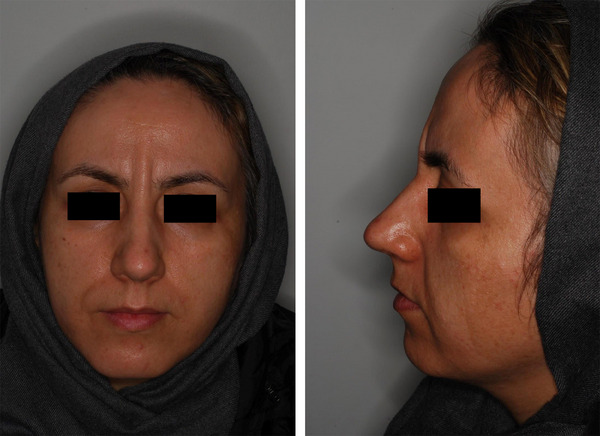 Figure 2
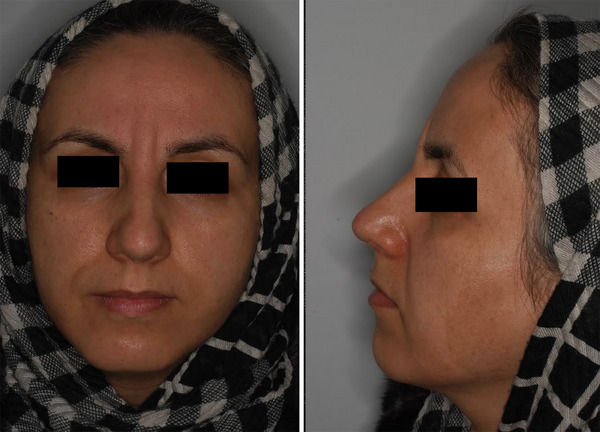 Figure 3
Peer Reviews
No public reviews on file for this paper yet. If you reviewed it on a platform where reviews are public (OpenReview, ICLR, NeurIPS, ICML), you can paste yours below so the community can read it here.
Videos
No videos yet. Explain this paper in a talk, walkthrough, or lecture? Add one.
Taxonomy
TopicsDermatologic Treatments and Research · Nail Diseases and Treatments · Surgical Sutures and Adhesives
Dear Editor,
Wrinkles are obvious lines or folds in the skin that make an inappropriate appearance on the face and negatively affect mental health and self‐esteem. Glabellar lines, also known as worry lines, are caused by contractions of different muscles of the face, including the corrugator, depressor supercilii, and/or procerus muscles, leading to an undesirable gap between the eyebrows.1 Several procedures, such as surgery, botulinum toxin type A injection, and implants, have been utilized for the treatment of wrinkles, although patients usually prefer non‐invasive and minimally invasive methods.2 Herein, we reported a patient with deep glabellar lines successfully treated with Endolift, a minimally invasive approach.
A 42‐year‐old female suffering from vertical glabellar lines was presented to Jordan Dermatology and Hair Transplantation Center, Tehran, Iran. Over the past year, she underwent botulinum toxin type A injection twice and filler injection once, which all failed to improve her vertical glabellar lines (Figure 1). Before the treatment, the targeted area was carefully examined and the subject was informed about the contraindications, warnings, and possible complications associated with the Endolift. The area was cleaned up using a remover solution and the patient was positioned on a flatbed. After receiving injectable local anesthesia with lidocaine, she was treated with one session of Endolift (LASEMAR1500 machine, Eufoton s.r.l.) with the setting of power of 3.5–4 WATTs, total energy of 150 J, T ON of 25 ms and T OFF of 75 ms, and fiber of 400µm. The size of the fiber was adjusted based on the depth of the wrinkle and the thickness of the skin. The fiber was transferred vertically under the glabellar line with reciprocal motion in the targeted area. The technique did not require recovery time. Regular photography (with a Nikon 10.2‐megapixel camera) was taken of the patient before and after the procedure as well as one month after treatment. After the procedure, a remarkable decrease in the depth of the glabellar lines and muscle bulk of the treated area was observed (Figure 2). Moreover, the patient's satisfaction was evaluated based on a four‐point scale from very satisfied to unsatisfied (from four to one, respectively) As a result, the subject was very satisfied after a single session of treatment. Regarding adverse events, the patient reported mild pain, redness, and swelling in the treatment area, which resolved after a few days. Subsequently, four weeks after the procedure, the patient was very satisfied with the treatment. Moreover, a remarkable improvement was reported at a follow‐up visit by a dermatologist (Figure 3).
Various therapeutic approaches have been utilized for the improvement of wrinkles. Previously, surgical procedures, such as the endoscopic facelift technique, were the most frequent rejuvenation procedures with acceptable results.3 Nonetheless, in some cases, surgical procedures aggravated the volume loss. Besides, they increase the risk of forehead area nerve and blood vessel damage and hairline alteration.4 Botulinum toxin type A is a popular, easy treatment technique for the resolution of upper face area rhytides with desirable but reversible effects, which needs repeated rounds of injection to maintain the result.5 Radiofrequency is another potential therapeutic choice with the ability to enhance collagen synthesis and dermal remodeling; however, it may cause scarring, depigmentation, and eruptive keratoacanthomas.6
Endolift laser is a novel, minimally invasive method that has been utilized in various cosmetic fields with desirable outcomes5. This procedure uses a non‐ablative fractional diode laser with a wavelength of 1470 nm as the energy source and transmits the energy to the treated tissue via a fiber 200–600 µm in diameter, eventually providing focused tissue ablation and coagulation. Aside from its clinical effectiveness, Endolift does not cause adverse events such as scarring, muscle atrophy, brow ptosis, and facial nerve damage, which commonly occur following surgery and botulinum toxin type A injection. Furthermore, no recovery time is needed for this procedure, and patients are able to go back to their daily routine immediately. Nonetheless, large‐scale randomized controlled trials are warranted to assess the efficacy and safety of this procedure and its different implications.
The application of Endolift was successful in treating glabellar lines. Endolift is a safe and effective method for promoting skin rejuvenation as well as improving facial wrinkles and the overall aesthetic appearance of the face with self‐limited adverse events. However, further investigations should be conducted to evaluate the efficacy and safety of this rejuvenation method.
CONFLICT OF INTEREST STATEMENT
The authors declared no conflict of interest.
ETHICS APPROVAL AND CONSENT TO PARTICIPATE
All procedures followed were in accordance with the ethical standards of the responsible committee on human experimentation (institutional and national) and with the Helsinki Declaration of 1975, as revised in 2000. Formal consent is not required for this type of study.
CONSENT FOR PUBLICATION
Written informed consent was obtained from the patient for publication of this case report and any accompanying images. A copy of the written consent is available for review by the Editor‐in‐Chief of this journal.
The reference list from the paper itself. Each links out to its DOI / PubMed record.
- 1Mussarat A , Mustafa MS , Azam S , Uddin M , Nasrullah RMU , Siddiq MA . DAXI (Daxibotulinumtoxin A)—an innovative approach for frown lines. Int J Gen Med. 2023;16:1267‐1269.37065981 10.2147/IJGM.S 406563 PMC 10103897 · doi ↗ · pubmed ↗
- 2Lotfi E , Dell Avanzato R , Ahramiyanpour N , Shadmanyazdi F , Khosravi S . Evaluation of eyebrow position and upper eyelid laxity after endolift laser treatment. Skin Res Technol. 2023;29(10):e 13498.37881059 10.1111/srt.13498 PMC 10570406 · doi ↗ · pubmed ↗
- 3Brandt FS , Cazzaniga A . Hyaluronic acid gel fillers in the management of facial aging. Clin Interv Aging. 2008;3(1):153‐159.18488885 10.2147/cia.s 2135 PMC 2544360 · doi ↗ · pubmed ↗
- 4Elmelegy N , Hegazy M . Dermal subcision of Nemoto's ligaments as a long‐lasting treatment for forehead and glabellar wrinkles. Eur J Plast Surg. 2019;42:1‐10.
- 5Nilforoushzadeh MA , Heidari‐Kharaji M , Fakhim T , Hosseini ST , Rafiee S , Shahverdi M , Najar Nobari N . Efficacy evaluation of endolift laser for treatment of nasolabial folds and marionette lines. Skin Res Technol. 2023;29(10):e 13480.37881043 10.1111/srt.13480 PMC 10523256 · doi ↗ · pubmed ↗
- 6Kleidona IA , Karypidis D , Lowe N , Myers S , Ghanem A . Fractional radiofrequency in the treatment of skin aging: an evidence‐based treatment protocol. J Cosmet Laser Ther. 2020;22(1):9‐25.31825296 10.1080/14764172.2019.1674448 · doi ↗ · pubmed ↗