Acute-Onset Lower Extremity Weakness and Urinary Retention in a Chronically Immunosuppressed Patient: Diagnosis and Management of Herpes Simplex Virus Type 2 Myelitis
Jaya Chandra, Hamid R Khatibi

TL;DR
A chronically immunosuppressed man developed lower body weakness and urinary issues due to herpes simplex virus type 2 myelitis and fully recovered after treatment.
Contribution
This case report highlights HSV-2 myelitis as a rare but treatable cause of acute neurological deficits in immunosuppressed individuals.
Findings
HSV-2 myelitis presented with bilateral lower extremity weakness and urinary retention in an immunosuppressed patient.
Diagnosis was confirmed via CSF and serum PCR testing for herpes simplex virus type 2.
Treatment with IV steroids and antiviral therapy led to complete neurological recovery after four months of physical therapy.
Abstract
A 34-year-old immunosuppressed male presented with worsening bilateral lower extremity weakness and urinary retention accompanied by a painless clean-based chancre on his glans penis. Physical examination revealed symmetrically diminished lower extremity weakness most pronounced with hip flexion and knee extension and absent Achilles reflexes. Full MRI spine without contrast was noncontributory. Lumbar puncture showed elevated protein and total nucleated cells with lymphocytic predominance. Both CSF and serum polymerase chain reaction were positive for herpes simplex virus type 2. He received IV methylprednisolone and acyclovir and underwent four months of physical therapy with complete resolution of his neurologic deficits.
Genes, proteins, chemicals, diseases, species, mutations and cell lines named across the full text — each resolved to its canonical identifier and authoritative record.
Click any figure to enlarge with its caption.
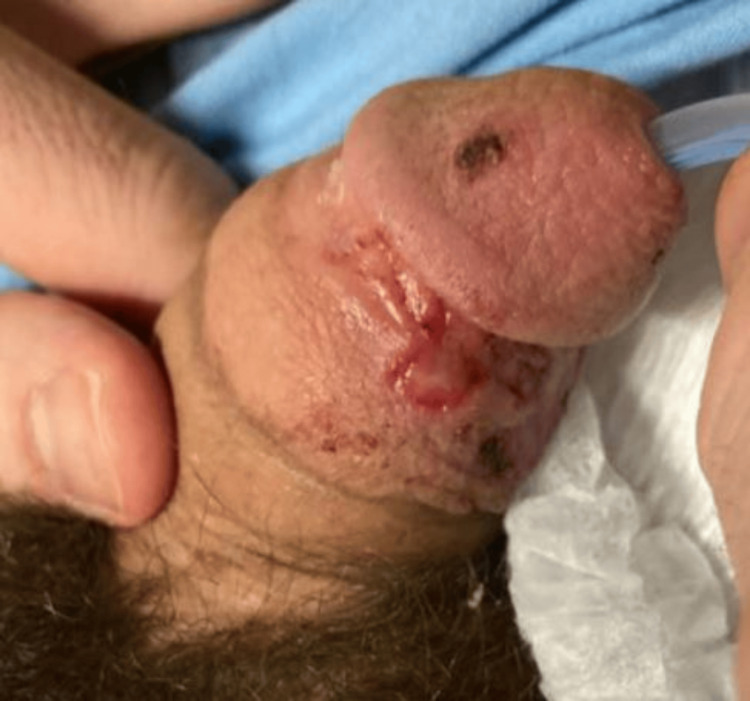 Figure 1
| Test | Observed value | Reference range |
| Serum studies | ||
| HSV 1 | Not detected | Not detected |
| HSV 2 | Detected | Not detected |
| HIV Ag/Ab | Nonreactive | Nonreactive |
| RPR | Nonreactive | Nonreactive |
| Borrelia burgdorferi antibodies, IgM | Negative | Negative |
| CMV IgM | 12.0 | ≤29.9 AU/mL |
| EBV Ab to viral capsid Ag IgG | >750.0 | 0.0-21.9 U/mL |
| EBV Ab to viral capsid Ag IgM | 27.3 | 0.0-43.9 U/mL |
| EBV Ab to nuclear Ag IgG | 169.0 | 0.0-21.9 U/mL |
| EBV Ab to early (D) Ag IgG | <5.0 | 0.0-10.9 U/mL |
| Parvovirus B19 Ab, IgG | 3.99 | ≤0.90 IV |
| Parvovirus B19 Ab, IgM | 0.19 | ≤0.90 IV |
| Urine studies | ||
| Chlamydia trachomatis PCR, urine | Not detected | Not detected |
| Neisseria gonorrhea PCR, urine | Not detected | Not detected |
| CSF fluid analysis | ||
| Glucose | 75 mg/dL | 40-80 mg/dL |
| Protein | 531 mg/dL | 12-60 mg/dL |
| Total nucleated cells | 1963/cumm | 0-5/cumm |
| Red blood cells | 8000 | 0/cumm/cumm |
| Segmented cells | 1% | 0-6% |
| Lymphocytes | 91% | 0-90% |
| Monocytes | 8% | 0-45% |
| Culture | No growth | No growth |
| Gram stain | Rare segmented neutrophils were observed, no bacteria were seen | |
| CSF meningitis/encephalitis molecular panel | ||
| Escherichia coli K1 | Not detected | Not detected |
| Haemophilus influenza | Not detected | Not detected |
| Listeria monocytogenes | Not detected | Not detected |
| Neisseria meningitidis | Not detected | Not detected |
| Streptococcus agalactiae | Not detected | Not detected |
| Streptococcus pneumoniae | Not detected | Not detected |
| Cytomegalovirus | Not detected | Not detected |
| Enterovirus | Not detected | Not detected |
| HSV-1 | Not detected | Not detected |
| HSV-2 | Detected | Not detected |
| HHV-6 | Not detected | Not detected |
| Parechovirus | Not detected | Not detected |
| Varicella-zoster virus | Not detected | Not detected |
| Cryptococcus neoformans/gatti | Not detected | Not detected |
| Additional CSF studies | ||
| VDRL | Nonreactive | Nonreactive |
| Lyme antibody | 0.92 LIV | ≤ 0.99 LIV |
| West Nile antibody, IgM | 0.53 IV | ≤ 0.89 IV |
| West Nile antibody, IgG | 0.14 IV | ≤ 1.29 IV |
Peer Reviews
No public reviews on file for this paper yet. If you reviewed it on a platform where reviews are public (OpenReview, ICLR, NeurIPS, ICML), you can paste yours below so the community can read it here.
Videos
No videos yet. Explain this paper in a talk, walkthrough, or lecture? Add one.
Taxonomy
TopicsPolyomavirus and related diseases · Herpesvirus Infections and Treatments · Infectious Diseases and Tuberculosis
Introduction
Ascending motor weakness and urinary retention can raise higher clinical suspicion for a demyelinating process such as acute inflammatory demyelinating polyneuropathy [1]. However, a comprehensive evaluation of recent illness, sexual history, immunosuppression status, and associated dermatological findings can broaden the differential diagnoses. The timeline of different symptoms may also aid in narrowing the differentials and may prompt further investigation into certain aspects of a patient’s medical history. Herpes simplex virus type 2 (HSV-2) infection can cause sensory symptoms such as paresthesia, motor weakness or flaccid paresis, or autonomic dysfunction. Dermatological manifestations, such as herpetic eruptions, may not always occur with the onset of neurological symptoms [2]. In this report, we present a chronically immunosuppressed patient who developed worsening bilateral ascending lower extremity weakness with urinary retention and was initially thought to have acute inflammatory demyelinating polyneuropathy at an outside facility prior to being transferred to our hospital. On further evaluation during foley exchange, the patient was noted to have a painless clean-based chancre on his glans penis which prompted additional diagnostic workup for sexually transmitted diseases, specifically herpes simplex virus (HSV). This case demonstrates the importance of obtaining a comprehensive history and physical examination.
Case presentation
A 34-year-old male status post renal transplant for medullary sponge kidney disease on an anti-graft rejection regimen (mycophenolate and tacrolimus) initially presented to an outside hospital with a three-week history of progressively worsening bilateral lower extremity weakness and urinary retention requiring foley catheter placement. On further evaluation, he was noted to have a painless clean-based chancre on his glans penis, which he attributed to traumatic foley placement (Figure 1).
Painless clean-based chancre on the glans penis
Furthermore, he reported an associated upper respiratory viral illness approximately one week prior to the onset of lower extremity weakness and dysuria approximately three weeks prior which had spontaneously resolved. Physical examination revealed symmetrically diminished lower extremity weakness most pronounced with hip flexion and knee extension and absent Achilles reflexes (Video 1).
Bilateral lower extremity deficits on physical examinationRecording of bilateral lower extremity deficits on physical examination demonstrating symmetrically diminished lower extremity weakness most pronounced with hip flexion and knee extension and absent Achilles reflexes.
Full MRI spine without contrast was non-contributory. The patient denied a history of sexually transmitted infections and stated he was in a monogamous heterosexual relationship. Lumbar puncture showed elevated protein and total nucleated cells with lymphocytic predominance (Table 1). Both CSF and serum polymerase chain reaction (PCR) were positive for HSV-2 (Table 1).
The patient's partner later reported she had not been monogamous and had sexual intercourse with another person. She was found to be positive for HSV-2 and was determined to be the source of the patient's infection. The patient was diagnosed with myelitis and neurogenic bladder secondary to HSV-2 infection and received IV methylprednisolone 500 mg every 12 hours for three days and IV acyclovir 650 mg (10 mg/kg) every eight hours for 21 days. The patient’s clinical status gradually improved at the time of discharge to the inpatient rehabilitation unit. He was transitioned to life-long suppressive treatment with oral acyclovir 400 mg every 12 hours. The patient was ultimately discharged home after 19 days of inpatient rehabilitation with plans for outpatient physical therapy three times per week. Four months later, he was able to independently perform his activities of daily living without assistance and return to his regular exercise routine.
Discussion
HSV-2 is a neurotropic virus that can reactivate in the sacral ganglia, dorsal root ganglia, and trigeminal ganglia and result in genital herpes, transient bladder paralysis, encephalitis, aseptic meningitis, myelitis, radiculopathy, and acute retinal necrosis [3,4]. HSV-2 has been found to cause thoracic or lumbosacral ascending myelitis, especially in immunocompromised patients. Sensory symptoms can include loss of sensation, ascending paresthesia, or back pain at or proximal to the level of myelitis. Motor symptoms include sphincter dysfunction and weakness or flaccid paresis of the arm and leg muscles, in particular the flexors of the lower extremities and extensors of the upper extremities. Autonomic dysfunction can present as constipation, urinary retention, temperature dysregulation, or episodes of hypertension [4]. Acute ascending HSV-2 myelitis often initially presents with urinary dysfunction and sensorimotor deficits in the lower extremities followed by progressively worsening ascending myelopathy [2]. MRI of the spine may demonstrate enlargement of the conus medullaris or lower spinal cord along with hyperintensity on T2-weighted images and enhancement of the adjacent roots on gadolinium-enhanced images [4].
Although the dermatological findings in combination with the sensorimotor deficits help in the diagnosis of HSV-2 myelitis, herpetic eruptions may not always be present with the onset of neurological symptoms. A lumbar puncture with PCR analysis of the CSF can help further guide the diagnosis. Although HSV is not commonly isolated from the CSF and HSV antibody titers may not be elevated early in the disease stage, PCR techniques have allowed for rapid, sensitive, and noninvasive diagnosis of HSV myelitis [2]. Quantitative measurements of CSF antibodies are not recommended in an acute diagnosis but can be helpful in retrospective diagnosis or if CSF is obtained later in the disease course and is PCR negative. Research has shown that PCR testing has a sensitivity and specificity of 98% and 94%, respectively, and positive and negative predictive values of 95% and 98%, respectively. Prompt treatment of HSV-2 myelitis should be initiated with acyclovir 10 mg/kg of body weight every eight hours for 14 to 21 days to prevent further progression of the disease [5].
Genital herpes lesions often present as painful skin lesions approximately 2 mm to 4 mm in size associated with surrounding erythema. Lesions can progress to ulcerations, erosions, or vesiculopustules. Vesicles and pustules may have a central umbilicated depression while ulcerations and erosions typically have scalloped borders. If active genital lesions are present in HSV-2 infections, vesicles can be unroofed to obtain viral cultures of vesicular fluid. Specimens can also be swabbed and tested via PCR or direct fluorescent antibody testing. Tzanck smear is an alternative form of testing via scraping of active genital lesions, but this method has low sensitivity and specificity and is not used as commonly as other types of tests. Research has shown that real-time PCR is a rapid, reproducible, and efficient diagnostic method for detecting HSV-2 in active genital lesions [6-9].
Conclusions
In conclusion, HSV-2 can present with ascending myelitis, autonomic dysfunction, and dermatologic findings as seen in this patient with bilateral ascending lower extremity weakness, urinary retention, and painless chancre of the glans penis. Although the patient reported being in a monogamous heterosexual relationship, it was later determined that his sexual partner had not been monogamous. Despite the unremarkable MRI findings in this patient, the combination of his physical examination findings, timeline of symptoms, and CSF analysis helped to determine the final diagnosis. This case demonstrates that a comprehensive medical history should be obtained from patients as it can help with narrowing the differential diagnosis and guide further diagnostic evaluation.
The reference list from the paper itself. Each links out to its DOI / PubMed record.
- 1A case of Guillain-Barré syndrome (GBS) presenting with acute urinary retention and T 6 sensory level Clin Med (Lond) Khoo CS Ali AH Remli R Tan HJ 3083101820183007255510.7861/clinmedicine.18-4-308PMC 6334053 · doi ↗ · pubmed ↗
- 2Herpes simplex virus myelitis: clinical manifestations and diagnosis by the polymerase chain reaction method Eur Neurol Nakajima H Furutama D Kimura F 163167391998960539310.1159/000007927 · doi ↗ · pubmed ↗
- 3Spread of herpes simplex virus to the spinal cord is independent of spread to dorsal root ganglia J Virol Ohashi M Bertke AS Patel A Krause PR 303030328520112115986910.1128/JVI.02426-10PMC 3067948 · doi ↗ · pubmed ↗
- 4Neurological complications of herpes simplex virus type 2 infection Arch Neurol Berger JR Houff S 5966006520081847473410.1001/archneur.65.5.596 · doi ↗ · pubmed ↗
- 5Herpes simplex virus infections of the central nervous system Continuum (Minneap Minn) Whitley RJ 170417132120152663378410.1212/CON.0000000000000243 · doi ↗ · pubmed ↗
- 6Herpes simplex virus type 2 ascending myeloradiculitis: MRI findings and rapid diagnosis by the polymerase chain method J Neurol Neurosurg Psychiatry Ellie E Rozenberg F Dousset V Beylot-Barry M 869870571994802168610.1136/jnnp.57.7.869PMC 1073042 · doi ↗ · pubmed ↗
- 7Herpes simplex virus type 2 myelitis: case report and review of the literature Front Neurol Nardone R Versace V Brigo F 199820172853991310.3389/fneur.2017.00199 PMC 5423910 · doi ↗ · pubmed ↗
- 8Genital herpes simplex virus infections: clinical manifestations, course, and complications Ann Intern Med Corey L Adams HG Brown ZA Holmes KK 958972981983634471210.7326/0003-4819-98-6-958 · doi ↗ · pubmed ↗