A Small Genome amidst the Giants: Evidence of Genome Reduction in a Small Tubulinid Free-Living Amoeba
Yonas I Tekle, Hanna Tefera

TL;DR
This study explores the genome of Echinamoeba silvestris, a small amoeba with the smallest known genome in its group, revealing insights into genome reduction and evolution.
Contribution
The paper presents the first detailed genomic analysis of Echinamoeba silvestris, highlighting its unusually small genome and gene contraction patterns.
Findings
E. silvestris has the smallest free-living amoeba genome in the Tubulinea clade and Amoebozoa.
The genome shows extensive gene contraction in ORFan genes and biological processes, with no expansion in cellular components.
E. silvestris has the lowest mean number of introns per gene and a low percentage of repetitive elements.
Abstract
This study investigates the genomic characteristics of Echinamoeba silvestris, a small-sized amoeba within the Tubulinea clade of the Amoebozoa supergroup. Despite Tubulinea’s significance in various fields, genomic data for this clade have been scarce. E. silvestris presents the smallest free-living amoeba genome within Tubulinea and Amoebozoa to date. Comparative analysis reveals intriguing parallels with parasitic lineages in terms of genome size and predicted gene numbers, emphasizing the need to understand the consequences of reduced genomes in free-living amoebae. Functional categorization of predicted genes in E. silvestris shows similar percentages of ortholog groups to other amoebae in various categories, but a distinctive feature is the extensive gene contraction in orphan (ORFan) genes and those involved in biological processes. Notably, among the few genes that underwent…
Genes, proteins, chemicals, diseases, species, mutations and cell lines named across the full text — each resolved to its canonical identifier and authoritative record.
Click any figure to enlarge with its caption.
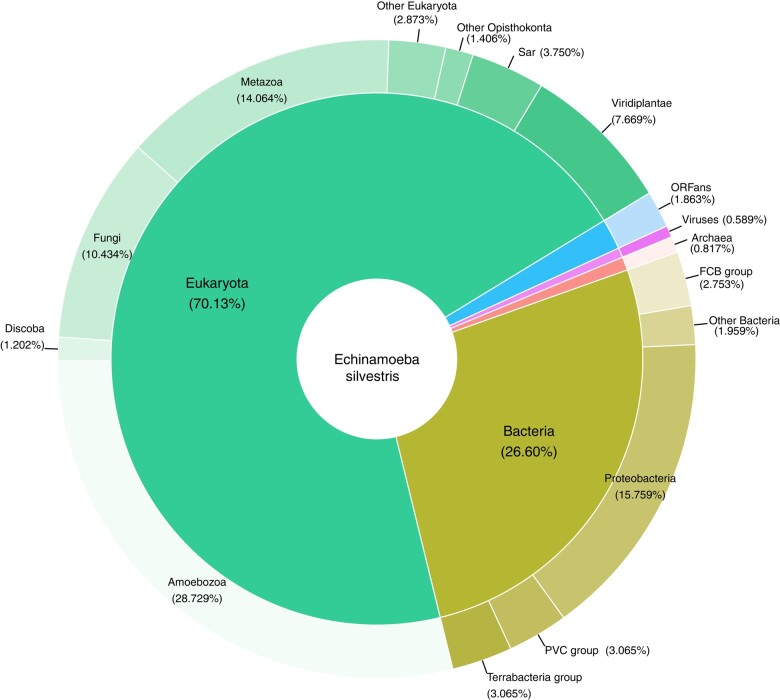 Figure 1
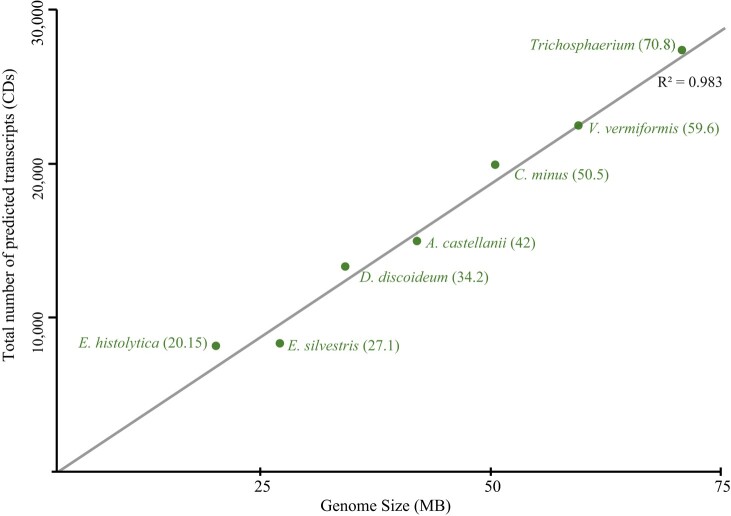 Figure 2
Peer Reviews
No public reviews on file for this paper yet. If you reviewed it on a platform where reviews are public (OpenReview, ICLR, NeurIPS, ICML), you can paste yours below so the community can read it here.
Videos
No videos yet. Explain this paper in a talk, walkthrough, or lecture? Add one.
Taxonomy
TopicsProtist diversity and phylogeny · Parasitic Infections and Diagnostics · Microbial Community Ecology and Physiology