Pre- and post-implementation protocol for non-operative management of grade III-V splenic injuries: An observational study
Ismail Mahmood, Basil Younis, Mohammad Alabdallat, Saji Mathradikkal, Husham Abdelrahman, Ayman El-Menyar, Mohammad Asim, Mohammad Kasim, Monira Mollazehi, Ammar Al-Hassani, Ruben Peralta, Sandro Rizoli, Hassan Al-Thani

TL;DR
A standardized protocol for managing severe splenic injuries in stable patients increased non-operative success rates and reduced surgery and blood transfusions.
Contribution
A new treatment protocol for grade III-V splenic injuries improved non-operative management success rates and reduced surgical interventions.
Findings
Non-operative management rates increased from 50.6% to 65.6% after protocol implementation.
Blood transfusion rates decreased from 64.2% to 45.9% post-protocol.
Angioembolization and follow-up CT scans became more common in the post-protocol group.
Abstract
Grade (III–V) blunt splenic injuries (BSI) in hemodynamically stable patients represent clinical challenges for successful non-operative management (NOM). In 2014, Our institution proposed a treatment protocol requiring splenic angiography and embolization for stable, intermediate, and high-grade BSI. It also included a follow-up CT scan for grade III BSI. We sought to assess the success rate of NOM in treating intermediate and high-grade BSI, following a standardized treatment protocol at a level 1 trauma center. An observational retrospective study was conducted. Data of patients with BSI from June 2011 to September 2019 were reviewed using the Qatar National Trauma Registry. Patients’ demographics, CT scan and angiographic findings, grade of splenic injuries, and outcomes were analyzed. The pre- and post-implementation of treatment protocol periods were compared. During the study…
Genes, proteins, chemicals, diseases, species, mutations and cell lines named across the full text — each resolved to its canonical identifier and authoritative record.
Click any figure to enlarge with its caption.
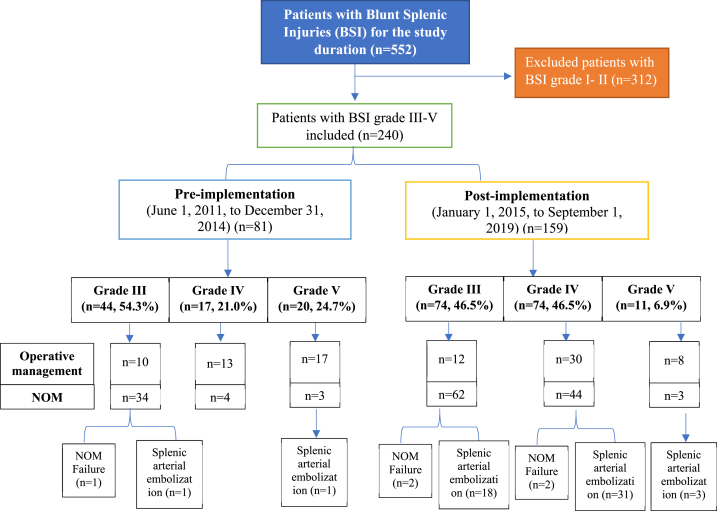 Figure 1
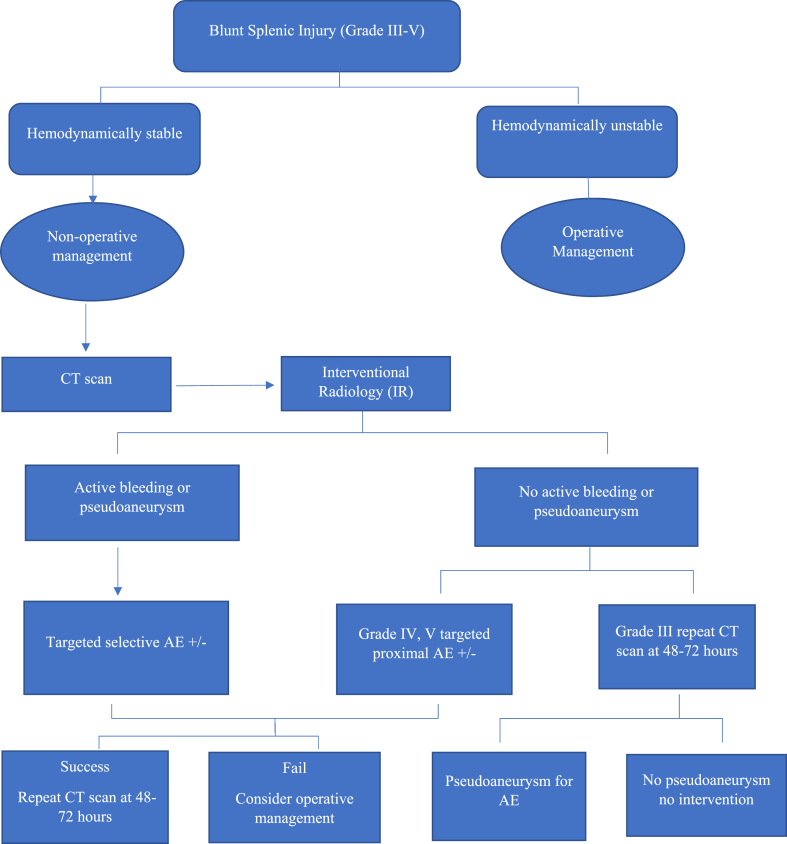 Figure 2
Peer Reviews
No public reviews on file for this paper yet. If you reviewed it on a platform where reviews are public (OpenReview, ICLR, NeurIPS, ICML), you can paste yours below so the community can read it here.
Videos
No videos yet. Explain this paper in a talk, walkthrough, or lecture? Add one.
Taxonomy
TopicsAbdominal Trauma and Injuries · Trauma and Emergency Care Studies · Pelvic and Acetabular Injuries