Catalysis by subsurface metal atoms in Al(001) through electron transfer
Bo Sun, Ding Ma

Abstract
Genes, proteins, chemicals, diseases, species, mutations and cell lines named across the full text — each resolved to its canonical identifier and authoritative record.
Click any figure to enlarge with its caption.
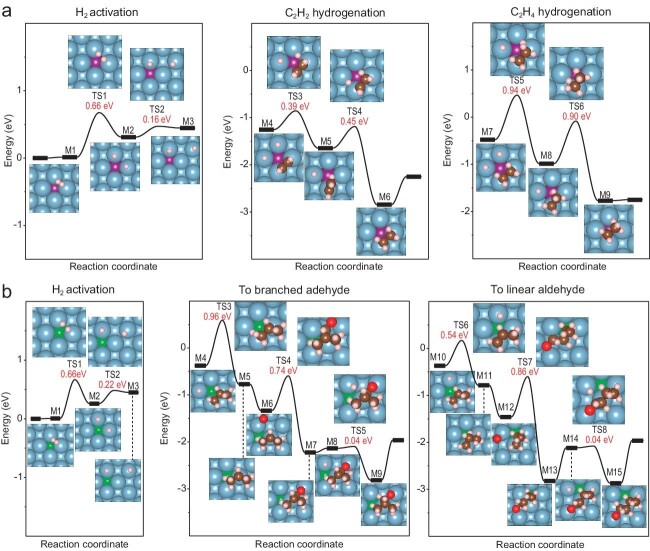 Figure 1
Peer Reviews
No public reviews on file for this paper yet. If you reviewed it on a platform where reviews are public (OpenReview, ICLR, NeurIPS, ICML), you can paste yours below so the community can read it here.
Videos
No videos yet. Explain this paper in a talk, walkthrough, or lecture? Add one.
Taxonomy
TopicsCatalytic Processes in Materials Science · Advanced Materials Characterization Techniques · Advanced Chemical Physics Studies
Heterogeneous catalysis plays a crucial role in the chemical industry, which has evolved from the investigation of chemisorption to an electronic structure [1]. Diverse strategies, such as alloying, doping, and confining, have been applied to enhance the catalytic properties of active sites through electronic modulation. The electron transfer between active sites and substrates profoundly influences catalytic activity [2]. However, the identification of electrons in catalytic processes is generally challenging due to the difficulties in tracing dynamic processes. Thus, verifying metallic catalysis transferred with electron or electron interaction as media holds great significance.
Recently, Professor Landong Li from Nankai University and colleagues reported unique metallic systems containing buried catalytically active transitional metals and exposed catalytically inert main group metals [3], which exhibited remarkable performance in a variety of reactions such as alkyne semi-hydrogenation, olefin hydroformylation and Suzuki-coupling reactions, revealing the effective conduction of catalytic properties through metallic bonding. Inspired by the disappearance of surface transitional metal species on aluminum substrate upon annealing, density functional theory (DFT) calculations were conducted by the team. It was observed that several d-block metals showed a tendency to self-disperse and sink, and could be well stabilized in the subsurface region of single crystal aluminum. Meanwhile, the electronic interaction between buried single transitional metal and adjacent aluminum atoms via metallic bonding was well demonstrated.
Based on the results of these calculations, they began to seek solid evidence on the structure of the unique metallic system (M/Al) and the electron transfer between transitional metals and aluminum substrate through scanning tunneling microscopy (STM). Typically, it was found that both palladium and rhodium exclusively located in the subsurface region of Al(001) and Al(111) single crystals as isolated atoms, with distinct electron transfer from palladium or rhodium to adjacent aluminum atoms.
The research team then performed DFT predictions on the catalytic properties of M/Al in several important reactions, including acetylene semi-hydrogenation and propylene hydroformylation (Fig. 1). The results revealed that the intrinsic catalytic properties of palladium and rhodium could be conducted to the outermost inert aluminum layer, yielding catalytically active M/Al systems, even though palladium and rhodium atoms were completely buried inside the aluminum single crystal and inaccessible to reaction substrates.
Guided by theoretical predictions and surface science observations, the team finally constructed real main group metal systems containing buried transitional metal centers, which showed excellent catalytic performance in reactions of alkyne semi-hydrogenation, olefin hydroformylation and Suzuki-coupling. These results further confirm that the catalytic properties of buried transitional metals can be transferred to exposed catalytically inert main group metals, thereby illustrating the conductive catalysis.
In contrast to traditional supported systems, this concept might offer an efficient shield for conventional active centers against poisoning or leaching by the conductive layer. More importantly, it is proposed that the catalytic properties of buried transitional metals can be precisely regulated or completely altered when passing through the conductive layer.
The reference list from the paper itself. Each links out to its DOI / PubMed record.
- 1Dong C, Li Y, Cheng D et al. ACS Catal 2020; 10: 11011–45.10.1021/acscatal.0c 02818 · doi ↗
- 2Vogt C, Weckhuysen BM. Nat Rev Chem 2022; 6: 89–111.10.1038/s 41570-021-00340-y 37117296 · doi ↗ · pubmed ↗
- 3Deng X, Zheng C, Li Y et al. Nat Sci Rev 2024; 11: nwae 015.10.1093/nsr/nwae 015PMC 1084936138328681 · doi ↗ · pubmed ↗