Body Part Pain Affects Subjective and Objective Handball Performance in Japanese Male National Athletes—Results of Short-Term Practical Monitoring of Athletes’ Conditions
Issei Ogasawara, Daichi Shindo, Kazuki Fujiwara, Haruka Suzuki, Yuki Ueno, Hiroyuki Kato, Michihiro Takada, Yusuke Adachi, Manabu Todoroki, Susumu Iwasaki, Nobukazu Okimoto, Ken Nakata

TL;DR
This study found that pain in specific body parts, like the dominant elbow, affects Japanese handball athletes' concentration and satisfaction during training, even if it doesn't impact measurable performance metrics.
Contribution
The novel contribution is identifying how pain in upper extremities affects subjective performance in elite handball athletes, despite no measurable impact on objective metrics.
Findings
Pain in the dominant elbow was strongly linked to reduced concentration and satisfaction with body movement.
No significant effect of body pain on objective performance metrics like heart rate or body acceleration was found.
Most athletes reported pain in the dominant shoulder, followed by other key joints involved in handball throwing.
Abstract
This short-term survey examined the effect of body part pain on subjective and objective handball performance in Japanese male national handball athletes. Fourteen athletes participated in this study. Assessments of pain in 10 body parts and subjective performance (concentration and satisfaction with body movement) were performed using a visual analog scale from 0 to 10 over four consecutive training days. Monitoring of heart rate and body acceleration during training was also performed to quantify the objective performance. Path analysis and linear mixed modeling were employed to assess the relationship between body pain scores and subjective/objective handball performance. Over the four days of the study period, the body part in which most athletes reported pain was the dominant shoulder (6 of 14 athletes), followed by the dominant knee, the dominant elbow, the dominant ankle joint,…
Genes, proteins, chemicals, diseases, species, mutations and cell lines named across the full text — each resolved to its canonical identifier and authoritative record.
Click any figure to enlarge with its caption.
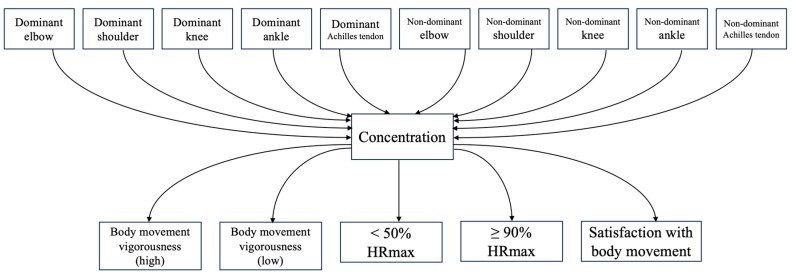 Figure 1
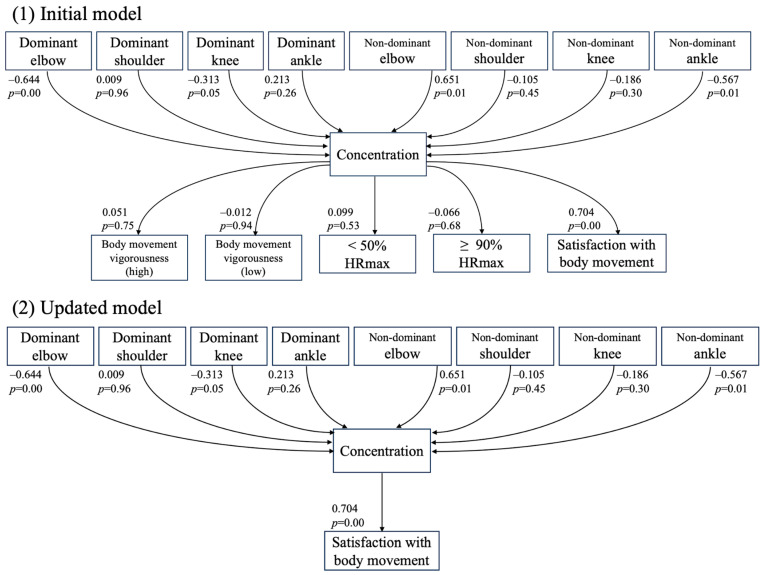 Figure 2
Peer Reviews
No public reviews on file for this paper yet. If you reviewed it on a platform where reviews are public (OpenReview, ICLR, NeurIPS, ICML), you can paste yours below so the community can read it here.
Videos
No videos yet. Explain this paper in a talk, walkthrough, or lecture? Add one.
Taxonomy
TopicsSports injuries and prevention · Sport Psychology and Performance · Sports Performance and Training