Neurofilament Light Chain Concentration in Cerebrospinal Fluid in Children with Acute Nontraumatic Neurological Disorders
Tobias Geis, Svena Gutzeit, Sigrid Disse, Jens Kuhle, Sotiris Fouzas, Sven Wellmann

TL;DR
This study measured a protein in spinal fluid to help distinguish between different neurological conditions in children.
Contribution
The study is the first to compare neurofilament light chain levels in children with various neurological disorders.
Findings
Children with Lyme neuroborreliosis had significantly higher cNfL levels than those with viral meningitis.
cNfL levels in children with Bell’s palsy were lower than in those with Lyme neuroborreliosis.
There was no correlation between cNfL levels and age in the studied children.
Abstract
(1) Introduction: This pilot study aimed to analyze neurofilament light chain levels in cerebrospinal fluid (cNfL) in a cohort of children with different acute nontraumatic neurological conditions. (2) Methods: This prospective observational cohort study consisted of 35 children aged 3 months to 17 years and was performed from November 2017 to December 2019. Patients’ clinical data were reviewed, and patients were assigned to the following groups: n = 10 (28.6%) meningitis, 5 (14.3%) Bell’s palsy, 7 (20.0%) febrile non-CNS infection, 3 (8.6%) complex febrile seizure, 4 (11.4%) idiopathic intracranial hypertension, and 6 (17.1%) others. cNfL levels were measured using a sensitive single-molecule array assay. (3) Results: The cNfL levels [median (range)] in children with meningitis were 120.5 pg/mL (58.1–205.4), in Bell’s palsy 88.6 pg/mL (48.8–144.5), in febrile non-CNS infection 103.9…
Genes, proteins, chemicals, diseases, species, mutations and cell lines named across the full text — each resolved to its canonical identifier and authoritative record.
Click any figure to enlarge with its caption.
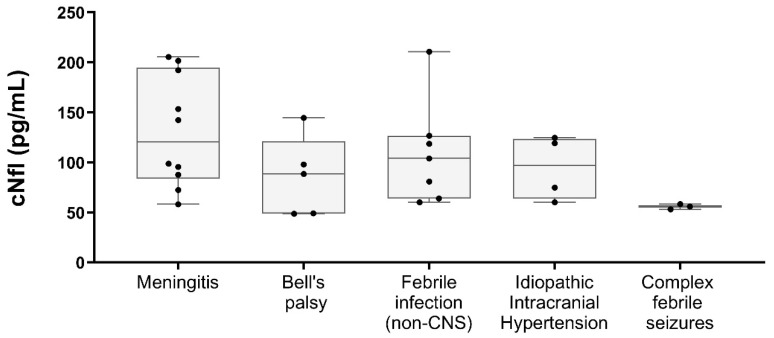 Figure 1
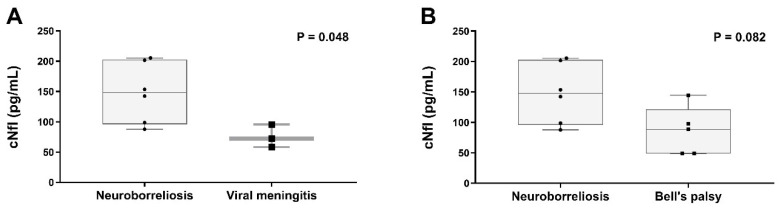 Figure 2
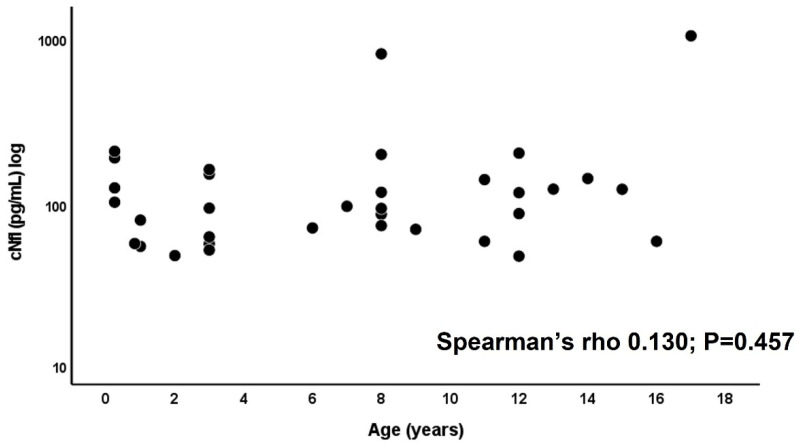 Figure 3
Peer Reviews
No public reviews on file for this paper yet. If you reviewed it on a platform where reviews are public (OpenReview, ICLR, NeurIPS, ICML), you can paste yours below so the community can read it here.
Videos
No videos yet. Explain this paper in a talk, walkthrough, or lecture? Add one.
Taxonomy
TopicsVector-borne infectious diseases · Viral Infections and Vectors · Dermatological diseases and infestations