Sex-Based Analysis of Quality Indicators of End-of-Life Care in Gastrointestinal Malignancies
Caitlin S. Lees, Hsien Seow, Kelvin K. W. Chan, Anastasia Gayowsky, Shaila J. Merchant, Aynharan Sinnarajah

TL;DR
The study finds that fewer female patients with gastrointestinal cancers receive aggressive end-of-life care compared to males.
Contribution
This paper provides new insights into sex-based differences in end-of-life care quality for gastrointestinal cancer patients.
Findings
A smaller proportion of females received aggressive end-of-life care compared to males (14.3% vs. 19.0%).
Younger females (18–39 years) had higher odds of receiving aggressive care than older females.
Rates of supportive care increased over time for both sexes, while aggressive care rates remained stable.
Abstract
Indices of aggressive or supportive end-of-life (EOL) care are used to evaluate health services quality. Disparities according to sex were previously described, with studies showing that male sex is associated with aggressive EOL care. This is a secondary analysis of 69,983 patients who died of a GI malignancy in Ontario between 2006 and 2018. Quality indices from the last 14–30 days of life and aggregate measures for aggressive and supportive EOL care were derived from administrative data. Hospitalizations, emergency department use, intensive care unit admissions, and receipt of chemotherapy were considered indices of aggressive care, while physician house call and palliative home care were considered indices of supportive care. Overall, a smaller proportion of females experienced aggressive care at EOL (14.3% vs. 19.0%, standardized difference = 0.13, where ≥0.1 is a meaningful…
Genes, proteins, chemicals, diseases, species, mutations and cell lines named across the full text — each resolved to its canonical identifier and authoritative record.
Click any figure to enlarge with its caption.
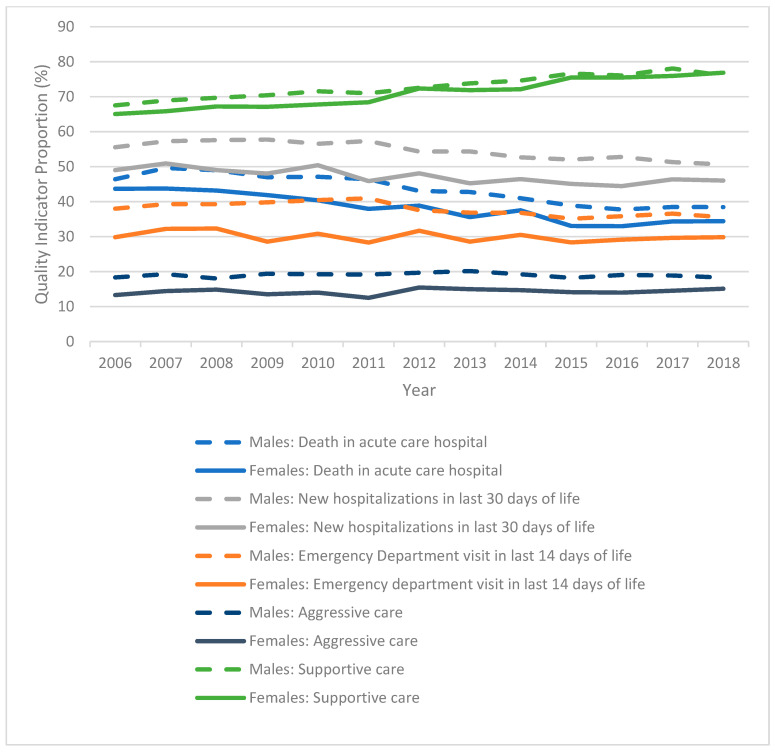 Figure 1
Peer Reviews
No public reviews on file for this paper yet. If you reviewed it on a platform where reviews are public (OpenReview, ICLR, NeurIPS, ICML), you can paste yours below so the community can read it here.
Videos
No videos yet. Explain this paper in a talk, walkthrough, or lecture? Add one.
Taxonomy
TopicsPalliative Care and End-of-Life Issues · Childhood Cancer Survivors' Quality of Life · Family and Patient Care in Intensive Care Units