Whole-Genome Resequencing−Based Qualitative Trait Locus Mapping Correlated yellow with the Mutant Color in Honeybees, Apis cerana cerana
Shanshan Shao, Qiang Huang, Yalin Pei, Junyan Hu, Zilong Wang, Lizhen Zhang, Xujiang He, Xiaobo Wu, Weiyu Yan

TL;DR
This study identifies the yellow gene as responsible for a brown body color mutation in honeybees using genome resequencing and gene expression analysis.
Contribution
The study identifies the yellow gene as the causal locus for a brown body color mutation in honeybees using genome resequencing and RNA interference.
Findings
The yellow gene on chromosome 11 is linked to the brown body color mutation in honeybees.
A 2-base deletion in exon 4 of the yellow gene causes a frameshift mutation.
RNA interference of the yellow gene results in lighter cuticle coloration without affecting survival.
Abstract
This study examined the genetic basis of a mutation in cuticle color in the honeybee Apis cerana cerana using genome resequencing of wild−type and mutant drones produced by a single virgin queen. A candidate locus was identified by calculating the Euclidean distance between mutants and wild types at each SNP, performing Lowess regression to fit a curve to these data, and setting a threshold of the top 0.5% Euclidean distance for candidate region selection. From this, genes with synonymous substitutions became candidate genes. One of these genes, the yellow gene, had a 2 bp deletion causing a frameshift mutation. RT−qPCR of this gene was performed on RNA extracted from mutant and wild−type drones; gene expression was only significantly different between wild types and mutants at the yellow gene. Finally, RNA interference silencing of the yellow gene was used to reduce yellow gene…
Genes, proteins, chemicals, diseases, species, mutations and cell lines named across the full text — each resolved to its canonical identifier and authoritative record.
Click any figure to enlarge with its caption.
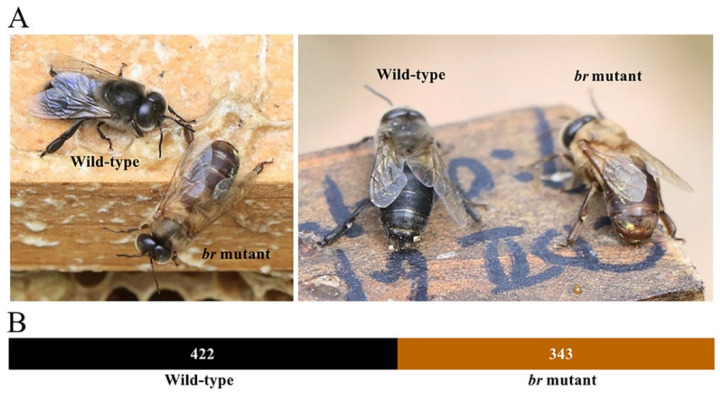 Figure 1
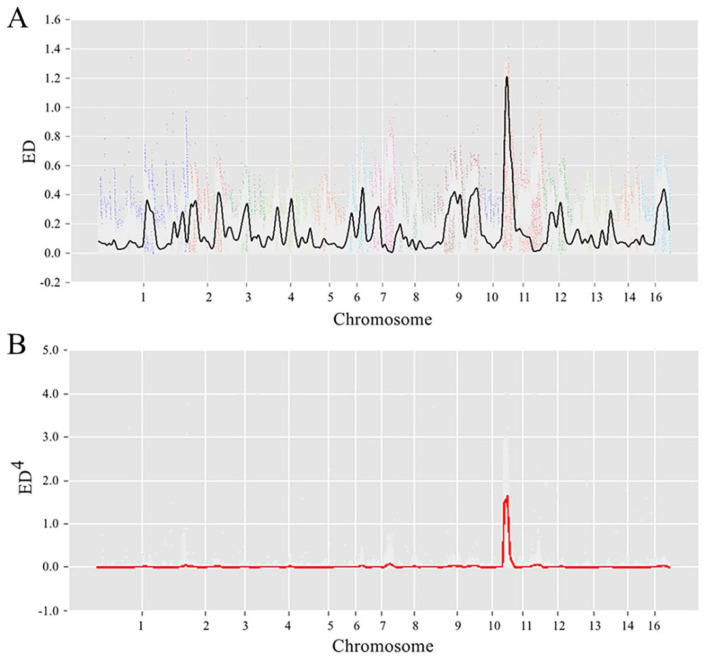 Figure 2
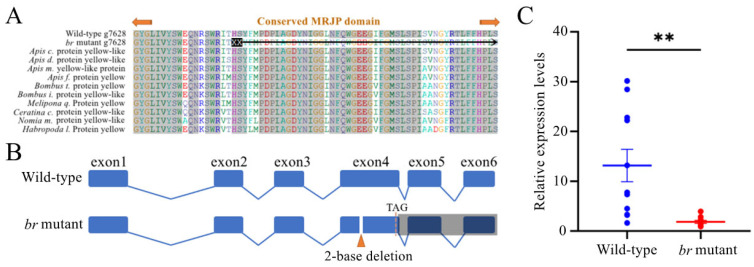 Figure 3
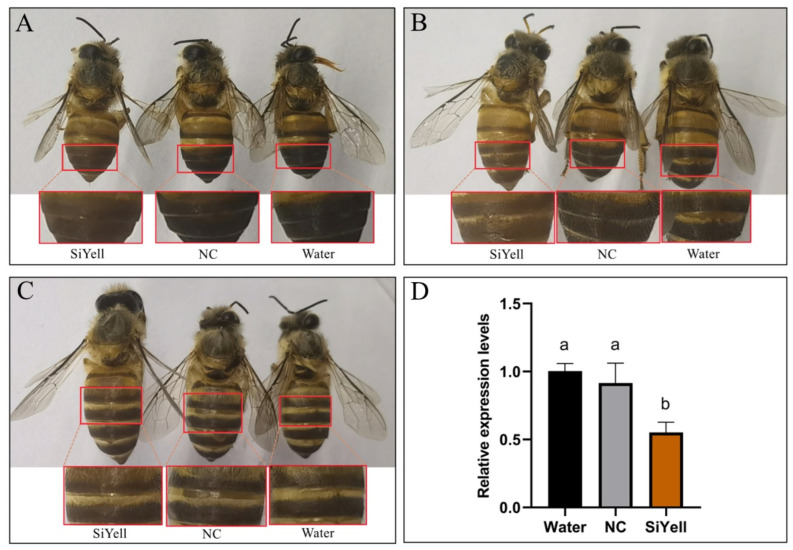 Figure 4
Peer Reviews
No public reviews on file for this paper yet. If you reviewed it on a platform where reviews are public (OpenReview, ICLR, NeurIPS, ICML), you can paste yours below so the community can read it here.
Videos
No videos yet. Explain this paper in a talk, walkthrough, or lecture? Add one.
Taxonomy
TopicsInsect and Pesticide Research · Insect and Arachnid Ecology and Behavior · Plant and animal studies