Effectiveness and cost-effectiveness of a web-based cardiac rehabilitation programme for people with chronic stable angina: protocol for the ACTIVATE (Angina Controlled Trial Investigating the Value of the ‘Activate your heart’ Therapeutic E-intervention) randomised controlled trial
Nefyn H Williams, Brendan Collins, Terence J Comerford, Susanna Dodd, Michael Fisher, Ben Hardwick, Sophie Hennessy, Kate Jolly, Ian Jones, Deirdre Lane, Gregory Y H Lip, Erica Morgan, Penelope Ralph, Dick Thijssen, Sally J Singh

TL;DR
This study will test if a web-based cardiac rehab program helps people with chronic angina more than usual care, and if it's cost-effective.
Contribution
The study introduces a novel web-based cardiac rehabilitation program for chronic stable angina patients and evaluates its effectiveness and cost-effectiveness.
Findings
The trial will assess physical limitations, dyspnea, and mental health outcomes in participants.
A process evaluation will explore how the web-based program is implemented and its impacts.
Safety and cost-utility will be analyzed from a health service perspective.
Abstract
Chronic stable angina is common and disabling. Cardiac rehabilitation is routinely offered to people following myocardial infarction or revascularisation procedures and has the potential to help people with chronic stable angina. However, there is insufficient evidence of effectiveness and cost-effectiveness for its routine use in this patient group. The objectives of this study are to compare the effectiveness and cost-effectiveness of the ‘Activate Your Heart’ cardiac rehabilitation programme for people with chronic stable angina compared with usual care. ACTIVATE is a multicentre, parallel-group, two-arm, superiority, pragmatic randomised controlled trial, with recruitment from primary and secondary care centres in England and Wales and a target sample size of 518 (1:1 allocation; allocation sequence by minimisation programme with built-in random element). The study uses secure…
Genes, proteins, chemicals, diseases, species, mutations and cell lines named across the full text — each resolved to its canonical identifier and authoritative record.
Click any figure to enlarge with its caption.
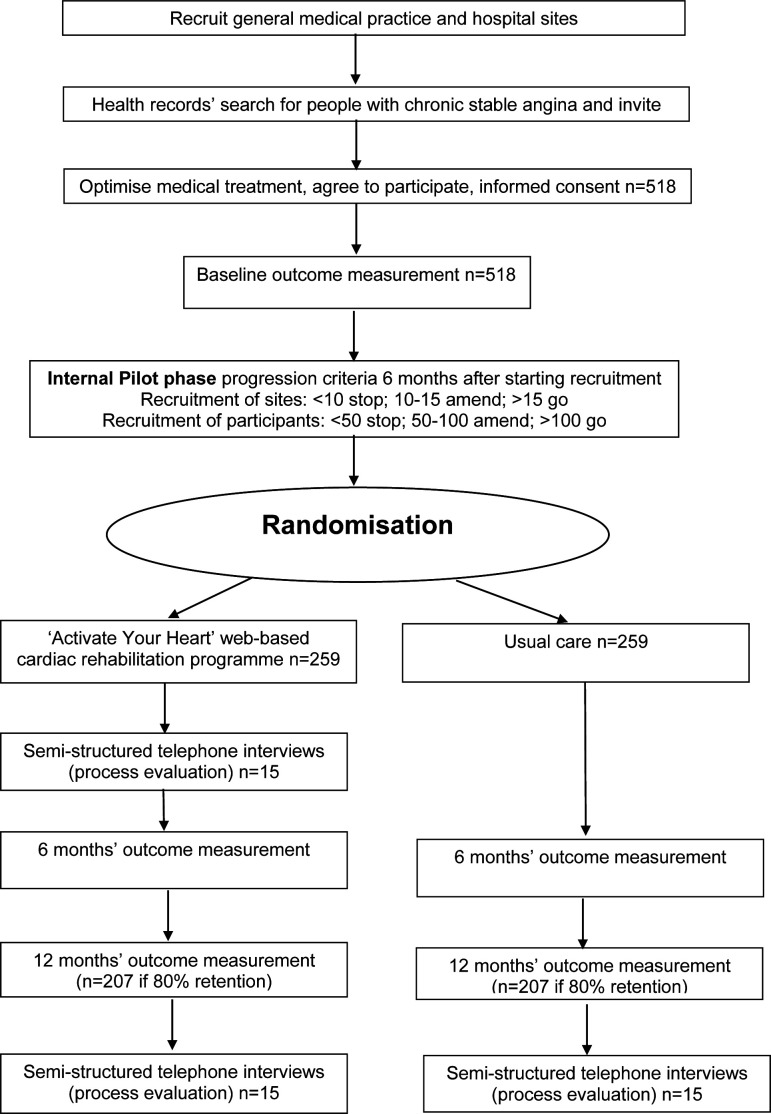 Figure 1
Peer Reviews
No public reviews on file for this paper yet. If you reviewed it on a platform where reviews are public (OpenReview, ICLR, NeurIPS, ICML), you can paste yours below so the community can read it here.
Videos
No videos yet. Explain this paper in a talk, walkthrough, or lecture? Add one.
Taxonomy
TopicsCardiac Health and Mental Health · Health Systems, Economic Evaluations, Quality of Life · Pain Management and Treatment