A Case of Perforating Folliculitis in a Peritoneal Dialysis Patient
Glenn Goodwin, Katherine L. O’Neil, Megan Dekok, Moshe Bengio, Philip O. Scumpia, Abhishek Roka, Alexander J. Scumpia

TL;DR
A 30-year-old man on peritoneal dialysis developed a skin condition called perforating folliculitis, which is rare and often linked to chronic kidney disease.
Contribution
This case report highlights perforating folliculitis in a peritoneal dialysis patient, emphasizing its diagnostic challenges in renal disease.
Findings
The patient presented with a rash consistent with perforating folliculitis.
Perforating folliculitis was associated with chronic renal disease in this case.
The condition was identified through clinical examination and patient history.
Abstract
A 30-year-old male with a past medical history of hypertension and renal failure on peritoneal dialysis presented to the emergency department with a chief complaint of a rash on his anterior trunk for the prior three weeks. Dermatological examination revealed multiple, discrete folliculocentric, erythematous, and hyperpigmented papules, with scattered adjacent angulated erosions. Perforating folliculitis is a rare and often difficult to diagnose skin condition classically seen in patients with chronic renal disease or underlying immunodeficiency.
Genes, proteins, chemicals, diseases, species, mutations and cell lines named across the full text — each resolved to its canonical identifier and authoritative record.
Click any figure to enlarge with its caption.
 Image
ImagePeer Reviews
No public reviews on file for this paper yet. If you reviewed it on a platform where reviews are public (OpenReview, ICLR, NeurIPS, ICML), you can paste yours below so the community can read it here.
Videos
No videos yet. Explain this paper in a talk, walkthrough, or lecture? Add one.
Taxonomy
TopicsDermatological and Skeletal Disorders · Skin and Cellular Biology Research · Inflammatory Myopathies and Dermatomyositis
CASE PRESENTATION
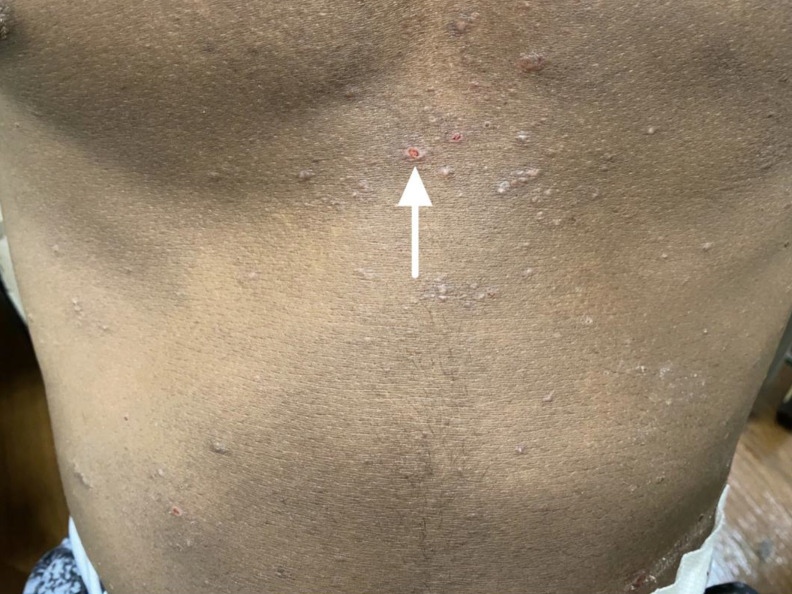
A 30-year-old male with a past medical history of hypertension and renal failure on peritoneal dialysis presented to the emergency department (ED) through triage with a chief complaint of a pruritic rash on his anterior trunk for the prior three weeks. The patient had complaints of multiple dark, erythematous, raised, pruritic lesions on the lower chest and anterior abdomen. He denied any new exposures, new medications, or recent travel. Symptomatic management was not initiated prior to presenting to the ED. The patient also denied associated systemic symptoms. Routine laboratory results were within normal limits. Dermatological examination revealed multiple, discrete folliculocentric, erythematous, and hyperpigmented papules with scattered adjacent angulated erosions (Image). The rash spared mucosal surfaces with no signs of contiguous spread onto the limbs, palms, or soles.
30-year-old male with multiple, discrete folliculocentric, erythematous, and hyperpigmented papules on the anterior chest consistent with perforating folliculitis (arrow).
DISCUSSION
Perforating disorders are characterized by transepidermal extrusion of altered keratin or other dermal connective tissue products and include four main conditions; however, the secondary form of this collection of diseases is regarded as acquired perforating dermatosis (APD)1 ^,^ 2 The only way to differentiate among the four conditions is through histopathological assessment, but clinical diagnosis of APD is often sufficient in the setting of a phenotypical assessment of the lesions along with the patient having diabetes and/or chronic renal failure.2 Other common associated comorbidities include diabetes, vitamin A deficiency, and HIV.2 ^–^ 4
The diagnosis of perforating folliculitis can be challenging. Emergency physicians are trained to recognize well-known, life-threatening rashes; however, they must also be cognizant of more benign rashes. While not life-threatening, these rashes can be debilitating and cause severe patient discomfort, necessitating accurate diagnosis to administer proper care and management. Our patient was treated with topical 0.1% triamcinolone lotion and given outpatient dermatology follow-up upon discharge from the ED. Perforating folliculitis is often treated with systemic or topical corticosteroids, retinoids, and keratolytic agents such as urea or salicylic acid.5 The pruritic symptoms are often treated with emollients and oral antihistamines.5
The reference list from the paper itself. Each links out to its DOI / PubMed record.
- 1Fernandes KA Lima LA Guedes J Cet al. Acquired perforating dermatosis in a patient with chronic renal failure. An Bras Dermatol. 2016;91(5 suppl 1):10–3.28300880 10.1590/abd 1806-4841.20164619 PMC 5324979 · doi ↗ · pubmed ↗
- 2Rapini RP Herbert AA Drucker CR. Acquired perforating dermatosis. Evidence for combined transepidermal elimination of both collagen and elastic fibers. Arch Dermatol. 1989;125(8):1074–8.2757403 10.1001/archderm.125.8.1074 · doi ↗ · pubmed ↗
- 3Hudson RD and Apisarnthanarax P. Renal failure and perforating folliculitis. JAMA. 1982;247(14):1936.7062497 · pubmed ↗
- 4Neill SM Pembroke A Cdu Vivier A Wet al. Phrynoderma and perforating folliculitis due to vitamin A deficiency in a diabetic. J R Soc Med. 1988;81(3):171–2.3357162 10.1177/014107688808100319 PMC 1291517 · doi ↗ · pubmed ↗
- 5Haseer Koya H Ananthan D Varghese D Njeru M Curtiss C Khanna A. Acquired reactive perforating dermatosis: a rare skin manifestation in end stage renal disease. Nephrology (Carlton). 2014;19(8):515–6.25066144 10.1111/nep.12289 · doi ↗ · pubmed ↗