Publisher Correction: The impact of toxic trolling comments on anti-vaccine YouTube videos
Kunihiro Miyazaki, Takayuki Uchiba, Haewoon Kwak, Jisun An, Kazutoshi Sasahara

Abstract
Genes, proteins, chemicals, diseases, species, mutations and cell lines named across the full text — each resolved to its canonical identifier and authoritative record.
Click any figure to enlarge with its caption.
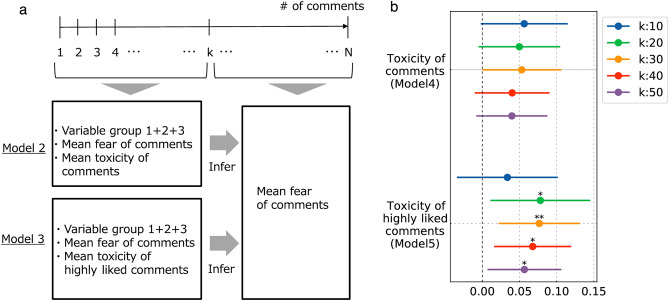 Figure 3
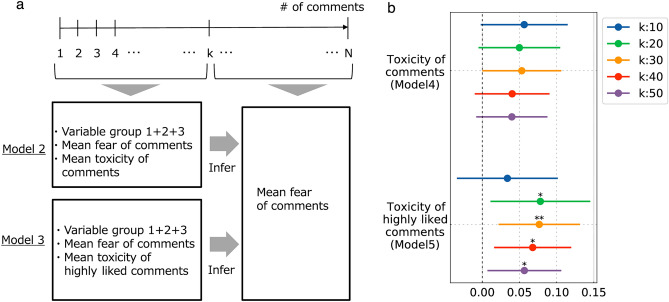 Figure 4
Peer Reviews
No public reviews on file for this paper yet. If you reviewed it on a platform where reviews are public (OpenReview, ICLR, NeurIPS, ICML), you can paste yours below so the community can read it here.
Videos
No videos yet. Explain this paper in a talk, walkthrough, or lecture? Add one.
Taxonomy
TopicsVaccine Coverage and Hesitancy
Correction to: Scientific Reports 10.1038/s41598-024-54925-w, published online 01 March 2024
In the original version of the Article, Figure 4 was a duplication of Figure 3. The original Figures 3 and 4 and accompanying legends appear below.
The original Article has been corrected.Figure 3. Measuring the association of toxicity of early comments with the fear in later comments. (a) Illustration of the problem setting. N comments in chronological order for a given video are divided into early and later halves, separated by k. Then, the average fear of comments in the comment range is predicted by the variables noted in Model 4 and Model 5, respectively, and the coefficients are obtained. (b) Forest plots showing the coefficients of average toxicity of comments and highly liked comments across window size \documentclass[12pt]{minimal} \usepackage{amsmath} \usepackage{wasysym} \usepackage{amsfonts} \usepackage{amssymb} \usepackage{amsbsy} \usepackage{mathrsfs} \usepackage{upgreek} \setlength{\oddsidemargin}{-69pt} \begin{document}$$k=\{\mathrm{10,20,30,40,50}\}$$\end{document} . Both are positive regardless of k, but only the mean toxicity of highly liked comments is largely significant. The average toxicity of highly liked comments has a high coefficient compared to the average toxicity of all comments (1.3 times higher in the average value in the five windows).Figure 4. Measuring the association of the fear of early comments with the toxicity in later comments. (a) Illustration of the problem set. N comments in chronological order for a given video are divided into early and later halves, separated by k. Then, the mean fear in comments in the comment range is inferred by the variables noted in Model 6 and Model 7, respectively, and the coefficients are obtained. (b) Forest plots showing the coefficients of the fear in comments and the fear in highly liked comments, for \documentclass[12pt]{minimal} \usepackage{amsmath} \usepackage{wasysym} \usepackage{amsfonts} \usepackage{amssymb} \usepackage{amsbsy} \usepackage{mathrsfs} \usepackage{upgreek} \setlength{\oddsidemargin}{-69pt} \begin{document}$$k=\{\mathrm{10,20,30,40,50}\}$$\end{document} . Only the coefficients for fear in highly liked comments are largely significant (3 out of 5 cases).