Complete resolution of generalized annular elastolytic giant cell granuloma with doxycycline
Dídac Marín-Piñero, M. Ángeles Sola-Casas, Noelia Perez-Muñoz

Abstract
Genes, proteins, chemicals, diseases, species, mutations and cell lines named across the full text — each resolved to its canonical identifier and authoritative record.
Click any figure to enlarge with its caption.
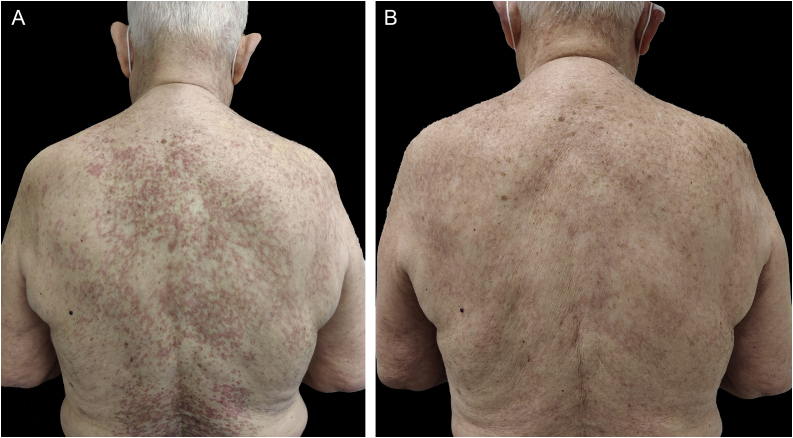 Figure 1
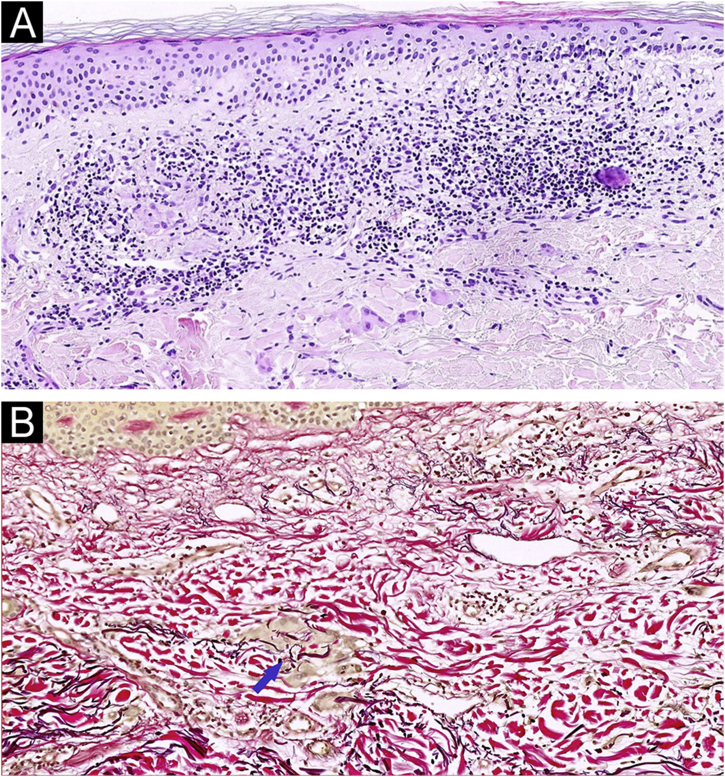 Figure 2
Peer Reviews
No public reviews on file for this paper yet. If you reviewed it on a platform where reviews are public (OpenReview, ICLR, NeurIPS, ICML), you can paste yours below so the community can read it here.
Videos
No videos yet. Explain this paper in a talk, walkthrough, or lecture? Add one.
Taxonomy
TopicsSkin Diseases and Diabetes · Dermatological and Skeletal Disorders · Cutaneous lymphoproliferative disorders research
Dear Editor,
Annular Elastolytic Giant Cell Granuloma (AEGCG) is a rare granulomatous dermatosis with unclear etiology and physiopathology. Histopathological hallmarks are elastolysis and elastophagocytosis. The definitive mechanism that leads to damage of the elastic fibers has not yet been elucidated. Treatment is still challenging and the use of tetracyclines is controversial due to their potential phototoxicity. Herein, we present a case of generalized AEGCG that achieved a complete resolution after daily doxycycline and review the previous cases treated with tetracyclines.
An 88-year-old man with mild hypertension under treatment with lisinopril, visited our dermatology department presenting multiple erythematous and mild pruritic annular plaques with atrophic center located on the back, shoulders, posterior neck, and upper chest that had appeared over the last month (Fig. 1A). Initial differential diagnosis included subacute cutaneous lupus erythematosus, generalized granuloma annulare and annular psoriasis. A punch biopsy taken from an erythematous border showed a scattered dermal granulomatous infiltrate of multinucleated giant cells with elastophagocytosis consistent with the diagnosis of AEGCG (Fig. 2). Laboratory studies including complete blood cell count, glucose levels, liver and renal function, and antinuclear antibodies were normal. Considering that the lesions were not photo-distributed, the little sun exposure by the patient, and the previously reported cases of AEGCG treated with tetracyclines, doxycycline 100 mg daily was initiated. After five months, complete resolution of the lesions and pruritus were observed (Fig. 1B). Nevertheless, the lesions rapidly recurred when doxycycline was discontinued but after its reintroduction, the patient experienced marked improvement during the following 12 months.Figure 1(A) Multiple erythematous annular plaques on the back and posterior neck at the initial visit. (B) Complete resolution of the lesions after 5 months under treatment with doxycycline 100 mg/dayFigure 1Figure 2(A) Skin biopsy specimen showing a scattered dermal granulomatous infiltrate with phagocytosis of elastic fibers by multinucleated giant cells. (Hematoxylin & eosin, ×100). (B Elastophagocytosis by multinucleated giant cells demonstrated by elastic fibers stain. The blue arrow indicates the elastophagocytosis. (Verhoeff-Van Gieson; ×100)Figure 2
AEGCG was first described as actinic granuloma by O’Brien in 1975 to indicate the causal role of actinic damage triggering elastolysis and elastophagocytosis. However, photoaged skin with degenerative elastin changes is rarely associated with elastophagocytosis. Lesions of AEGCG are often located on nonexposed skin so other factors aside from heat and ultraviolet radiation should be considered. Several events may damage the elastic fibers and trigger the inflammatory response that leads to its phagocytosis. One of these triggers may be hyperglycemia in diabetes mellitus, as it has been frequently reported as a concomitant disease. Many other associations such as malignancies and inflammatory diseases have been described but probably the most common presentation is idiopathic.1 Despite its benign course, AEGCG can take up to several years to resolve, lesions are usually extensive and may require different treatment modalities to prevent its progression. Anti-inflammatory and anti-granulomatous effects of tetracyclines are well known but they are not regarded as a convenient treatment due to their phototoxicity and the seldom reported risk to trigger AEGCG.2 Nevertheless, tetracyclines have shown excellent outcomes with complete responses in both limited3, 4 and generalized5 forms involving sun-exposed and nonexposed skin with no side effects. Table 13, 4, 5 summarizes the main features of our patient and the three previously published cases of AEGCG treated with tetracyclines.Table 1. Overview of published cases of AEGCG treated with tetracyclinesTable 1ArticleCasesAgeSexComorbiditiesPattern and locationPrevious treatmentsTetracycline and doseOutcomeNanbu et al. (2015)3146MaleNoneSolitary annular plaque on the templeTopical corticosteroidMinocycline 200 mg/day and 100 mg/dayResolution after 11 weeksKabuto et al. (2017)5180MaleDiabetes mellitusAnnular plaques on the posterior neck, back, chest, upper arms, wrists, dorsum of hands and tightsTopical tacrolimus, topical corticosteroid and oral tranilastMinocycline 200 mg/day and 100 mg/dayResolution after 6 monthsJeha et al. (2020)4167MaleChronic kidney disease, diabetes mellitus and coronary artery diseaseAnnular plaques on ventral forearms and proximal thighsTopical and intralesional corticosteroidsDoxycycline 200 mg/dayResolution after 6 monthsCurrent case188MaleHypertensionAnnular plaques on the whole back, shoulders, posterior neck, and upper chestNoneDoxycycline 100 mg/dayResolution after 5 months
In conclusion, tetracyclines should be considered a safe first-line treatment for patients with extensive or generalized AEGCG or a second-line option for localized forms that do not respond to conventional topical treatments.
Financial support
None declared.
Authors' contributions
Marín-Piñero D: Approval of the final version of the manuscript; design and planning of the study; drafting and editing of the manuscript; collection, analysis, and interpretation of data; effective participation in research orientation; intellectual participation in the propaedeutic and/or therapeutic conduct of the studied cases; critical review of the literature; critical review of the manuscript.
Sola-Casas MA: Approval of the final version of the manuscript; design and planning of the study; drafting and editing of the manuscript; effective participation in research orientation; intellectual participation in the propaedeutic and/or therapeutic conduct of the studied cases; critical review of the literature; critical review of the manuscript
Perez-Muñoz N: Approval of the final version of the manuscript; design and planning of the study; drafting and editing of the manuscript; effective participation in research orientation; intellectual participation in the propaedeutic and/or therapeutic conduct of the studied cases; critical review of the literature; critical review of the manuscript
Conflicts of interest
None declared.
The reference list from the paper itself. Each links out to its DOI / PubMed record.
- 1Gutiérrez-González E.Pereiro M.Jr Toribio J.Elastolytic actinic giant cell granuloma Dermatol Clin.3320153313412614341710.1016/j.det.2015.03.002 · doi ↗ · pubmed ↗
- 2Lim D.S.Triscott J.O’Brien’s actinic granuloma in association with prolonged doxycycline phototoxicity Australas J Dermatol.44200367701258108610.1046/j.1440-0960.2003.00641.x · doi ↗ · pubmed ↗
- 3Nanbu A.Sugiura K.Kono M.Muro Y.Akiyama M.Annular elastolytic giant cell granuloma successfully treated with minocycline hydrochloride Acta Derm Venereol.9520157567572563292410.2340/00015555-2056 · doi ↗ · pubmed ↗
- 4Jeha G.M.Luckett K.O.Kole L.Actinic granuloma responding to doxycycline JAAD Case Rep.62020113211343313445210.1016/j.jdcr.2020.08.034PMC 7591335 · doi ↗ · pubmed ↗
- 5Kabuto M.Fujimoto N.Tanaka T.Generalized annular elastolytic giant cell granuloma successfully treated with the long-term use of minocycline hydrochloride Eur J Dermatol.2720171781792787373410.1684/ejd.2016.2926 · doi ↗ · pubmed ↗