Impact of an educational flyer and sensitization on performance-enhancement attitudes of bodybuilders in United Arab Emirates
Dixon Thomas, Adhnan Abdul Shabeek, Hala Ahmed, Malak Mohammed, Marina Kawaguchi-Suzuki, Ashley Anderson, Aji Gopakumar, Reema Alhosani, Sherief Khalifa, David Mottram, Nicholas Gibbs, Valentin Panayotov, Narayana Goruntla

TL;DR
This study shows that an educational flyer reduced bodybuilders' willingness to use performance-enhancing substances in the UAE.
Contribution
A pharmacy-led educational intervention using the PEAS scale effectively shifted attitudes toward avoiding doping among bodybuilders.
Findings
PEAS scores decreased significantly for all eight items after the educational intervention.
Full-time professionals, students, and part-time bodybuilders showed differing attitudes (p-value <0.05).
The intervention led to a favorable shift in attitudes toward avoiding performance-enhancing substances.
Abstract
Background: A high proportion of bodybuilders use supplements to improve performance, with some turning to prohibited substances and methods. The attitudes of bodybuilders towards performance enhancement may be gauged through surveys such as the Performance Enhancement Attitude Scales (PEAS). Educational interventions are recommended as part of anti-doping measures. The objective of this project was to assess the impact of a pharmacy-led intervention using an antidoping educational flyer and the performance enhancement attitude scale to measure the attitude of bodybuilders in the United Arab Emirates (UAE). Methods: The PEAS eight-item short form questionnaire was administered to male bodybuilders in the UAE. The PEAS was conducted before and after administration of an educational flyer concerning the problems associated with supplement use among bodybuilders. The Wilcoxon Signed-Rank…
Genes, proteins, chemicals, diseases, species, mutations and cell lines named across the full text — each resolved to its canonical identifier and authoritative record.
Click any figure to enlarge with its caption.
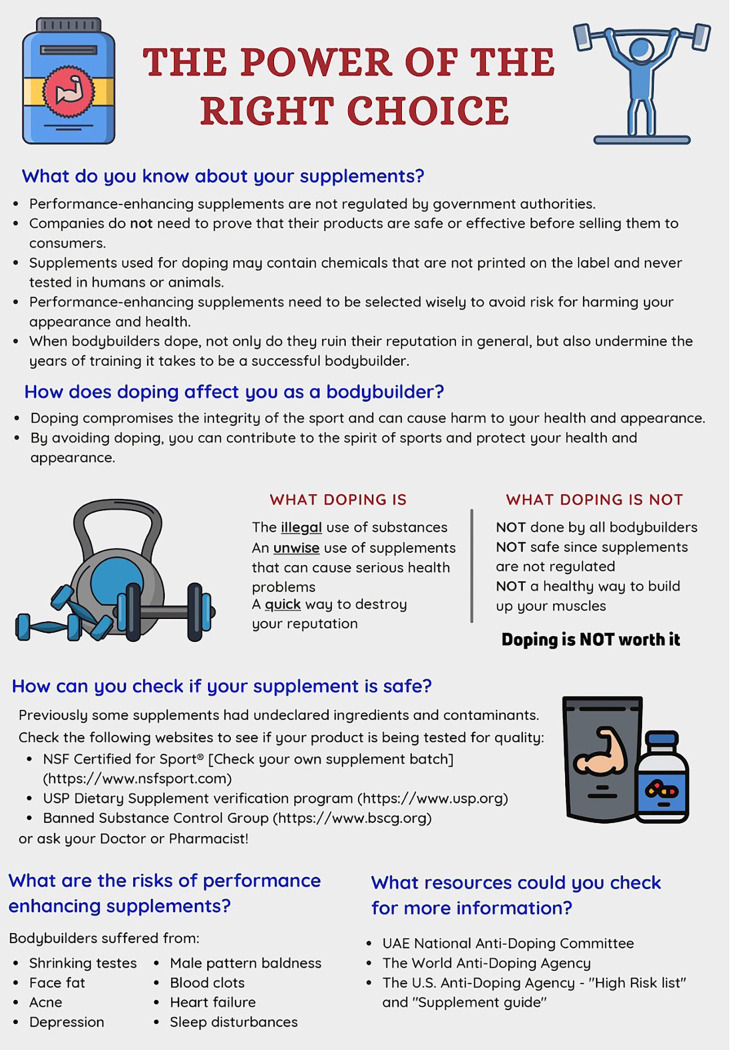 Figure 1
| Modified (for bodybuilding) Performance Enhancement Attitude Scale (PEAS) 8-item short form | Timing of survey to intervention | Strongly Agree & Agree | Slightly Agree & Slightly Disagree | Disagree & Strongly Disagree | |||
|---|---|---|---|---|---|---|---|
| N | % | N | % | N | % | ||
| 1. Legalizing performance enhancements would be beneficial. | Before | 89 | 40.8 | 59 | 27.1 | 70 | 32.1 |
| After | 20 | 9.2 | 39 | 17.9 | 159 | 72.9 | |
| 2. Doping is necessary to be competitive. | Before | 58 | 26.6 | 52 | 23.9 | 108 | 49.5 |
| After | 15 | 6.9 | 40 | 18.3 | 163 | 74.8 | |
| 3. The risks related to doping are exaggerated. | Before | 52 | 23.9 | 75 | 34.4 | 91 | 41.7 |
| After | 12 | 5.5 | 52 | 23.9 | 154 | 70.6 | |
| 4. Bodybuilders should not feel guilty about breaking the rules and taking performance-enhancing drugs. | Before | 69 | 31.7 | 44 | 20.2 | 105 | 48.2 |
| After | 18 | 8.3 | 44 | 20.2 | 156 | 71.6 | |
| 5. Doping is an unavoidable part of the competitive sport/bodybuilding. | Before | 76 | 34.9 | 53 | 24.3 | 89 | 40.8 |
| After | 20 | 9.2 | 44 | 20.2 | 154 | 70.6 | |
| 6. Doping is not cheating since everyone does it. | Before | 62 | 28.4 | 46 | 21.1 | 110 | 50.5 |
| After | 19 | 8.7 | 36 | 16.5 | 163 | 74.8 | |
| 7. Only the quality of performance should matter, not the way bodybuilders achieve it. | Before | 72 | 33.0 | 47 | 21.6 | 99 | 45.4 |
| After | 24 | 11.0 | 44 | 20.2 | 150 | 68.8 | |
| 8. There is no difference between drugs and dietary supplements that are all used to enhance performance. | Before | 29 | 13.3 | 31 | 14.2 | 158 | 72.5 |
| After | 15 | 6.9 | 38 | 17.4 | 165 | 75.7 | |
| Sl | Modified (for bodybuilding) Performance Enhancement Attitude Scale (PEAS) 8-item short form | Timing of survey to intervention | Number of responses | Median | p-value |
|---|---|---|---|---|---|
| 1 | Legalizing performance enhancements would be beneficial for sports or bodybuilding. | Before | 218 | Slightly Agree (4) | <0.001 |
| After | 218 | Strongly Disagree (1) | |||
| 2 | Doping is necessary to be competitive. | Before | 218 | Slightly Disagree (3) | <0.001 |
| After | 218 | Disagree (2) | |||
| 3 | The risks related to doping are exaggerated. | Before | 218 | Slightly Disagree (3) | <0.001 |
| After | 218 | Strongly Disagree (1) | |||
| 4 | Bodybuilders should not feel guilty about breaking the rules and taking performance-enhancing drugs. | Before | 218 | Slightly Disagree (3) | <0.001 |
| After | 218 | Disagree (2) | |||
| 5 | Doping is an unavoidable part of the competitive sport/bodybuilding. | Before | 218 | Slightly Agree (4) | <0.001 |
| After | 218 | Disagree (2) | |||
| 6 | Doping is not cheating since everyone does it. | Before | 218 | Disagree (2) | <0.001 |
| After | 218 | Disagree (2) | |||
| 7 | Only the quality of performance should matter, not the way bodybuilders achieve it. | Before | 218 | Slightly Disagree (3) | <0.001 |
| After | 218 | Disagree (2) | |||
| 8 | There is no difference between drugs and dietary supplements that are all used to enhance performance. | Before | 218 | Disagree (2) | 0.031 |
| After | 218 | Strongly Disagree (1) |
Peer Reviews
No public reviews on file for this paper yet. If you reviewed it on a platform where reviews are public (OpenReview, ICLR, NeurIPS, ICML), you can paste yours below so the community can read it here.
Videos
No videos yet. Explain this paper in a talk, walkthrough, or lecture? Add one.
Taxonomy
TopicsDoping in Sports · Motivation and Self-Concept in Sports · Sport Psychology and Performance
Introduction
Exercise in gymnasiums is a feasible way to be physically active in the United Arab Emirates (UAE). Chronic diseases pose significant public health issues among the UAE population. ^ 1 ^ In particular, attitudes about obesity management need improvement. ^ 2 ^ There is a lack of public awareness of the importance of engaging in physical activity in the UAE, resulting in high levels of sedentary behavior among young adults. ^ 3 ^ Promotion of the benefits of physical activity are therefore required among the UAE population. ^ 4 ^
It is acknowledged, however, that gymnasium use may progress from simple exercise regimens to a desire for image enhancement that leads some to bodybuilding. ^ 5 ^ Among gymnasium users in the UAE, bodybuilding, either for non-competitive (recreational) or competitive purposes, is a popular sport. The motivation for bodybuilding is manifold and ranges from the improvement of body image and well-being through to participation in competitive sport. ^ 6 ^
Many gymnasium-users take supplements to improve their performance or image enhancement. In a study in Sharjah, it was shown that about half of the men exercising in gyms were using dietary supplements. ^ 7 ^ In another study, in Dubai, it was reported that people who were consuming dietary supplements had a high level of knowledge about the supplements that they used and consequently, adverse events were infrequent. ^ 8 ^
Dietary supplements are used widely among bodybuilders. However, in addition, some bodybuilders may use hormonal products, which pose a potential health risk ^ 9 ^ and may lead to illegal doping in the competitive areas of bodybuilding. ^ 10 ^ ^,^ ^ 11 ^ Some bodybuilders in the Gulf region reportedly use anabolic steroids, ^ 12 ^ reflecting an increased prevalence of anabolic-androgenic steroid (AAS) use generally across the Eastern Mediterranean Region. ^ 13 ^
Many factors contribute to performance enhancement by bodybuilders and its progressive normalization. ^ 14 ^ There is a growing body of evidence which suggests that anabolic androgenic steroids are used globally by a diverse population, with varying motivations, including bodybuilders. ^ 15 ^ As the trend of bodybuilding is transforming to create a well-defined and moderately muscular body, it is speculated that fitness doping is becoming increasingly common. ^ 16 ^ However, the boundary between natural performance enhancement and doping might be blurred for the bodybuilders. Considering the potential adverse effects of AAS use on health, it is important to consider intervention strategies to prevent misuse, both in sport and in the general population. ^ 17 ^ Such strategies include targeted education and a greater understanding on doping attitudes through tools such as the Performance Enhancement Attitude Scale (PEAS). ^ 18 ^
Pharmacists are well-placed and highly accessible resources of drug information for the public. The opportunity exists to increase pharmacy-led initiatives that support the antidoping movement.
Antidoping assessments and education raise awareness of doping. It is suspected that bodybuilders might be sensitized to the problems of performance enhancement attitude just by filling out the pre-intervention survey. This awareness of perceptions associated with doping, in addition to the educational flyer developed for antidoping education for bodybuilders, was expected to influence attitudes toward higher concern for the risk of performance enhancement substances among bodybuilders in the study population.
Aim
The aim of this project was to assess the impact on local bodybuilders’ views of using substances for performance enhancement before and after a pharmacy led intervention using an antidoping educational flyer, as measured by the PEAS.
Methods
Research design
The study used a pre-post intervention design. Attitudinal data were collected using a PEAS. An antidoping educational flyer was designed by a sports pharmacy team with a simple infographic design and clear messaging on the risk of doping. Sports pharmacy team members then administered the intervention by presenting the educational flyer to bodybuilders enrolled in the study. The educational flyer is included as Figure 1. The educational flyer was provided to bodybuilders prior to the post-intervention survey. The second PEAS survey was administered approximately one month after the first administration of the PEAS survey among the study population.
Educational flyer.
Study population
The study population included self-described bodybuilders in the UAE. The study did not use any brand name or manufacturer names of any performance enhancement substance. Being a male bodybuilder who uses nutritional supplements and consenting to participate in the study were the inclusion criteria. Any level of bodybuilders, including recreational, amateur, or professional athletes, were recruited. Bodybuilders who were not regularly practicing in their gym, could not read English, or were not living in the UAE were excluded from the study population. Background data was collected from the bodybuilders on their level of involvement in bodybuilding and nutritional supplements used.
Sample size, survey technique, and settings
The sample size was calculated using a formula that considers the population size, margin of error, and sampling confidence level. Survey Monkey's sample size calculator accounts for the three factors mentioned above. The bodybuilder population in UAE is approximately 500,000, based on data from Dubai World Trade Centre. Using a 95% confidence interval and margin of error of eight, the calculated sample size was 151 bodybuilders. The sampling strategy included distributing a pre-intervention survey to registered study participants through email and WhatsApp. A post-intervention survey following the educational intervention was sent only to those who completed the pre-intervention survey. Each survey was conducted using Google Forms and paper-based by member of the sports pharmacy team visiting local gyms. The total duration of the study was one year.
Study instrument & validation procedure
A modified version of the PEAS, known as the eight-item short form, was used as the survey instrument. ^ 18 ^ ^,^ ^ 19 ^ For each item a six-point Likert scale of strongly disagree (1), disagree (2), slightly disagree (3), slightly agree (4), agree (5), and strongly agree (6) was used. The PEAS is an internationally validated instrument. Only in required items, the word “bodybuilding” was added to connect to the athletes of this study population. The meaning of doping was added in parenthesis when it appeared for the first time on the survey. In addition to some background enquiries, the pre- and post-survey questionnaire included the following eight-items.
- 1.Legalizing performance enhancements would be beneficial for sports or bodybuilding (competitive or non-competitive).
- 2.Doping (consuming prohibited substances) is necessary to be competitive.
- 3.The risks related to doping (consuming prohibited substances) are exaggerated.
- 4.Bodybuilders should not feel guilty about breaking the rules and taking performance-enhancing drugs.
- 5.Doping is an unavoidable part of competitive sport/bodybuilding.
- 6.Doping is not cheating since everyone does it.
- 7.Only the quality of performance should matter, not the way bodybuilders achieve it.
- 8.There is no difference between drugs and dietary supplements that are all used to enhance performance.
A higher number for the final score of the PEAS suggests agreement with the statements that support use of performance enhancing substances or the doping culture.
Ethical consideration
Ethical approval to conduct the research was granted by the Institutional Review Board of the Gulf Medical University (IRB/COP/STD/73/Oct-2021). Written informed consent was obtained for participating in the study. No personal identifiers of study participants were collected except email and phone numbers for sending the post-intervention survey. Such contact details were kept confidential. No brand names of bodybuilding supplements or medications were mentioned in the study. All confidential information was maintained by the authors from Gulf Medical University and not shared with the authors from other organizations in this study.
Data analysis
Descriptive and analytical statistical tools were used to compare the attitudes of bodybuilders before and after the pharmacy-led educational intervention. Wilcoxon Signed-Rank test was used to assess performance enhancement attitude (PEA) scores before and after the intervention. Kruskal Wallis tests were used to find the statistical significance of the pre-post intervention among different groups. SPSS version 26 (Armonk) was used for all the analyses.
Results
Of the 322 bodybuilders who filled out the pre-intervention survey, 254 completed the post-intervention surveys (79% response rate). ^ 29 ^ For the analysis, 22 respondents were removed due to the lack of matching email or mobile numbers used as identifiers in the pre-survey to post-survey tracking. Other respondents were excluded from the study by not being located in the UAE or reporting they were not consuming dietary supplements. A final total of 218 respondents were used for the data analysis. The majority (98.2%) of study participants found the antidoping educational flyer to be informative, while four (1.8%) participants responded that it was not informative enough.
The study population constituted of 80 bodybuilders of non-sports employment, 16 full-time bodybuilders, 111 university students, and 11 school students. All were male. The Kruskal Wallis test showed a significant difference in the post-intervention (p-value 0.002) but not in pre-intervention (p-value 0.07) among the four subgroups of this study population.
When the average score is compared among the four groups by the median test, the median (average) of the overall pre-score varied across the groups (p-value <0.001), but the average of the overall pre-score is almost the same between the groups (p-value 0.07). It implies that the post score changed significantly when compared with the average pre-score, but the average attitude level became stable and is matched among different types of participants.
With the intervention of the educational flyer and sensitization, the PEA was changed favorably towards recognition of concerns associated with doping among the participants. Agreement to pro-doping statements in the PEAS survey decreased, meaning disagreement increased with the intervention as shown in Table 1. For tabulation, “strongly agree” and “agree” were combined; likewise, responses of “slightly agree” and “slightly disagree,” and “disagree” and “strongly disagree” were combined.
As per the Wilcoxon sign rank test, the average performance enhancement attitude levels before and after were significantly different in the study sample. The distribution of attitude scores were reduced from before to after the intervention with statistical significance in addition to median of agreement decreased for 7 out of 8 items ( Table 2).
The median score for the pre-intervention survey was 24, and for the post-intervention survey was 14. The decrease in median score demonstrated a movement away from supporting use of performance enhancement substances and toward an anti-doping awareness.
Discussion
The aim of this study was to assess any changes in the attitude of bodybuilders in the UAE about the use of supplements and doping, following the introduction of an antidoping educational flyer. The major finding was that there were significant changes in the attitudes of the study population to performance enhancement through supplement use and doping practices following pharmacy-led education with introduction of an antidoping flyer. Analysis of the responses to the eight-item PEAS survey revealed significantly different scores between pre- and post-intervention, suggesting less support for the use of performance enhancement substance among study participants. Using median, statistical tests proved the significance of the decrease in all eight survey items. Educational interventions and sensitization of sports people have shown similar results in the following studies.
It was found that doping susceptibility perceptions can be immediately reduced with educational interventions. The face-to-face intervention was observed to be more sustainable than online interventions among high-level athletes. ^ 20 ^ Nevertheless, a mobile application was found to be a practical method for disseminating anti-doping education. The application improved knowledge and decreased favorable doping attitudes among coaches. The mobile application had educational modules on nutritional supplements, substances, rules, leadership, and fair play. ^ 21 ^ Practical strength training advice provided in addition to anti-doping education to youth athletes was found beneficial in decreasing PEA. ^ 22 ^ PEA was found in many studies among gym users and athletes. Such studies proposed educational interventions to decrease PEA. ^ 7 ^ ^,^ ^ 8 ^ ^,^ ^ 23 ^
Sensitizing those who have potential for doping needs to start early, even in schools. Students who were professionally involved in sports perceived performance enhancement as more acceptable than other students. ^ 24 ^ Body image, nutritional supplement use, and weight change behaviors influence adolescents' PEA. ^ 25 ^ Media literacy interventions were effective to decrease doping behaviors of adolescent students. ^ 26 ^ It is accepted that attitudes and knowledge about doping are influenced by educational activity. ^ 27 ^ ^,^ ^ 28 ^ In addition, it is also possible that the studies itself had sensitized participants against PEA as assumed in our study.
Conclusion
This study showed that the PEAS short-form survey, along with the introduction of an antidoping educational flyer provided by a sports pharmacy team, resulted in decreasing PEA among bodybuilding populations in the UAE. The decline of PEA was significant for all eight items of the PEAS. Bodybuilders, regardless of level of profession in the sport or level of competition, showed reduction in their attitude scores in the post-intervention survey. This study shows the potential for pharmacy-led educational interventions for bodybuilder athletes to influence favorable PEA, in support of the antidoping movement.
Limitations
A limitation of the study was that, even though the UAE is a multicultural society, with English and Arabic being common languages, the survey was only conducted in English; therefore, the study population might not have fully represented the UAE population.
The reference list from the paper itself. Each links out to its DOI / PubMed record.
- 1Loney T Aw TC Handysides DG : An analysis of the health status of the United Arab Emirates: the ‘Big 4’ public health issues. Glob. Health Action. 2013 Dec 1;6(1):20100. 10.3402/gha.v 6i 0.20100 23394856 PMC 3566378 · doi ↗ · pubmed ↗
- 2Nawar R Ibrahim E Abusnana S : Understanding the Gaps in Obesity Management in the UAE: Perceptions, Barriers, and Attitudes. Dubai Diabetes Endocrinol. J. 2021;27(2):37–49. 10.1159/000514359 · doi ↗
- 3Dalibalta S Majdalawieh A Yousef S : Objectively quantified physical activity and sedentary behaviour in a young UAE population. BMJ Open Sport Exerc. 2021 Jan 1;7(1):e 000957. 10.1136/bmjsem-2020-000957 33489309 PMC 7797257 · doi ↗ · pubmed ↗
- 4Yammine K : The prevalence of physical activity among the young population of UAE: a meta-analysis. Perspect. Public Health. 2017 Sep;137(5):275–280. 10.1177/1757913916675388 27810999 · doi ↗ · pubmed ↗
- 5Coquet R Roussel P Ohl F : Understanding the paths to appearance-and performance-enhancing drug use in bodybuilding. Front. Psychol. 2018;9:1431. 10.3389/fpsyg.2018.01431 30135676 PMC 6092691 · doi ↗ · pubmed ↗
- 6Christiansen AV Vinther AS Liokaftos D : Outline of a typology of men’s use of anabolic androgenic steroids in fitness and strength training environments. Drugs: Educ. Prev. Policy. 2017 May 4;24(3):295–305. 10.1080/09687637.2016.1231173 · doi ↗
- 7Sharif SI Mohammed A Mohammed I : Evaluation of knowledge, attitude and use of dietary supplements among people exercising in the gym in Sharjah-United Arab Emirates. Phys. Med. Rehabil. Res. 2018;3(5):1–5.31172033
- 8Abdulla NM Aziz F Blair I : Prevalence of, and factors associated with health supplement use in Dubai, United Arab Emirates: a population-based cross-sectional study. BMC Complement. Altern. Med. 2019 Dec;19(1):1–1.31299957 10.1186/s 12906-019-2593-6PMC 6624985 · doi ↗ · pubmed ↗