Electronic diffusion in a normal state of high-Tc cuprate YBa2Cu3O6+x
Jure Kokalj

TL;DR
This paper investigates electronic diffusion in high-temperature superconducting cuprates using heat transport and resistivity measurements.
Contribution
The study provides new insights into incoherent transport and charge susceptibility effects in underdoped cuprates.
Findings
Electronic diffusion shows strongly incoherent transport in underdoped samples.
Mean free path reaches the MIR limit above ~200 K in underdoped samples.
Charge susceptibility significantly affects resistivity in YBa2Cu3O6+x.
Abstract
The bad metallic phase with resistivity above the Mott–Ioffe–Regel (MIR) limit, which appears also in cuprate superconductors, was recently understood by cold atom and computer simulations of the Hubbard model via charge susceptibility and charge diffusion constant. However, since reliable simulations can be typically done only at temperatures above the experimental temperatures, the question for cuprate superconductors is still open. This paper addresses this question by resorting to heat transport, which allows for the estimate of electronic diffusion and it further combines it with the resistivity to estimate the charge susceptibility. The doping and temperature dependencies of diffusion constant and charge susceptibilities are shown and discussed for two samples of YBa2Cu3O6+x. Results indicate strongly incoherent transport, mean free path corresponding to the MIR limit for the…
Click any figure to enlarge with its caption.
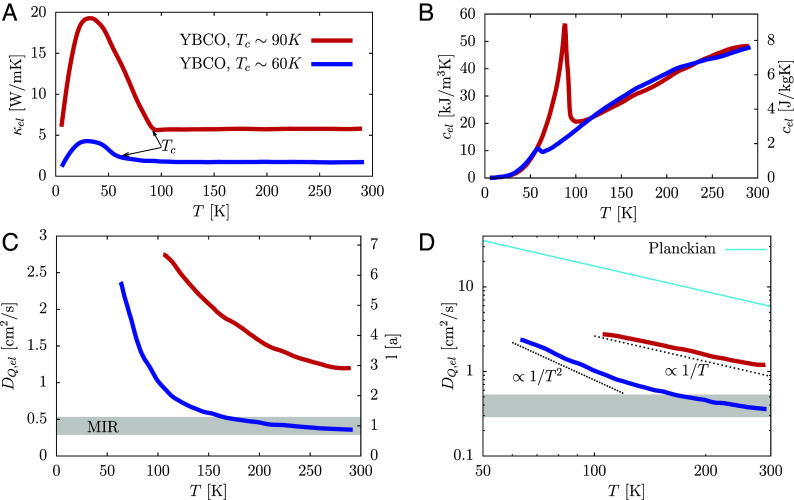 Fig. 1
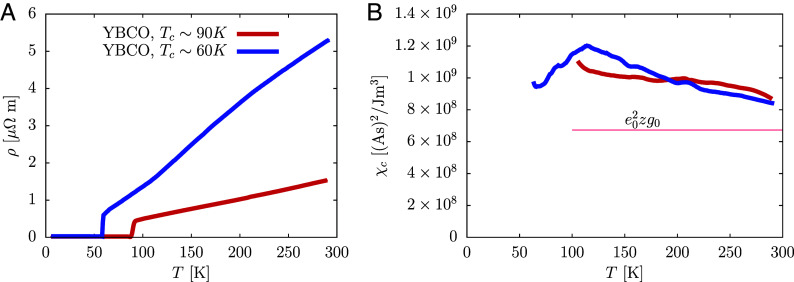 Fig. 2
- —Slovenian Research and Innovation Agency
Peer Reviews
No public reviews on file for this paper yet. If you reviewed it on a platform where reviews are public (OpenReview, ICLR, NeurIPS, ICML), you can paste yours below so the community can read it here.
Videos
No videos yet. Explain this paper in a talk, walkthrough, or lecture? Add one.
Taxonomy
TopicsPhysics of Superconductivity and Magnetism · Theoretical and Computational Physics · Advanced Condensed Matter Physics
Understanding the resistivity in the normal state of high-Tc cuprates poses one of the central challenges in strongly correlated systems for almost four decades and could be a crucial step for understanding the superconductivity. Resistivity shows unusually high values reaching well above the proposed Mott–Ioffe–Regel (MIR) limit at high temperatures (e.g., above 300 K for low hole dopings in YBa_2_Cu_3_O_6+x_). Such bad-metallic behavior was recently understood with cold atoms (1) and computer (2, 3, 4) simulations of Hubbard model in terms of strongly suppressed charge susceptibility , which results in large resistivity ρ via the Nernst–Einstein relation . It was further shown that besides the charge diffusion constant , which decreases with T and saturates at very high T, also decreases with T and importantly affects the T dependence of ρ. Model simulations correspond to very high T and merely touch cuprate’s experimental high-T regime. This raises an important question. Is the behavior observed in simulations for high T, e.g., the importance of the T-dependence of stretched into the experimental lower T regime for cuprates? This seems plausible, since for some dopings ρ shows no qualitative change from the highest T all the way down to the superconducting transition temperature T_c_. This question could be answered with data either on or , but both are still elusive for experimental probing.
Here, we resort to another line of research with many remarkable discoveries for cuprates: The study of thermal properties. Measured specific heat and its electronic part stay robust with practically no corrections since the early measurements (5). Heat conductivity offered an early support for the d-wave pairing in cuprates (6) and revealed increased heat conduction below T_c_ triggering hot debate (7, 8) on its origin: increased mean-free-path of either phonons or non-superconducting electrons. The latter was strongly supported by the increased infrared conductivity (9, 10). For the insulating parent compound, the magnonic was determined as the difference between the measured in-plane and out-of-plane conductivities allowing the extraction (11) of very long magnonic mean free paths (longer than 100 unit cells). Introductions of impurities (10, 11), defects (12), and magnetic fields (11) were used to reveal the conduction and scattering mechanisms. Furthermore, directly measured heat diffusion constant was discussed in terms of Planckian dissipation and a soup-like mixture of electrons and phonons (13).
Results and Discussion
Heat transport is special in a sense that all quantities in its Nernst–Einstein equation can be independently measured—even the heat diffusion constant (13). The challenge however is the separation of phononic and electronic contributions to the total conductivity . Takenaka et al. (10) carefully analyzed the O and Zn doping dependence of for YBa_2_Cu_3_O_6+x_ (YBCO) and obtained good estimates for (Fig. 1A). We use these data, together with the data for (Fig. 1B) from Loram et al. (5) to estimate the electronic heat diffusion constant via the Nernst–Einstein relation . The resulting for two measured compounds with (x 0.68) and (x 0.93) in the non-superconducting regime is shown in Fig. 1C. decreases with increasing T as expected, since it is related to the mean free path via and normally decreases with increasing T due to increasing scattering. Here, is a mean quasiparticle velocity. By using its estimate m/s (13) and setting to minimal value ( with being a lattice constant) one obtains a MIR limit for (Fig. 1C). Remarkably, for the compound decreases to such value already at relatively low and shows signs of saturation close to MIR value at higher . This reveals strongly incoherent behavior in such regime. From value of and one can estimate (right y axis in Fig. 1C). This average value of is small and reaches at lowest . dependence of can be related to the dependence of scattering time via . In Fig. 1D we show that for compound the behavior at lowest is most consistent with Fermi liquid like scattering , advocated, e.g., in ref. 14, while the compound shows more like behavior. We show in Fig. 1D also the comparison to the suggested (15) lower bound on diffusion obtained from a Planckian timescale . is shown for a numerical prefactor of the order unity set to . is much smaller and the consistency with for a compound requires , while smaller is needed for consistency with compound.
(A) Electronic heat conductivity κel for two YBCO samples (Tc∼60 K and Tc∼90 K) from ref. 10. Transition temperatures Tc are indicated. (B) Electronic specific heat as measured for similar samples from ref. 5. (C) Calculated electronic heat diffusion constant DQ,el for two samples showing decrease with T and for Tc∼60 K sample also values and tendency for saturation close to the MIR limit at higher T. Due to some uncertainty in definition of MIR limit, it is shown with 30% range from l=a. Right y-axis shows estimated mean free path. (D) DQ,el in logarithmic scale compared with 1/T2, 1/T and suggested Planckian lower bound for a prefactor α=1.
By having values for , we can make a step toward estimating . and typically do not behave the same, but they are related. It was found that within a dynamical mean field theory (16), they are at low related by , with a factor and being a quasiparticle weight. By assuming a constant factor in regime of measured data and setting it to an approximate value , we obtain a sensible approximation for . This can be used together with the data on resistivity (10) (Fig. 2A) to calculate via the Nernst-Einstein relation . The resulting is shown in Fig. 2B. It is compared to the theoretical estimate , with being a non-interacting density of states. is larger than theoretical estimate and in addition shows some T dependence. A clear cusp is seen for compound at presumably corresponding to the charge density-wave (CDW) phase transition (17). More relevant for our discussion is its T and doping dependence above such T. While both compounds show decreasing with increasing T, the decrease for compound is stronger. From 200 K to 300 K, its decreases by about 15%, which is comparable to the decrease of for about 20% (together they give an increase of for about 50%). This is similar to the behavior observed in the Hubbard model (1). T dependence of therefore plays an important role for in YBCO and may turn out to be even greater at higher T as is expected to be saturating while increases further. This agrees well with the picture from the optical conductivity (18), in which the increase of resistivity with increasing T in the bad metallic phase is due to the transfer of low frequency spectral weight to higher frequencies, while the mean free path is saturating. It is interesting to note, that with decreasing doping, is increasing, which is consistent with the phase separation tendency, for which diverges at some point in the extended phase diagram (19). We also note that the Nernst–Einstein relation is applicable also to the pseudogap phase as it relies (2, 3, 15) only on the normal behavior with some scattering or current relaxation mechanism leading to the finite diffusion constant.
(A) Resistivity ρ for the same YBCO samples as in Fig. 1. (B) Via the Nernst–Einstein relation deduced charge susceptibility χc and its comparison with theoretical estimate. χc shows notable T and doping dependence, as well as cusp at presumably CDW transition.
One should keep in mind that the analysis here is based on experimental data, which have some degree of uncertainty and that the properties are averaged over all carriers with no differentiation, e.g., nodal vs. anti-nodal Fermi surface parts. However, the main outcomes like strongly incoherent electronic transport close to expected MIR saturation and the first estimate of suggesting notable T and doping dependence could withstand future tests. The presented behavior and insight also hint on possible better understanding and calls for further experimental efforts to pin down at least one additional quantity, either charge diffusion constant or charge susceptibility .
Materials and Methods
Some details on calculations can be found in SI Appendix.
All the data are taken from references and results calculated as explained in the text.
Supplementary Material
Appendix 01 (PDF)
The reference list from the paper itself. Each links out to its DOI / PubMed record.
- 1P. T. Brown , Bad metallic transport in a cold atom Fermi-Hubbard system. Science 363, 379–382 (2019).30523078 10.1126/science.aat 4134 · doi ↗ · pubmed ↗
- 2J. Kokalj, Bad-metallic behavior of doped Mott insulators. Phys. Rev. B 95, 041110 (2017).
- 3E. Perepelitsky , Transport and optical conductivity in the Hubbard model: A high-temperature expansion perspective. Phys. Rev. B 94, 235115 (2016).
- 4E. W. Huang , Strange metallicity in the doped Hubbard model. Science 366, 987–990 (2019).31753997 10.1126/science.aau 7063 · doi ↗ · pubmed ↗
- 5J. W. Loram , Electronic specific heat of Y Ba 2Cu 3O 6+x from 1.8 to 300 K. Phys. Rev. Lett. 71, 1740–1743 (1993).10054486 10.1103/Phys Rev Lett.71.1740 · doi ↗ · pubmed ↗
- 6M. J. Graf , Electronic thermal conductivity and the Wiedemann-Franz law for unconventional superconductors. Phys. Rev. B 53, 15147 (1996).10.1103/physrevb.53.151479983313 · doi ↗ · pubmed ↗
- 7R. C. Yu , Thermal conductivity of an untwinned Y Ba 2Cu 3O 7−δ single crystal and a new interpretation of the superconducting state thermal transport. Phys. Rev. Lett. 69, 1431 (1992).10047215 10.1103/Phys Rev Lett.69.1431 · doi ↗ · pubmed ↗
- 8M. Ausloos, M. Houssa, Thermal conductivity of unconventional superconductors: A probe of the order parameter symmetry. Supercond. Sci. Technol. 12, R 103 (1999).