Medical school department chair performance improvement: A qualitative study
Mohammad Mahboubi, Soleiman Ahmady, Azim Mirzazadeh, Afagh Zarei, Hadi Hamidi, Noushin Kohan

TL;DR
This study explores factors that influence the performance of medical school department chairs in Iran through qualitative analysis.
Contribution
The study identifies five key themes and nine subthemes affecting department chair performance in Iranian medical schools.
Findings
Five overarching themes were identified: human resource management, organizational behavior, performance support, leadership, and financial resources.
Nine subthemes emerged, including performance evaluation, job design, and motivational efforts.
Effective department chair performance can positively impact department operations and outcomes.
Abstract
In medical education, department chairs should play a significant role. The present qualitative study was conducted to identify factors that influence the performance improvement of department chairs at medical schools in Iran. The study was conducted in Iran in 2022 and used a thematic analysis method. Using a purposeful sampling method, 20 participants were invited to participate, including medical school deans and department chairs. Focus group discussion (FGD) was used for qualitative data gathering. Braun and Clarke’s thematic analysis was used to analyze data. There were 18 males and 2 females among the participants. The mean age of the participants was 45±4 years. Five overarching themes were formulated: human resource management, organizational behavior management, performance support system, leadership, and financial resources. Also, nine subthemes emerged, including…
Genes, proteins, chemicals, diseases, species, mutations and cell lines named across the full text — each resolved to its canonical identifier and authoritative record.
Click any figure to enlarge with its caption.
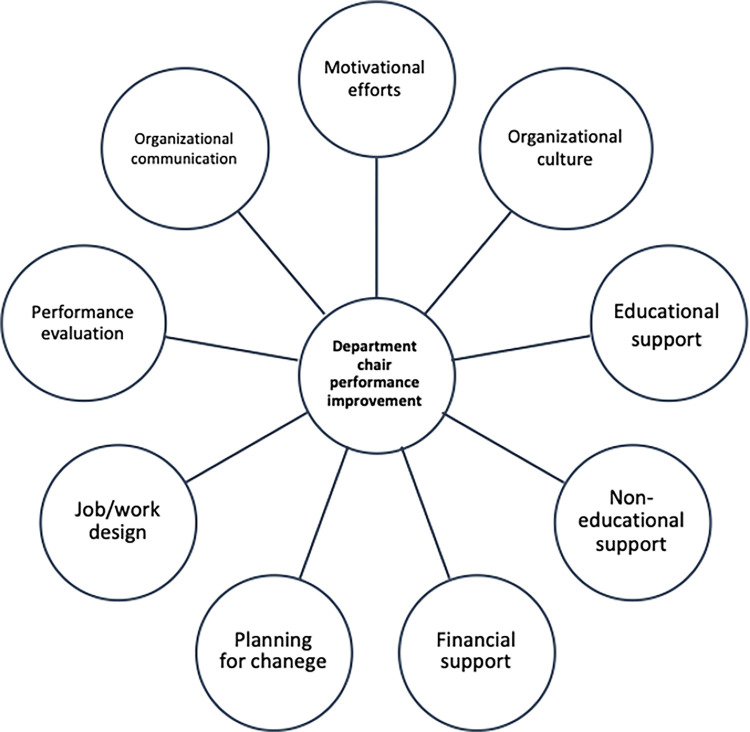 Fig 1
Fig 1Peer Reviews
No public reviews on file for this paper yet. If you reviewed it on a platform where reviews are public (OpenReview, ICLR, NeurIPS, ICML), you can paste yours below so the community can read it here.
Videos
No videos yet. Explain this paper in a talk, walkthrough, or lecture? Add one.
Taxonomy
TopicsOrganizational Strategy and Culture · Job Satisfaction and Organizational Behavior · Organizational Leadership and Management Strategies
Introduction
"No one plays a larger part in determining the character of higher educational institutions than the department chairman" [1]. The academic department is the main building block of universities in which most of the university labours are done [2]. It also significantly affects the university’s reputation and research excellence. Finally, it serves as a place for faculty and students to interact and share ideas. Wolverton (2005) suggested that “the department chairship is a series of interruptions and interactions with many people at multiple levels of the institution” [3]. Department chairs (DCs) are the agents of activities that shape department members’ attitudes and behaviors. They must be accountable to the upper managers of the organization on the one hand and faculties, staff, and students on the other hand. They play a significant role in managing universities [4].
The performance of DCs is categorized into three areas: roles and relationships, job responsibilities, and associated skills [5]. Studies have offered some responsibilities for DCs including recommendation of faculty members for appointment, promotion, tenure, control of budgets, class schedules and teaching assignments, affecting student interactions with the institution, and establishing and maintaining departmental culture [6].
Department chairs (DCs) are often at the forefront of decision making and have access to resources to help shape the department’s goals and objectives. They are also able to influence the recruitment, hiring, and retention of faculty, as well as the department’s budget and curriculum. Additionally, they can have a significant impact on the department’s culture and atmosphere by setting expectations and fostering an environment that is conducive to learning [5].
Universities are recognized as dynamic units for overcoming changes such as competition, globalization, technology development, and market orientation [7]. Therefore, it is not far-fetched if the roles of DCs, as the heads of the main building blocks of universities, have dramatically changed over time [8] Especially in medical education as a response to healthcare reform prospects, evolving technologies, and knowledge advances. These create significant uncertainties and corresponding responsibilities. The traditional medical education system struggles to keep up with change. It must adapt to meet the changing needs of the health care landscape [9].
Consequently, DCs are likely to be the most influential position in the university to deal with these challenges and manage situations; however, they are often underestimated, as academics with no experience or understanding are assigned to them [10]. This lack of expertise and understanding can lead to DCs being underutilized. This can negatively impact the university’s ability to respond to challenges and manage situations effectively. As such, universities must ensure that experienced and knowledgeable people are appointed to the DCs role.
In the study by Lieff et al. (2013), DCs’ performance is most influenced by their access to a supportive and comprehensive network [11]. And the transition from a faculty member to a department chair is from a ‘‘collegial, discipline-based world to a hierarchical, university-based reality” [12].
DCs are faced with many challenges that are context-dependent when managing challenges, which requires knowledge, experience, and development [13]. DCs’ performance must be studied in different areas of the world [14]. However, there are few studies that emphasize DCs’ roles or responsibilities. There is little known about factors influencing DC performance improvement in medical schools. As such, more research is needed to better understand the key factors that can influence performance improvement.
Also, it is important to mention that DC’s role, responsibilities, and performance vary depending on the culture. Consequently, academic departments can follow different leadership styles, decision-making procedures, and communication practices according to departmental rules. The impact of cultural differences on DC performance in universities must therefore be taken into account. Using a qualitative approach, we identified factors influencing department chairs’ performance improvement at Iranian medical schools.
Methods
The study was conducted in Iran in 2022 and used a thematic analysis method. Virtual University of Medical Sciences granted approval for this research through the research ethics committee with the registration number IR.VUMS.REC.1400.023.
Using a purposeful sampling method, 20 participants were invited to participate, including medical school deans and department chairs. Incorporating both chairs and deans into focus groups provided valuable insights into DC effectiveness. There is a difference between Deans and Chairs as far as their responsibilities and work experiences are concerned. In this study, it can be useful to identify potential areas of agreement and disagreement to better understand the phenomenon’s complexity. Focus group discussion (FGD) was used for qualitative data gathering. In this study, two group discussion sessions were held to ask participant opinions. An invitation E-mail containing the purpose of the FGDs was sent to the participants. All participants agreed to attend FGDs at a determined time and location.
Initially, the facilitator discussed the ground rules of FGD in terms of respect and confidentiality.
Informed consent was obtained from all participants. They were informed that they could withdraw from the study at any time without consequences. Moreover, permission was obtained for recording the interviews. Confidentiality was maintained throughout all data collection and analysis steps. The sessions continued until ideas were saturated: no one added anything new. Participants answered some questions based on the interview guide, such as: "What are the factors affecting the department chair’s performance improvement?", "How can academic leaders help department chairs perform better?", and ’’What are strategies for improving department chairs’ performance through policy implementation?".The aim of the questions was to better understand the opinions of the participants, as well as to identify any potential strategies or solutions for improving department chairs’ performance. FGD sessions lasted around 90 minutes and were organized and conducted by professional moderators using the discussion guide. Moreover, focus group sessions were audiotaped and transcribed. Thematic analysis was applied to analyse the data based on Braun and Clarke’s procedure [15]. The transcribed data were reviewed several times, and the most significant features were coded. Then, themes were searched and reviewed to be defined and labelled. This process continued until the overarching themes, themes, and sub-themes were formed. After that, the researchers created the thematic map by identifying themes and subthemes [15]. Member checking was used in the data analysis phase with two peers who were experts in educational management (co-authors) to ensure the credibility and trustworthiness of the findings. Furthermore, immersing in the data by the researchers and confirming the findings by participants were the other ways to guarantee the trustworthiness. Written informed consent was obtained from all participants.
Results
There were 18 males and 2 females among the participants. The mean age of the participants was 45±4 years. Based on the thematic analysis, the effective elements on DCs’ performance placed in five overarching themes emerged as follows: 1) Job preparation and expectations factors, 2) organizational behaviour management factors, 3) performance support system, 4) leadership and 5) financial resources development. These five overarching themes included nine themes as well. The nine subthemes were composed of thirty-two sub-themes which can be found in Table 1. The participants’ quotes were also tabulated in front of subthemes they related to in Table 1. The schematic conceptual framework developed accordingly is illustrated in Fig 1.
Conceptual framework of the related factors in medical school department chair performance improvement.
Table 1: Overarching themes and themes, sample of subthemes, and participant quotes.
Overarching theme 1: Job preparation and expectations factors
This overarching theme was generated from two themes including job/work design and performance evaluation. The participants mentioned the importance of selecting an appropriate person as well as clarifying the role and responsibilities to improve the performance of DCs. These factors were related to job and work design. In addition, the participants in the FGDs expressed their opinions on how performance evaluation can be improved. They highlighted defining good performance indicators as well as auditing the DCs in the base of these indicators.
Overarching theme 2: Organizational behaviour management factors
In this regard, three themes were identified. Participants expressed their views about organizational culture, organizational communication factors, as well as the efforts to motivate DCs.
Overarching theme 3: Performance support system
Educational and non-educational support factors are related to the performance support system*’*
Overarching theme 4: Leadership
According to the participants, department chairs (DCs) should possess the capacity to lead and be adaptable to change. Participants said DCs need to learn to change and improve their leadership ability.
Overarching theme 5: Financial resources development
Financial factors were mentioned as a guarantee factor for DC performance in the FGD. From their perspective, DCs need financial resources to execute programs.
The framework shows that higher managers could help DCs through creating appropriate organizational communication, motivational efforts, and creating a positive organizational culture. DCs also need to provide an educational and non-educational support system, leading to performance improvement. Most importantly, they need a university plan to develop their leadership and a financial resource to manage the changes or create a departmental program. Finally, DCs must evaluate and audit using the anticipated indicators defined in advance. However, first they must clarify their expectations and descriptions.
Discussion
The present study aimed to investigate factors affecting department chairs’ performance improvement. The study findings outweigh those of previous studies since we identified the dimensions of performance improvement from experts’ perspectives in an academic center, focused on both individual and organizational variables, and finally provided a framework that can be easily used in practice. Based on our results, performance evaluation is one of the most critical components of any performance improvement structure. Our findings are consistent with those of other studies reporting that DCs strongly agreed to have a managerial role and responsibility. The performance appraisal system is a prerequisite for ensuring performance success [16,17]. These qualitative findings confirm London (2011)’s suggestion for a performance evaluation system for assessing department chairs’ effectiveness [18]. Furthermore, this study indicated that both organizational job and work design affect academic DC performance. Our findings are consistent with studies that report that well-designed jobs and work have a constructive impact on employees’ motivation and performance; consequently, this improves individual and group organizational performance, such as participation, effective role modelling, and innovative achievement [19,20].
Based on our results, both organizational culture and organizational value could improve DCs’ performance. Organizational culture is "a system of shared meanings held by members who distinguish the organization from other organizations" [21]. These results support the hypothesis that organizational culture is linked to performance. However, management experts claim that successful organizations are those which promote cultural values in line with their strategies [22–24]. In addition, Koesmono (2014) revealed that organizational culture could affect organizational loyalty [25]. Given the findings of this study, organizational culture can improve individual and organizational performance. This result is supported by other studies, which indicate a relationship between strong culture and organizational effectiveness [23–26]. Mullakhmetov et al. (2018) discussed in his study that an effective culture is created by the combination of cultural values and norms. Therefore, culture-related factors affect performance [27].
Based on our results, the development of approaches and techniques for organizational communication, as well as organizational knowledge management in departments, is essential for improving the performance of DCs. These findings further support the idea that an organization with knowledge management strategies will use assets more efficiently and, as a result, will achieve better organizational performance [28]. Inter-organizational communication will facilitate continuous communication with senior faculties and university administrators, leading to a productive culture in which all members of the institution have a common commitment to performance improvement [29]. Our study confirms numerous studies reporting that more motivated staff are more productive and committed [30,31]. Koesmono (2014) revealed that extrinsic and intrinsic motivation significantly influences employees’ performance [25]. It will be desirable for higher-education organizations to provide educational support services for their DCs to improve their performance and productivity with activities such as preparing a forum for the exchange of experiences, developing a formal orientation program for new DCs, and establishing a mentoring system and leadership development programs [32,33].
The results of this study demonstrated that in addition to educational support, other non-educational support services are required (e.g., logistic support). It is in line with those studies suggesting that supportive organizations make sense of self-importance in their staff, rewarding them, and understanding and meeting their demands [34]. According to Eisenberger et al. (1986), organizational support is "employees’ perception of being valued and cared about by their organization" [35].
Since medical universities undergo rapid changes, DCs, as the leaders of this change, play a vital role in the effectiveness of change efforts [13,36]. The present study illustrated that the leadership delivered by the DCs is an essential factor for success. DCs must supervise the department and possess the power to influence the expected faculties’ interactions and lead a supportive culture for them as a leader [37,38]. Based on our literature review, we were surprised to find relatively few empirical studies about the factors associated with DC performance in peer-reviewed journals, the qualitative method is often employed when there are limited empirical publications available on a particular research construct.
According to Columbus et al, Several factors contributed to the advancement of chairs in academic surgery departments, both internal and external, It may prove crucial to promote career achievement and diversity in surgical management roles in the future to emphasize intrinsic strengths, cultivate supportive environments, and emphasize flexibility. It may also be possible to achieve this through workplace restructuring. As a surgical governance organization, encouraging inherent talents, nurturing conducive environments, and focusing on adaptability may be crucial for success and increasing representation [39].
Navaebrahim and Karimi studied the relationship between the skills of DC (technical, human relations, conceptual) and educational quality. Correlation analysis revealed technical and conceptual skills positively correlated with quality, but human relations skills did not correlate. Thus, technical and conceptual abilities of department heads seem to influence educational performance more so than human relations skills. This study investigated the link between managerial competencies and quality, finding technical and conceptual expertise most impactful for improving quality [40].
The study’s strength lies in its diverse sample of participants, from various universities, medical specialties, and experience levels. As a qualitative research has a context-centered nature, which makes generalizability across contexts difficult. Therefore, we believe that the present study provides significant insights regarding this topic, which can be used to formulate a significant "big-picture" view of the performance improvement of department chairs if complemented with similar research in the future, through meta-analysis.
These findings have important implications for medical schools and academic institutions, as they suggest practical ways to improve the functioning and performance of department chairs, ultimately enhancing the quality of medical education and research. Furthermore, the study’s qualitative approach provides a rich and nuanced understanding of the experiences and perspectives educational expert, which can inform future research and policymaking in this area.
Conclusion
In this study, we found some factors influencing DC performance improvement in medical schools. Overall, we hypothesized that department chairs’ effective performance may benefit department operations, processes, or outcomes. We propose that department chairs should possess strong leadership skills in order to effectively navigate the professional environment. They should build positive relationships with faculty, and remain committed to the university’s mission and vision.
The reference list from the paper itself. Each links out to its DOI / PubMed record.
- 1Baker A, Goodall AH. Feline followers and “umbrella carriers”: Department chairs’ influence on faculty job satisfaction and quit intentions. Res. Policy. 2020 May 1; 49(4):103955. Available from: 10.1016/j.respol.2020.103955. · doi ↗
- 2Yelibay M. Department chair as mentor: perceptions of young female faculty members from Kazakhstan. J. Prof. Cap. Community. 2021 Oct 5; 6(4):318–35. Available from: 10.1108/JPCC-01-2020-0001. · doi ↗
- 3Wolverton M, Ackerman R, Holt S. Preparing for leadership: What academic department chairs need to know. J. High. Educ. Policy Manag. 2005 Jul 1; 27(2):227–38. Available from: https://www.tandfonline.com/doi/abs/10.1080/13600800500120126.
- 4Shoenthal D. The Dynamics of Communication: Department Chair Responsibilities. PRIMUS 2020 Jul 2; 30(6):711–9. Available from: https://doi.org/101080/1051197020201737604.
- 5Mitchell JN. Measuring the Performance of the Chair. NDHE. 2004; 126:55–68. Available from: https://onlinelibrary.wiley.com/doi/full/ doi: 10.1002/he.148 · doi ↗
- 6Willett CG, Le QT. Willett CG, Le QT. The role of department chair. In Career Development in Academic Radiation Oncology 2021 May 26 (pp. 319–326). Cham: Springer International Publishing. https://link.springer.com/chapter/10.1007/978-3-030-71855-8_23.
- 7Villani E, Lechner C. How to acquire legitimacy and become a player in a regional innovation ecosystem? The case of a young university. J. Technol. Transf. 2021 Aug; 46:1017–45. Available from: https://link.springer.com/article/10.1007/s 10961-020-09803-8.
- 8Peacock J, Peacock J, Melville W. The evolving role of the science department chair. Int. J. Sci. Educ. 2019 Jan 22; 41(2):139–49. Available from: https://www.tandfonline.com/doi/abs/10.1080/09500693.2018.1539811.