Rare coronary artery anomaly: left anterior descending artery origin form right coronary cusp
Tomohiro Nakajima, Keitaro Nakanishi, Tsuyoshi Shibata, Keishi Ogura, Nobuyoshi Kawaharada

Abstract
Genes, proteins, chemicals, diseases, species, mutations and cell lines named across the full text — each resolved to its canonical identifier and authoritative record.
Click any figure to enlarge with its caption.
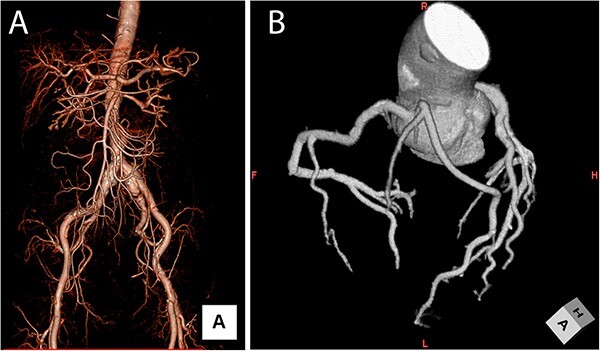 Figure 1
Peer Reviews
No public reviews on file for this paper yet. If you reviewed it on a platform where reviews are public (OpenReview, ICLR, NeurIPS, ICML), you can paste yours below so the community can read it here.
Videos
No videos yet. Explain this paper in a talk, walkthrough, or lecture? Add one.
Taxonomy
TopicsCoronary Artery Anomalies · Vascular anomalies and interventions · Cardiovascular Issues in Pregnancy
INTRODUCTION
Coronary artery anomalies are reported to be less than 1%. In this case, we report an incidentally discovered coronary artery anomaly during preoperative assessment for abdominal aortic aneurysm surgery [1].
CASE REPORT
The patient was a 77-year-old man. He was referred to our hospital because of bilateral common iliac artery aneurysms of 30 mm in diameter (Fig. 1A). He had never been diagnosed with any heart disease or abnormality during medical examinations. When he underwent coronary angiography 3D-CT as a preoperative evaluation for aneurysm surgery, it was found that he had an arterial malformation in which the anterior descending branch of the left coronary artery was protruding from the cusp of the right coronary apex. The left diagonal and circumflex branches of the left coronary artery ran from the cusp of the left coronary apex (Fig. 1B). The frequency of anomalous coronary artery originating from the opposite sinus of Valsalva with prepulmonic course is reported to be 0.04% [2].
Volume rendering computed tomography. (A) Bilateral common iliac arteries were found, with a diameter of 30 mm. (B) Coronary Volume rendering CT. The anterior descending branch of the left coronary artery originated from the right coronary apex cusp, and the vessel originating from the left coronary apex cusp perfused the left diagonal and circumflex regions.
According to reports from various authors, perioperative myocardial ischemia may occur during abdominal aortic aneurysm surgery with coronary artery lesions. In this case, the patient was treated with EVAR (Excluder) and discharged on the sixth postoperative day without any postoperative problems.
We have a case report of a left coronary artery aneurysm associated with an abdominal aortic aneurysm. The frequency of this abnormality was 0.04%. Although there was no coronary event, this information is very useful in the event of a coronary event in the future [3]. It is advisable to examine the coronary arteries during the preoperative examination for abdominal aortic aneurysm.
DISCUSSION
We encountered a case of coronary artery anomaly found during preoperative evaluation for abdominal aortic aneurysm. This case was particularly rare among coronary artery anomalies.
The reference list from the paper itself. Each links out to its DOI / PubMed record.
- 1King B, Rockman C, Han S, Siracuse JJ, Patel VI, Johnson WS. et al. Aortobifemoral reconstruction in open abdominal aortic aneurysm repair is associated with increased morbidity and mortality. J Vasc Surg 2023;78:77–88.e 3.36918104 10.1016/j.jvs.2023.03.019 · doi ↗ · pubmed ↗
- 2Behrendt CA, Thomalla G, Rimmele DL, Petersen EL, Twerenbold R, Debus ES. et al. Prevalence of peripheral arterial disease, abdominal aortic aneurysm, and risk factors in the Hamburg City health study: a cross sectional analysis. Eur J Vasc Endovasc Surg 2023;65:590–8.36634745 10.1016/j.ejvs.2023.01.002 · doi ↗ · pubmed ↗
- 3Gräni C, Benz DC, Schmied C, Vontobel J, Possner M, Clerc OF. et al. Prevalence and characteristics of coronary artery anomalies detected by coronary computed tomography angiography in 5634 consecutive patients in a single Centre in Switzerland. Swiss Med Wkly 2016;146:w 14294.27124568 10.4414/smw.2016.14294 · doi ↗ · pubmed ↗