Matrix Rhythm Therapy as a Novel Clinical Approach in the Rehabilitation of Surgically Treated Distal Radius Fracture: A Single Case Study
Pallavi R Bhakaney, Om C Wadhokar, Sakshi Upase

TL;DR
This case study explores the use of Matrix Rhythm Therapy in rehabilitating a surgically treated wrist fracture, showing improved recovery outcomes.
Contribution
The study introduces Matrix Rhythm Therapy as a novel addition to traditional physiotherapy for distal radius fracture rehabilitation.
Findings
Matrix Rhythm Therapy was integrated into conventional rehabilitation to enhance recovery.
The combined approach improved pain relief, range of motion, and functional outcomes.
Personalized treatment planning and progress evaluations supported better recovery.
Abstract
Distal radius fractures (DRFs) are prevalent among all hand injuries, commonly due to a fall on an outstretched hand. Not being treated properly can cause many complications such as malunion, non-union, reduced range of motion, and muscle strength. This case report presents a multidisciplinary approach to the physiotherapeutic management of a DRF treated with closed reduction internal fixation using K-wires. The rehabilitation protocol incorporated matrix rhythm therapy (MRT), a novel therapeutic technique, in combination with targeted therapeutic exercises. The study outlines the patient's journey from injury to recovery, detailing the integration of MRT sessions alongside conventional physiotherapy exercises. The comprehensive rehabilitation aimed to enhance pain relief, restore range of motion, and improve functional outcomes. The case highlights the synergistic benefits of…
Genes, proteins, chemicals, diseases, species, mutations and cell lines named across the full text — each resolved to its canonical identifier and authoritative record.
Click any figure to enlarge with its caption.
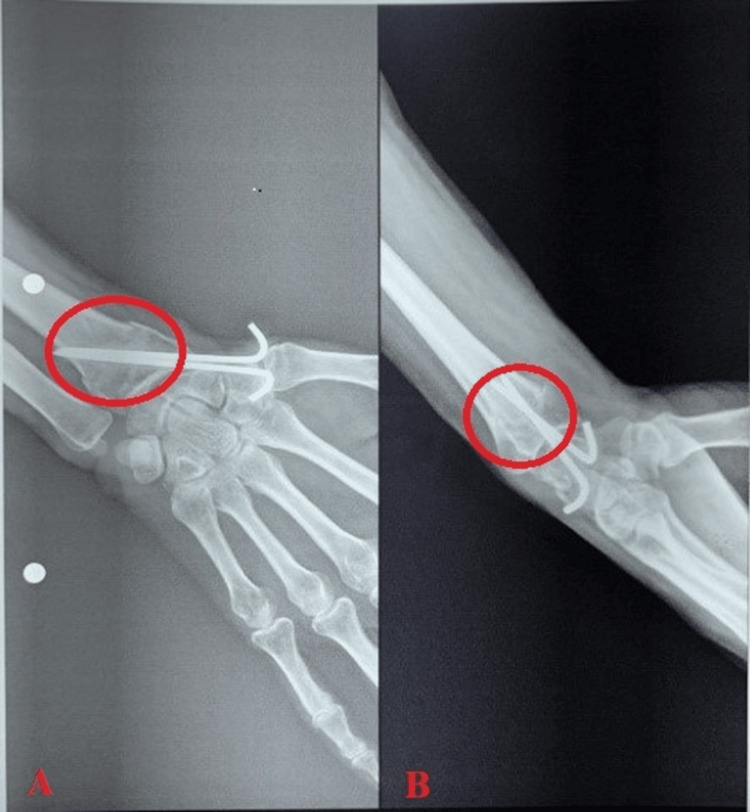 Figure 1
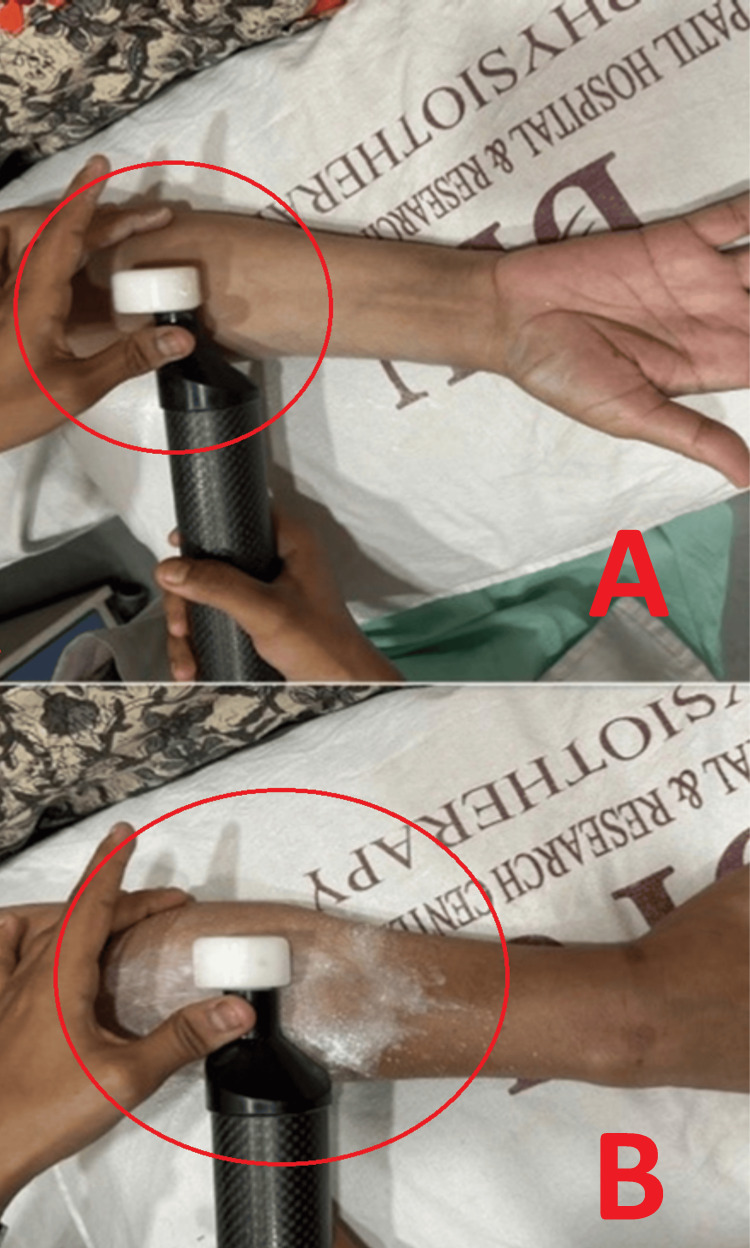 Figure 2
| Joint | Movement | Range of motion pre-treatment | Range of motion post-treatment | Muscles | Grade pre-treatment | Grade post-treatment |
| Right wrist | Flexion | 0-19° | 0-44° | Flexors | 2/5 | 4/5 |
| Extension | 0-25° | 0-46° | Extensors | 2/5 | 4/5 | |
| Radial deviation | 0-10° | 0-15° | Ulnar deviators | 2/5 | 4/5 | |
| Ulnar deviation | 0-15° | 0-23° | Radial deviators | 2/5 | 4/5 | |
| Supination | 0-45° | 0-75° | Supinator | 2/5 | 4/5 | |
| Pronation | 0-65° | 0-80° | Pronators | 2/5 | 4/5 | |
| Right elbow | Flexion | 0-130° | 0-135° | Flexors | 4/5 | 5/5 |
| Extension | 130-0° | 135-0° | Extensors | 4/5 | 5/5 |
| Intervention | Dosage | Rationale |
| Cryotherapy | 10 minutes thrice a day over the anterior aspect of the wrist | Application of ice reduces the nerve conduction velocity, causing damping of pain signals to a higher center |
| Active range of motion exercise (wrist musculature) | 10 repetitions of each movement twice daily | To maintain muscle pliability, avoid muscle atrophy, and prevent muscle wasting |
| Maitland mobilization (wrist, metacarpophalangeal, interphalangeal joints, and proximal radio-ulnar joint) | Grades 2 and 3 mobilizations, 10 oscillations, three sets | To break capsular adhesions, improve joint play, reduce pain, and augment the range of motion at the wrist |
| Matrix rhythm therapy (MRT) | 30 minutes over the anterior aspect of the wrist and forearm | The oscillation by MRT causes the re-establishment of the disturbed cellular frequency, resolves stiffness, augments tissue healing, and improves the range of motion |
| Ischemic compression technique | 90 seconds, three sets | Causing a local increase in circulation, promoting tissue healing |
| Muscle energy techniques (MET) | 20% of maximum, seven seconds hold, 10 repetitions | Activation of the Golgi tendon organ induces relaxation of the antagonist, accentuating the strengthening of the agonist |
| Gripping exercises | 10 repetitions thrice a day using a resistance band/smiley ball | Strengthening lumbricals, palmar, and dorsal interossei |
| Dexterity exercise | 10 repetitions thrice a day | Improving overall hand functionality |
| Outcome measures | Day 1 (pre-treatment) | Week 4 (post-treatment) |
| Numerical Pain Rating Scale (NPRS) | 8/10 on activity | 3/10 on activity |
| Disability of Arm, Shoulder, and Hand (DASH) | 76 | 45 |
| Patient-Rated Wrist Evaluation (PRWE) | 85 | 40 |
Peer Reviews
No public reviews on file for this paper yet. If you reviewed it on a platform where reviews are public (OpenReview, ICLR, NeurIPS, ICML), you can paste yours below so the community can read it here.
Videos
No videos yet. Explain this paper in a talk, walkthrough, or lecture? Add one.
Taxonomy
TopicsOrthopedic Surgery and Rehabilitation · Elbow and Forearm Trauma Treatment · Facial Nerve Paralysis Treatment and Research
Introduction
Distal radius fracture (DRF) is one of the most common bone fractures, contributing to nearly one of every five fractures in people aged 65 years or older [1]. The break usually happens due to falling on an outstretched or flexed hand. Signs include pain, swelling, and difficulty moving the wrist or hand. These can vary in severity, from simple fractures that may only require a cast to more complex fractures that may require surgical interventions. Complications of a DRF can arise during the delayed healing curative process or after treatment. These injuries can result in a higher incidence of long-term functional limitations, pain, and physical deformities [2]. Some potential complications include malunion, non-union, nerve and blood vessel damage, complex regional pain syndrome, stiffness, reduced range of motion, infection, chronic pain, etc. Physiotherapy has been an effective method to restore full joint movement and improve functional ability [3]. Additionally, massage therapy is widely considered a soft tissue manipulation technique that enhances blood circulation. A newly discovered vibro-massage method, called matrix rhythm therapy (MRT), is the latest advancement used in the field of physiotherapy. The MRT originates from research Dr. Randoll conducted at Erlangen University in the 1990s. It is a therapeutic device designed to stimulate and restore specific physiological vibrations in skeletal muscles and the nervous system [4]. This therapy enhances the natural rhythm of muscles and indirectly regulates associated processes. MRT is said to regulate as well as balance the normal physiological rhythm due to resynchronization. Due to the inflammatory process, restriction to the flow of oxygen causes restricted movement. Oscillations ranging from 8 to 12 Hz result in improved microcirculation, which, in turn, causes muscle relaxation. MRT has numerous effects on body systems ranging from physiological and chemical to physical. This method has a broad range of applications [5]. This case study demonstrates the efficiency of MRT in improving the targeted goal in a case of postoperative DRF.
Case presentation
A 61-year-old housewife reported a history of a fall in her house due to the slippery floor and experienced instant sharp pain and swelling on her right wrist. On admission to the hospital, a preliminary assessment was done, which included a series of investigations, including X-ray imaging and laboratory investigations like kidney function tests, calcium levels, vitamin D levels, etc. These revealed low levels of calcium and vitamin D. An X-ray of the right wrist showed a fracture of the distal radius. No relevant medical or pharmacological history was reported by the patient. Surgical intervention was planned, which included a closed reduction internal fixation with K-wire. The patient was discharged from the hospital on the third day and was called for follow-up regularly. Twenty days post-surgical treatment, suture removal was done, and antibiotics were prescribed. On the 2nd of October, the implant embedded within the patient was removed. The patient visited Dr. D. Y. Patil College of Physiotherapy Outpatient Department (OPD) with complaints of pain and stiffness in her right wrist around 28 days after the last follow-up of implant removal. On admission to the Physiotherapy OPD, her primary complaints included pain and inability to move her right wrist, associated with aggravating right lateral thumb pain. She gave a detailed history of a series of medical conditions, which include diabetes mellitus for 18-20 years (on medications), a left frozen shoulder three years ago, and chronic bronchitis for five years. She also mentioned the complaint of experiencing breathlessness after walking on an inclined surface.
During the general examination, the patient was oriented to time, place, and person. Initial assessment included postural assessment, which revealed the right shoulder was slightly elevated. Palpation of the right forearm revealed evident muscle wasting of the brachioradialis. There was a rise in the local body warmth; however, when checked for any sensory deficits, no positive findings were revealed. Besides this, weakness of finger abductors and adductors was seen, along with tightness in the brachioradialis muscle. The range of motion assessment was done before the commencement of the treatment, and after four weeks of the physiotherapy treatment, the range of motion of the right shoulder and left upper limb is full and functional. The pre- and post-range of motion and strength assessment is mentioned in Table 1.
The below-mentioned X-ray shows postoperative distal end radius fracture managed with K-wire fixation (Figures 1A-1B).
(A) AP view of the right wrist. (B) Lateral view of the postoperative distal end radius fracture managed with K-wire fixation.AP, anteroposterior
The goal of rehabilitation was directed toward managing pain, regaining functional range and strength, and improving the quality of life of the patient. With pertinent rehabilitation, the achievable outcomes were measured on outcome measures assessing overall functioning at the end of four weeks. The short-term goals were to manage pain, reduce swelling, improve the range of motion at the wrist, elbow, and phalanges, improve muscle strength and grip strength, followed by achieving the independence to perform the activities of daily living. A tailored treatment protocol was given to the patient considering the abovementioned goals to be achieved; the detailed treatment protocol is mentioned in Table 2, with the dosage and rationale for each intervention.
The MRT was started in the rehabilitation protocol on day 2. The patient was instructed not to consume tea, coffee, or alcohol since the morning till the time of the treatment, which can hamper the blood supply. The MRT was applied to the interosseous membrane for about 30 minutes, with a frequency of 8-12 Hz, parallel to the fibers of muscle groups, using solid lubricant to reduce friction over the skin (Figure 2). The treatment was given at a frequency of three times per week.
(A) Matrix rhythm therapy applied with the treatment head on the anterior compartment of the forearm. (B) Matrix rhythm therapy applied with the treatment head on the posterior compartment of the forearm.
The effectiveness of the rehabilitation protocol was measured using the following outcome measures (Table 3).
Discussion
The case report focuses on the documentation of analyzing the combined impact of MRT and therapeutic exercises in managing DRF. By combining traditional surgical interventions with advanced physiotherapeutic techniques like MRT, clinicians can optimize the healing process, improve patient outcomes, and enhance overall quality of life [6]. The successful integration of these modalities emphasizes the potential for their broader application in similar cases, encouraging further exploration and research in orthopedic physiotherapy. This combined approach influences clinical decision-making, emphasizing its potential to improve outcomes and patient satisfaction [7]. The objective in surgically treating DRF is to achieve the proper anatomical reconstruction of the joint surface, ensure stable fixation, and promote effective wrist and forearm motion [8]. Blomstrand et al. assessed the level of pain, the function of the hand, and activity performance in surgically treated DRF patients. They used the conventional methods of treatment, which included a range of motion exercises and overall hand functional exercises, and continuously focused on the strengthening exercises; their conclusion, however, is consistent with the findings of this case study, where all the factors were improved [9]. Moreover, novel methods of treatment in the field of physiotherapy such as Factor et al.’s pilot study on the application of pulsed electromagnetic field (PEMF) to 41 patients with DRF. The outcomes were measured on pain, range of motion, grip strength, and quality of life, which were seen to be improved [10]. Low-level laser therapy is also effective in relieving pain and improving the healing of closed bone fractures in the human wrist and hand [11]. Virtual reality is emerging in rehabilitation, as documented by Kulkarni et al., where virtual reality-based rehabilitative exercises were proposed to be administered using a head-mounted device, Oculus Quest. Kulkarni et al. hypothesized that virtual reality in DRF patients has proven to be effective in improving the condition of the patient and has also been seen as a non-exhaustive patient rehabilitation [12].
Conclusions
The case report highlights the promising outcomes achieved through a comprehensive treatment approach for DRFs and the integration of MRT alongside targeted therapeutic exercises. The synergistic effects of these interventions have significantly contributed to the patient's recovery and rehabilitation process. MRT, a unique and innovative physiotherapeutic modality, was pivotal in reducing pain, improving tissue dynamics, and enhancing overall healing. When coupled with tailored therapeutic exercises, the therapy helped restore range of motion, muscle strength, and functional abilities, leading to a more holistic recovery experience for the patient. As we move forward, healthcare professionals must continue exploring innovative and evidence-based therapies, such as MRT, to further refine rehabilitation protocols and enhance the recovery experiences of patients with DRFs. This case serves as a valuable reference, demonstrating the positive impact of a well-coordinated, multidisciplinary approach in achieving favorable outcomes and improving the lives of individuals recovering from complex fractures.
The reference list from the paper itself. Each links out to its DOI / PubMed record.
- 1Distal radius fracture outcomes and rehabilitation Geriatr Orthop Surg Rehabil Ikpeze TC Smith HC Lee DJ Elfar JC 202205720162784768010.1177/2151458516669202 PMC 5098688 · doi ↗ · pubmed ↗
- 2Rehabilitation for distal radial fractures in adults Cochrane Database Syst Rev Handoll HH Elliott J 02015201510.1002/14651858.CD 003324.pub 3PMC 925013226403335 · doi ↗ · pubmed ↗
- 3Physiotherapy intervention practice patterns used in rehabilitation after distal radial fracture Physiotherapy Bruder AM Taylor NF Dodd KJ Shields N 2332409920132320059910.1016/j.physio.2012.09.003 · doi ↗ · pubmed ↗
- 4Comparison of matrix rhythm therapy and stretching exercises on frozen shoulder: randomised controlled trial Türk Fiz Ve Rehabil Derg Çelik D Türkel N Atalar AC 8188272016
- 5Matrix rhythm therapy, India | Complete pain management system 11 2023 2023 https://marhythe.in/research
- 6Physiotherapy approach towards a typical case of injection induced radial nerve palsy presenting as wrist drop J Evol Med Dent Sci Bawiskar DP Bais AS Naqvi W 1722172492020
- 7Post-operative rehabilitation in a traumatic rare radial nerve palsy managed with tendon transfers: a case report Pan Afr Med J Phansopkar P Athawale V Birelliwar A Naqvi W Kamble S 1413620203284999610.11604/pamj.2020.36.141.23994 PMC 7422742 · doi ↗ · pubmed ↗
- 8Early rehabilitation of distal radius fractures stabilized by volar locking plate: a prospective randomized pilot study J Wrist Surg Quadlbauer S Pezzei C Jurkowitsch J 102112620172842891110.1055/s-0036-1587317 PMC 5397314 · doi ↗ · pubmed ↗