Author Correction: Curcumin and Curcuma longa L. extract ameliorate lipid accumulation through the regulation of the endoplasmic reticulum redox and ER stress
Hwa-Young Lee, Seung-Wook Kim, Geum-Hwa Lee, Min-Kyung Choi, Han-Wool Chung, Yong-Chul Lee, Hyung-Ryong Kim, Ho Jeong Kwon, Han-Jung Chae

Abstract
Genes, proteins, chemicals, diseases, species, mutations and cell lines named across the full text — each resolved to its canonical identifier and authoritative record.
Click any figure to enlarge with its caption.
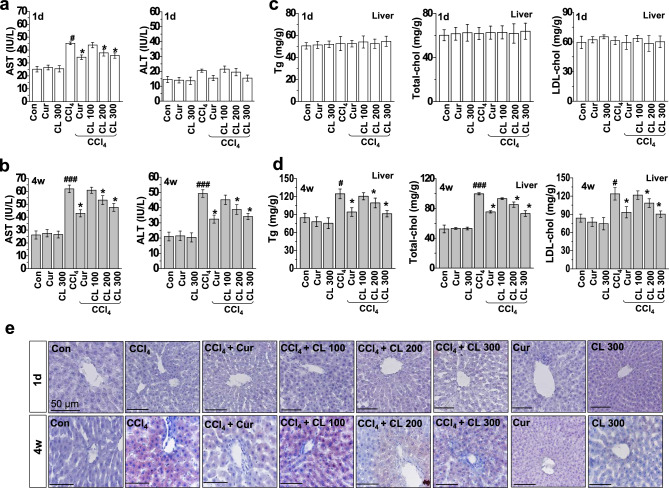 Figure 1
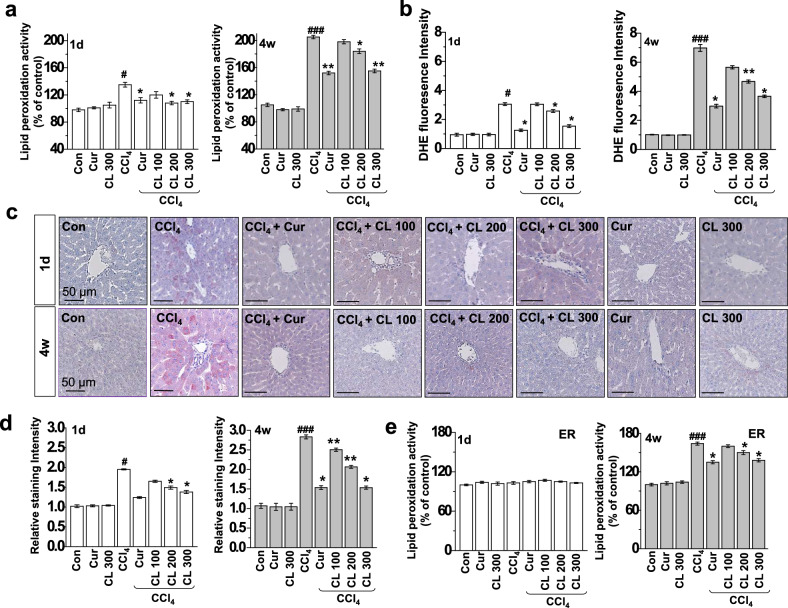 Figure 2
Peer Reviews
No public reviews on file for this paper yet. If you reviewed it on a platform where reviews are public (OpenReview, ICLR, NeurIPS, ICML), you can paste yours below so the community can read it here.
Videos
No videos yet. Explain this paper in a talk, walkthrough, or lecture? Add one.
Taxonomy
TopicsCurcumin's Biomedical Applications · Pharmacological Effects of Medicinal Plants · Pharmacological Effects of Natural Compounds
Correction to: Scientific Reports 10.1038/s41598-017-06872-y, published online 26 July 2017
The original Article contains errors. Due to mistakes during Figure assembly, there are overlaps within two Figures and with previously published articles.
Within Figure 1e the panel “CL 300” is a duplication of panel “1d CCl4 + Cur”. In addition, the panel “4w Cur” overlaps with panel “Curcumin” of Figure 2 in Lee, HY et al.^1^.Figure 1. Curcumin and Curcuma longa L. extract regulate serum levels of AST and ALT and hepatic lipid accumulation in acute and chronic CCl_4_-models. Rats were intraperitoneally treated with CCl_4_ (0.1 mL/100 g, body weight) one time for (a) 1 day or (b) every other day for 4 weeks. Curcumin (200 mg/kg) or Curcuma longa L. extract (100, 200, or 300 mg/kg) was given each day for 3 days before CCl_4_ treatment and once daily after CCl_4_ treatment. Liver and blood samples were collected from all sacrificed animals. Six-h fasting serum levels of AST and ALT were determined. Six h fasting liver triglyceride, total cholesterol, and LDL-cholesterol levels were measured in the (c) 1 day and (d) 4 week CCl_4_-treated rats. (e) Representative images of liver sections from each group stained with hematoxylin–eosin and Oil-Red-O for lipid content. Scale bars = 50 µm. The experiments were repeated three times using tissues from at least three different rats. ^#^P < 0.05, ^###^P < 0.001 vs. the control group; *P < 0.01 vs. the CCl_4_ group (n = 10 rats per group). Cur: curcumin, CL: Curcuma longa L., AST: aspartate aminotransferase, ALT: alanine aminotransferase.Figure 2. Curcumin and Curcuma longa L. extract regulate ROS accumulation in acute and chronic CCl_4_-models. Rats were intraperitoneally treated with CCl_4_ (0.1 mL/100 g body weight) one time for 1 day or every other day for 4 weeks. Curcumin (200 mg/kg) or Curcuma longa L. extract (100, 200, and 300 mg/kg) was given once daily. (a) Lipid peroxidation activity was measured in 1 day and 4 week CCl_4_-treated rats. (b) DHE staining in the liver was measured in 1 day and 4 week CCl_4_-treated rats. (c) Liver tissues from 1 day and 4 week CCl_4_-treated rats were stained with 4-HNE, and (d) the staining intensity of 4-HNE-positive cells was calculated. (e) Lipid peroxidation activity was measured in the ER fractions from the liver tissues of CCl_4_-treated rats. The experiments were repeated three times using tissues from at least three different rats. ^#^P < 0.05, ^###^P < 0.001 vs. the control group; *P < 0.01, **P < 0.05 vs. the CCl_4_ group (n = 10 rats per group). Cur: curcumin, CL: Curcuma longa L.
The corrected Figure 1 and accompanying legend appear below as Figure 1.
Within Figure 2c the panel “4w CL 300” duplicated panel “1d Con”, the panel “1d CCl4” is a duplication of “4w CCl4”, and the panel “4w CCL4 + CL 300” is duplicated from panel “1d CL 300”.
Additionally, in Figure 2c, the panel “4w Con” is similar to the panel “Control, Anti-4HNE” of Figure 4b in Lee, GH et al.^2^, the panel “4w CCl4 + CL 100” overlaps with “CCl4, Anti-4HNE” of Figure 4b in^2^, the panel “1d Cur” overlaps with “Curcumin + CCl4” of Figure 4b in^2^, and “4w Cur” shows similarities to “Curcumin, Anti-4HNE” of Figure 4b in^2^.
The corrected Figure 2 and accompanying legend appear below as Figure 2.
The reference list from the paper itself. Each links out to its DOI / PubMed record.
- 1Lee HY Kim SW Lee GH Turmeric extract and its active compound, curcumin, protect against chronic C Cl 4-induced liver damage by enhancing antioxidation BMC Complement. Altern. Med.20161631610.1186/s 12906-016-1307-627561811 PMC 5000414 · doi ↗ · pubmed ↗
- 2Lee GH Lee HY Choi MK Protective effect of Curcuma longa L. extract on C Cl 4-induced acute hepatic stress BMC Res. Notes 2017107710.1186/s 13104-017-2409-z 28143589 PMC 5286822 · doi ↗ · pubmed ↗