NMR measurements of transient low-populated tautomeric and anionic Watson–Crick-like G·T/U in RNA:DNA hybrids: implications for the fidelity of transcription and CRISPR/Cas9 gene editing
Or Szekely, Atul Kaushik Rangadurai, Stephanie Gu, Akanksha Manghrani, Serafima Guseva, Hashim M Al-Hashimi

TL;DR
This study uses NMR to show that rare G·T/U mismatches in RNA:DNA hybrids can form stable Watson–Crick-like structures, which may cause errors in transcription and CRISPR/Cas9 editing.
Contribution
The study reveals that anionic G·T/U mismatches form more readily in RNA:DNA hybrids than previously known, with implications for genetic fidelity.
Findings
G·T/U mismatches in RNA:DNA hybrids transiently form tautomeric and anionic Watson–Crick-like conformations.
Anionic dG·rU− forms with ten-fold higher propensity than dT−·rG and dG·dT− due to lower pKa of uracil.
These findings suggest a role for G·T/U mismatches in transcription errors and CRISPR/Cas9 off-target effects.
Abstract
Many biochemical processes use the Watson–Crick geometry to distinguish correct from incorrect base pairing. However, on rare occasions, mismatches such as G·T/U can transiently adopt Watson–Crick-like conformations through tautomerization or ionization of the bases, giving rise to replicative and translational errors. The propensities to form Watson–Crick-like mismatches in RNA:DNA hybrids remain unknown, making it unclear whether they can also contribute to errors during processes such as transcription and CRISPR/Cas editing. Here, using NMR R1ρ experiments, we show that dG·rU and dT·rG mismatches in two RNA:DNA hybrids transiently form tautomeric (Genol·T/U \documentclass[12pt]{minimal} \usepackage{amsmath} \usepackage{wasysym} \usepackage{amsfonts} \usepackage{amssymb} \usepackage{amsbsy} \usepackage{upgreek} \usepackage{mathrsfs} \setlength{\oddsidemargin}{-69pt} \begin{document} $…
Genes, proteins, chemicals, diseases, species, mutations and cell lines named across the full text — each resolved to its canonical identifier and authoritative record.
Click any figure to enlarge with its caption.
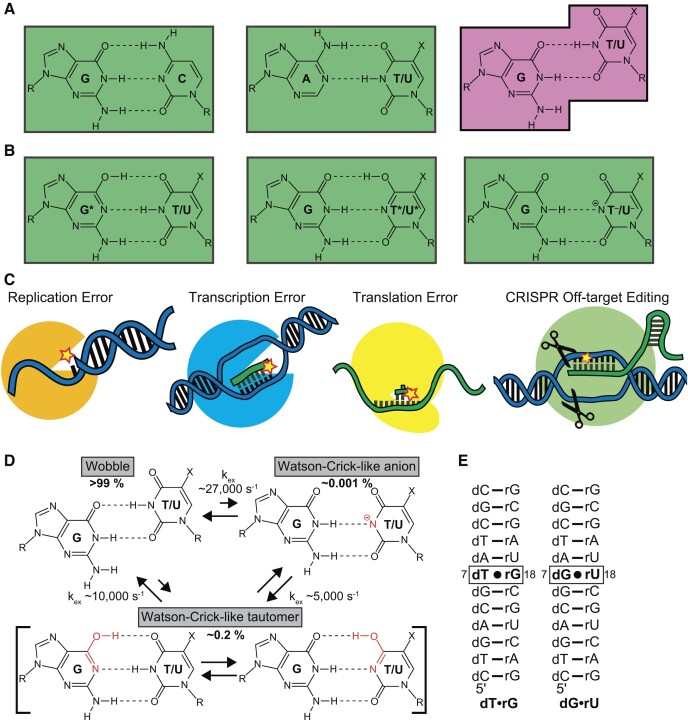 Figure 1
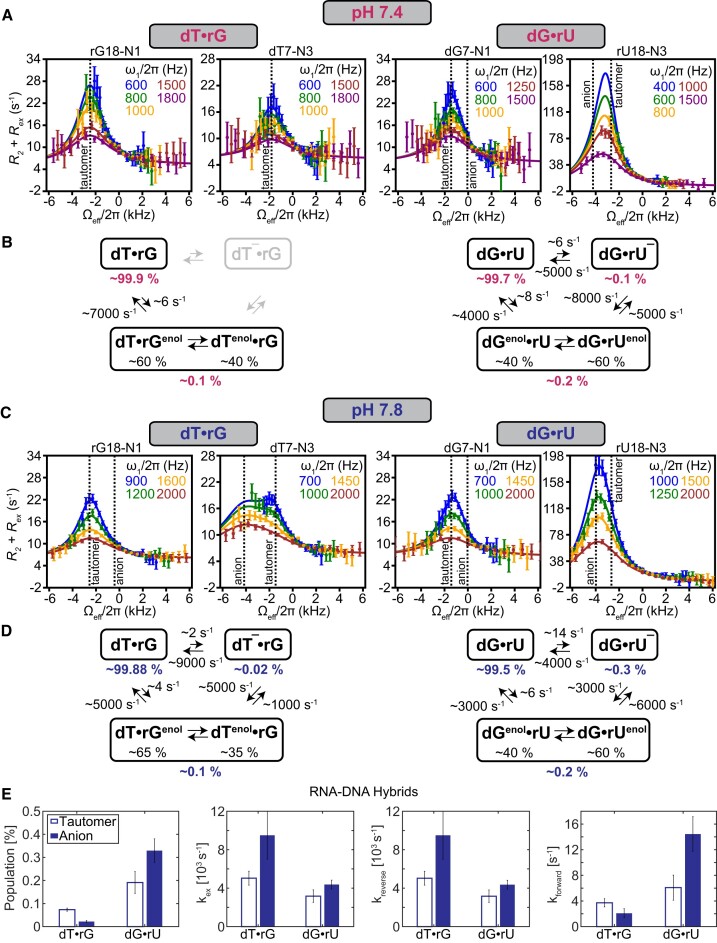 Figure 2
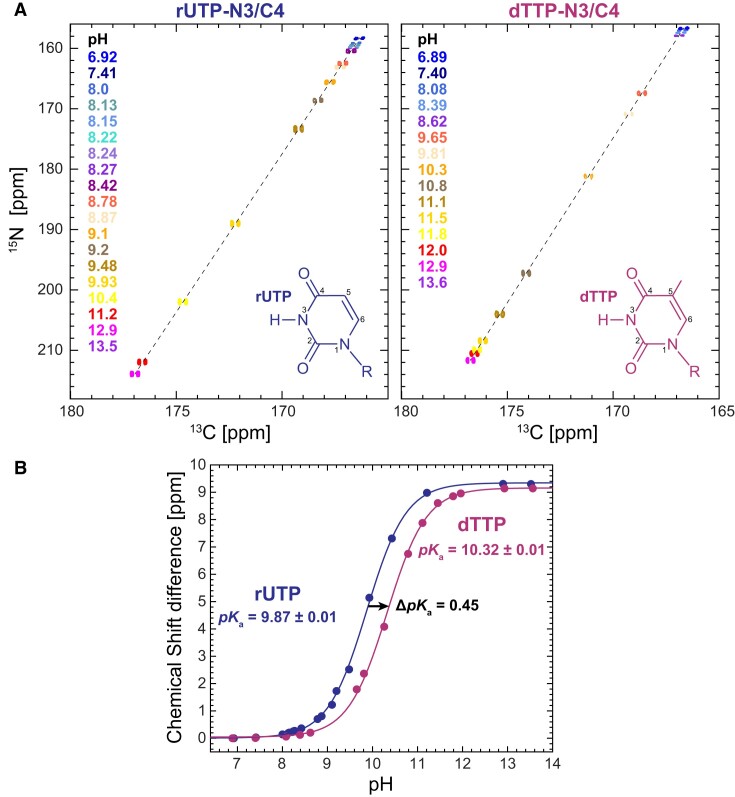 Figure 3
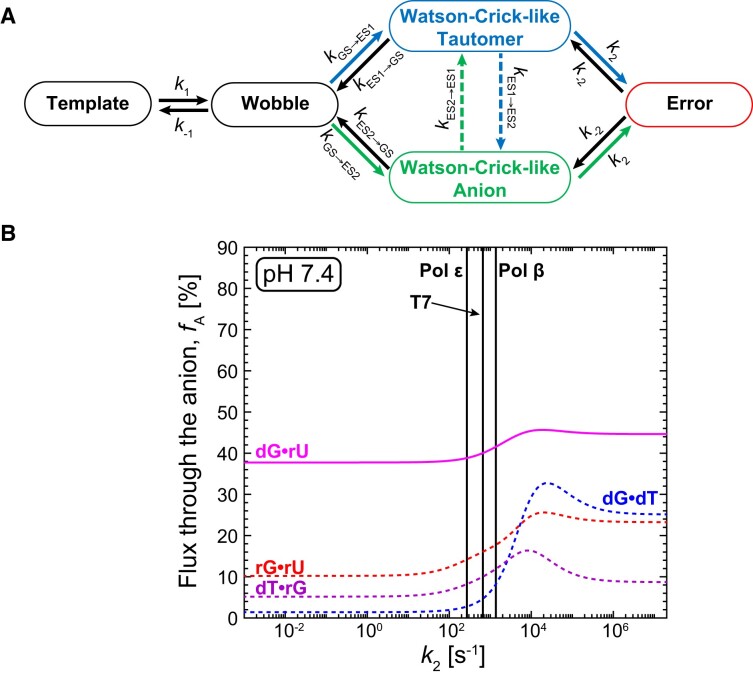 Figure 4
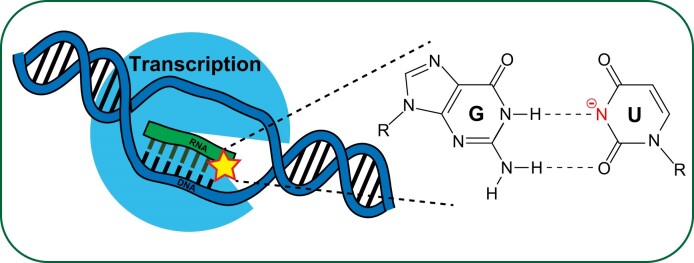 Figure 5
Peer Reviews
No public reviews on file for this paper yet. If you reviewed it on a platform where reviews are public (OpenReview, ICLR, NeurIPS, ICML), you can paste yours below so the community can read it here.
Videos
No videos yet. Explain this paper in a talk, walkthrough, or lecture? Add one.
Taxonomy
TopicsRadio, Podcasts, and Digital Media · Media and Digital Communication