Chaotic Zeeman effect: a fractional diffusion-like approch
Octavian Postavaru, Mariana M. Stanescu

TL;DR
This paper shows how fractional calculus can explain the chaotic Zeeman effect in quantum systems, linking it to the angle between magnetic fields.
Contribution
The paper introduces a novel fractional calculus approach to model the chaotic Zeeman effect and connects it to random matrix theory.
Findings
The chaotic Zeeman effect increases as the fractional coefficient α deviates from 1.
Non-Gaussian distributions are linked to non-stationary variables in this model.
A physical interpretation of the phenomenon is provided through the angle θ between magnetic fields.
Abstract
It is shown that the chaotic Zeeman effect of a quantum system can be formally viewed as a result of fractional calculus. The fractional calculation brings into the equations the angle \documentclass[12pt]{minimal} \usepackage{amsmath} \usepackage{wasysym} \usepackage{amsfonts} \usepackage{amssymb} \usepackage{amsbsy} \usepackage{mathrsfs} \usepackage{upgreek} \setlength{\oddsidemargin}{-69pt} \begin{document}\end{document}θ formed between the internal and the external magnetic field applied to the atom. The further the fractional coefficient \documentclass[12pt]{minimal} \usepackage{amsmath} \usepackage{wasysym} \usepackage{amsfonts} \usepackage{amssymb} \usepackage{amsbsy} \usepackage{mathrsfs} \usepackage{upgreek} \setlength{\oddsidemargin}{-69pt} \begin{document}\end{document}α is…
Genes, proteins, chemicals, diseases, species, mutations and cell lines named across the full text — each resolved to its canonical identifier and authoritative record.
Click any figure to enlarge with its caption.
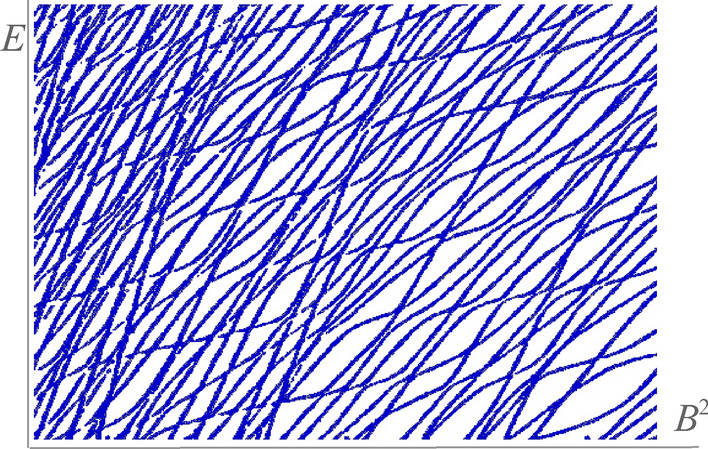 Figure 1
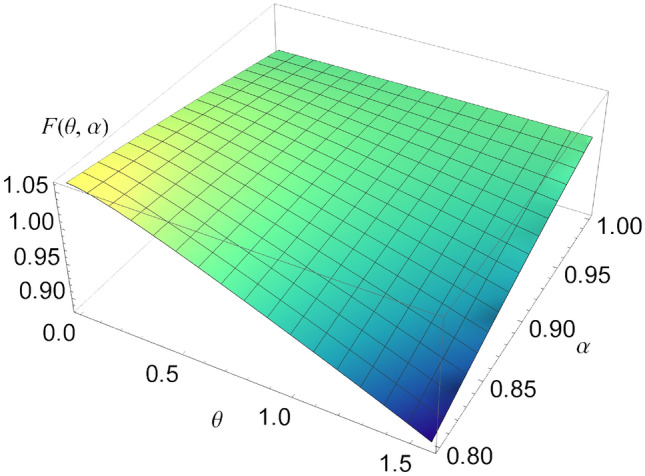 Figure 2
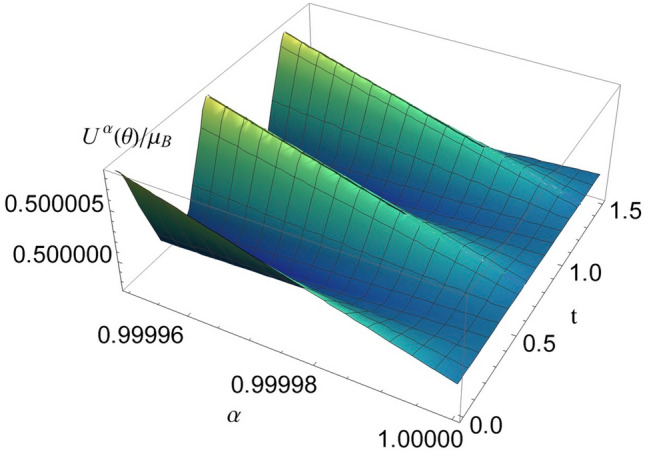 Figure 3
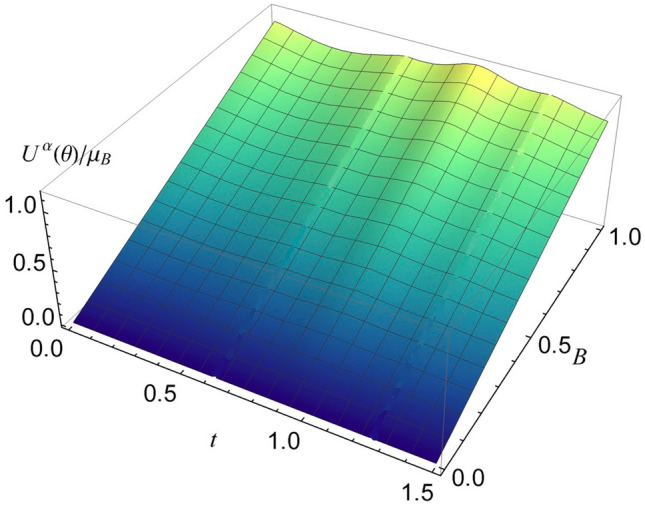 Figure 4
Peer Reviews
No public reviews on file for this paper yet. If you reviewed it on a platform where reviews are public (OpenReview, ICLR, NeurIPS, ICML), you can paste yours below so the community can read it here.
Videos
No videos yet. Explain this paper in a talk, walkthrough, or lecture? Add one.
Taxonomy
TopicsFractional Differential Equations Solutions · Statistical Mechanics and Entropy · Quantum chaos and dynamical systems