KaMRaT: a C++ toolkit for k-mer count matrix dimension reduction
Haoliang Xue, Mélina Gallopin, Camille Marchet, Ha N Nguyen, Yunfeng Wang, Antoine Lainé, Chloé Bessiere, Daniel Gautheret

TL;DR
KaMRaT is a C++ toolkit for analyzing RNA-seq data to find sequences that are specific to certain conditions or differentially expressed.
Contribution
KaMRaT introduces a new method for k-mer count matrix reduction in RNA-seq data without relying on gene annotations.
Findings
KaMRaT identifies differentially expressed sequences using k-mer count statistics.
The toolkit merges overlapping k-mers into contigs for improved analysis.
It enables sample-specific k-mer selection based on occurrence patterns.
Abstract
KaMRaT is designed for processing large k-mer count tables derived from multi-sample, RNA-seq data. Its primary objective is to identify condition-specific or differentially expressed sequences, regardless of gene or transcript annotation. KaMRaT is implemented in C++. Major functions include scoring k-mers based on count statistics, merging overlapping k-mers into contigs and selecting k-mers based on their occurrence across specific samples. Source code and documentation are available via https://github.com/Transipedia/KaMRaT.
Genes, proteins, chemicals, diseases, species, mutations and cell lines named across the full text — each resolved to its canonical identifier and authoritative record.
Click any figure to enlarge with its caption.
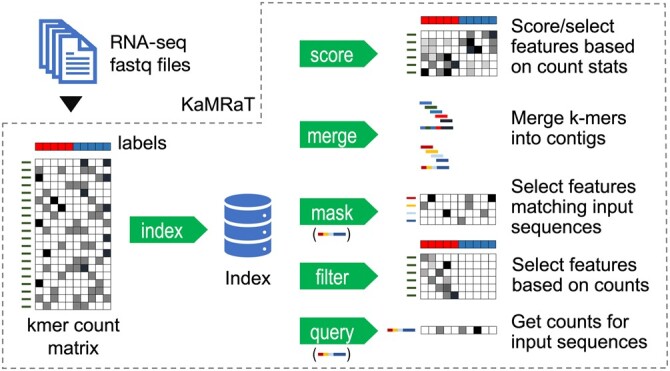 Figure 1
Peer Reviews
No public reviews on file for this paper yet. If you reviewed it on a platform where reviews are public (OpenReview, ICLR, NeurIPS, ICML), you can paste yours below so the community can read it here.
Videos
No videos yet. Explain this paper in a talk, walkthrough, or lecture? Add one.
Taxonomy
TopicsGene expression and cancer classification · Bioinformatics and Genomic Networks · Genomics and Phylogenetic Studies