A Case Report of Mycosis Fungoides Presenting With Blister Formation
Hirofumi Kawamoto, Natsuko Saito-Sasaki, Yumiko Sakuragi, Yu Sawada

TL;DR
A 40-year-old man with mycosis fungoides showed blistering as an early symptom, which led to a delayed diagnosis and partial response to treatment.
Contribution
This case report highlights blister formation as a rare early sign of mycosis fungoides, aiding in earlier detection.
Findings
Blistering was observed as a rare precursor symptom in a patient with mycosis fungoides.
The patient showed partial response to A-CHP therapy combined with brentuximab vedotin.
Early recognition of blistering may improve diagnosis and management of MF.
Abstract
Mycosis fungoides (MF) is the most common primary cutaneous T-cell lymphoma with a usually indolent course. Early detection is crucial for effective intervention. We present a case of a 40-year-old male with MF exhibiting blistering as a rare precursor symptom. Despite initial treatment for eczema, the condition worsened over 10 months, leading to erythema, edema, and enlarged lymph nodes. Laboratory and imaging findings confirmed the diagnosis of MF. The patient responded partially to cyclophosphamide/doxorubicin/prednisone in combination with brentuximab vedotin (A-CHP) therapy. This case highlights the significance of recognizing blistering as a prodromal symptom for early detection and management of MF.
Genes, proteins, chemicals, diseases, species, mutations and cell lines named across the full text — each resolved to its canonical identifier and authoritative record.
Click any figure to enlarge with its caption.
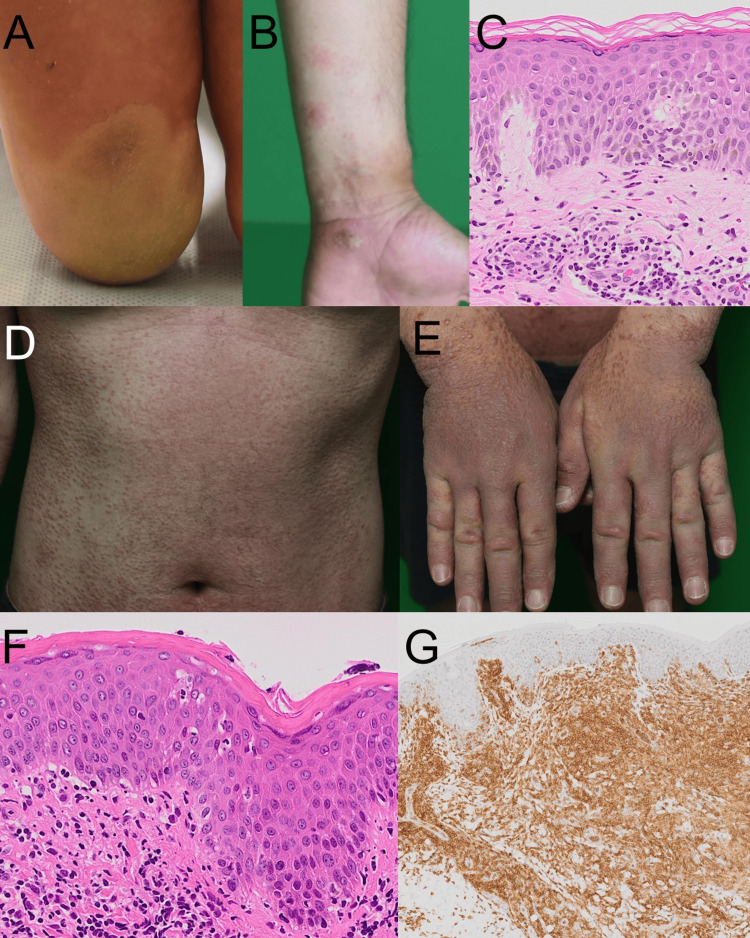 Figure 1
Peer Reviews
No public reviews on file for this paper yet. If you reviewed it on a platform where reviews are public (OpenReview, ICLR, NeurIPS, ICML), you can paste yours below so the community can read it here.
Videos
No videos yet. Explain this paper in a talk, walkthrough, or lecture? Add one.
Taxonomy
TopicsCutaneous lymphoproliferative disorders research · Lymphoma Diagnosis and Treatment · T-cell and Retrovirus Studies