Presence of active AKT in the nucleus upon adipocyte differentiation of 3T3-L1 cells
Marianne Goris, Rhîan G. Jacobsen, Aurélia E. Lewis

TL;DR
The study shows that active AKT is present in the nucleus during fat cell development, suggesting it plays a key role in this process.
Contribution
The study demonstrates for the first time that endogenous active AKT is present in the nucleus during adipogenesis.
Findings
Active AKT phosphorylated at Ser-473 increases rapidly after differentiation induction in 3T3-L1 cells.
Elevated active AKT levels are maintained in both cytoplasm and nucleus during adipogenesis.
Nuclear AKT is suggested to play an important role in adipocyte differentiation.
Abstract
AKT is an essential player in the phosphoinositide 3-kinase (PI3K) signalling pathway. Although the mechanisms of its action are well understood at the plasma membrane, AKT can also be found in the nucleus. In adipocytes, this pathway is activated during the process of adipogenesis and solicits both plasma membrane and nuclear AKT activity. However, the endogenous presence of active AKT in the nucleus during adipogenesis has not been shown. Here, we show that the levels of active AKT phosphorylated at Ser-473 increase rapidly after the induction of differentiation in 3T3-L1 cells, both in the cytoplasm and in the nucleus, and tend to remain elevated over the course of differentiation. In conclusion, these results support the notion that nuclear AKT plays an important role in this process.
Genes, proteins, chemicals, diseases, species, mutations and cell lines named across the full text — each resolved to its canonical identifier and authoritative record.
Click any figure to enlarge with its caption.
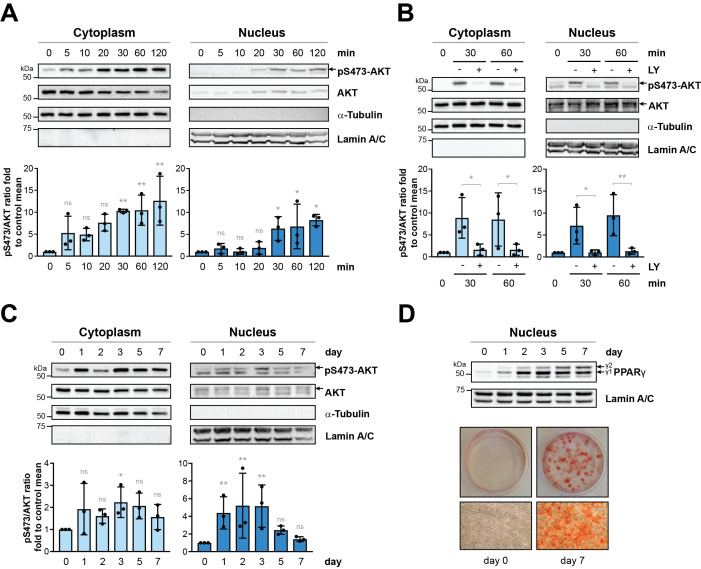 Figure 1
Peer Reviews
No public reviews on file for this paper yet. If you reviewed it on a platform where reviews are public (OpenReview, ICLR, NeurIPS, ICML), you can paste yours below so the community can read it here.
Videos
No videos yet. Explain this paper in a talk, walkthrough, or lecture? Add one.
Taxonomy
TopicsPI3K/AKT/mTOR signaling in cancer · Biochemical and Molecular Research · Protein Degradation and Inhibitors