Endoscopic ultrasound-guided pancreatic duct drainage with a two-step puncture technique for a non-dilated pancreatic duct
Shunsuke Horitani, Masaaki Shimatani, Masataka Kano, Toshiyuki Mitsuyama, Tsukasa Ikeura, Shuntaro Mukai, Takao Itoi

Abstract
Genes, proteins, chemicals, diseases, species, mutations and cell lines named across the full text — each resolved to its canonical identifier and authoritative record.
Click any figure to enlarge with its caption.
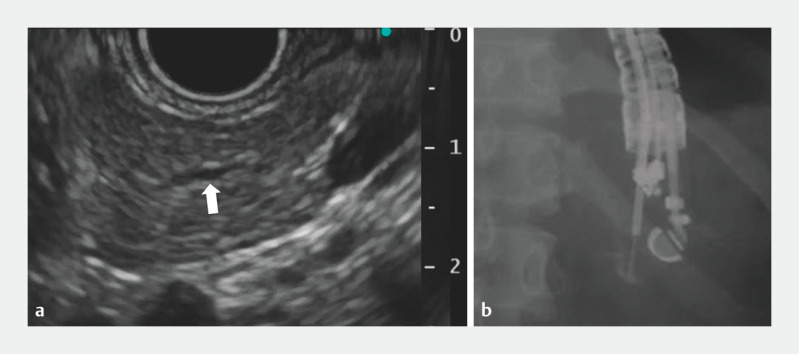 Fig. 1
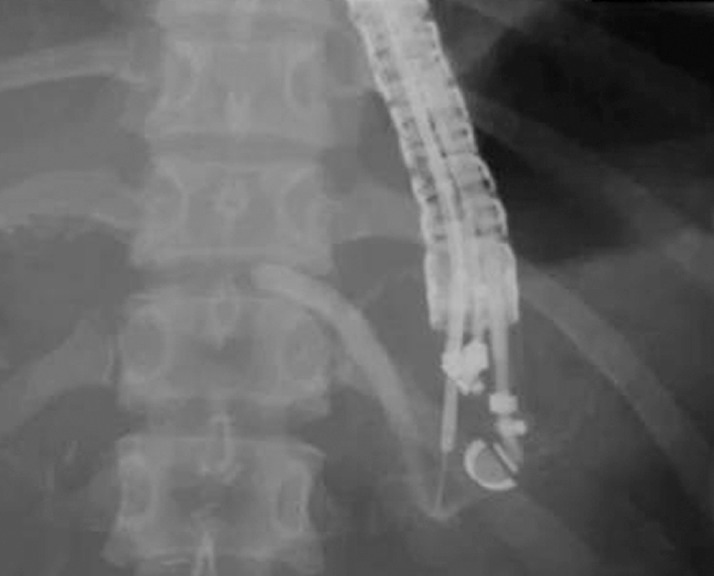 Fig. 2
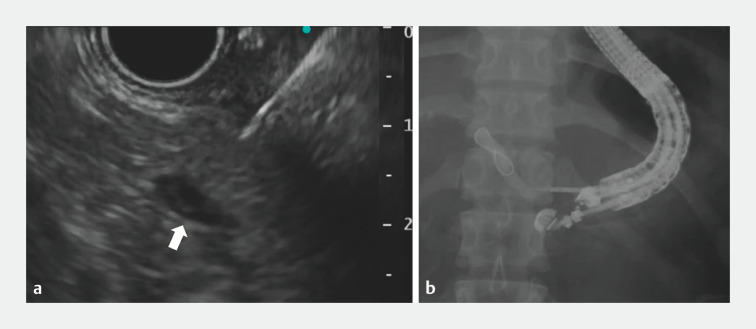 Fig. 3
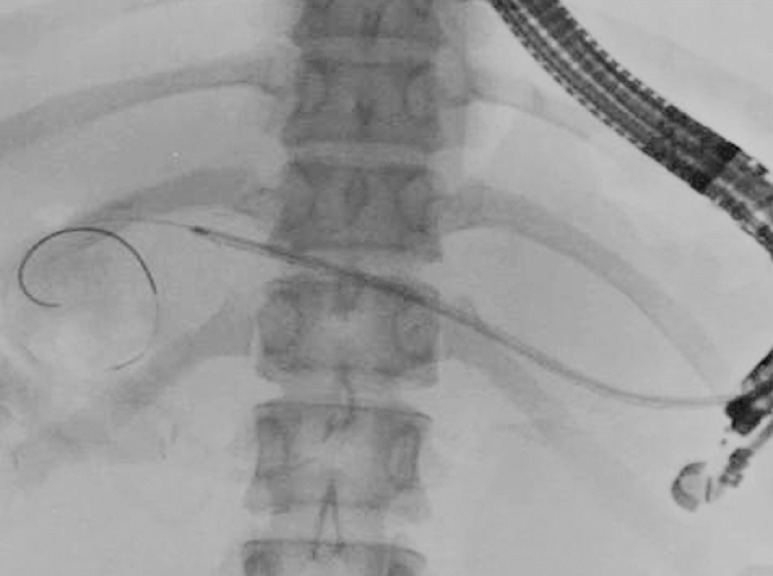 Fig. 4
Peer Reviews
No public reviews on file for this paper yet. If you reviewed it on a platform where reviews are public (OpenReview, ICLR, NeurIPS, ICML), you can paste yours below so the community can read it here.
Videos
No videos yet. Explain this paper in a talk, walkthrough, or lecture? Add one.
Taxonomy
TopicsPancreatitis Pathology and Treatment · Pancreatic and Hepatic Oncology Research · Pediatric Hepatobiliary Diseases and Treatments
Endoscopic ultrasound-guided pancreatic duct drainage (EUS-PD) has emerged as an option in patients with failure of standard transpapillary endoscopic retrograde access to the pancreatic duct (PD) or surgically altered anatomy 1 . The ductal pressure of a non-dilated PD is often low and the duct can be easily compressed by the tip of the needle, thus requiring a technical tip to handle this situation 2 . We describe successful EUS-PD with a two-step puncture technique for a non-dilated PD after pancreaticoduodenectomy as a result of solid pseudopapillary neoplasm ( Video 1 ).
Endoscopic ultrasound-guided pancreatic duct drainage with two-step puncture technique for a non-dilated pancreatic duct was achieved. This method is effective for draining a non-dilated pancreatic duct.Video 1
An 18-year-old woman was referred to our hospital because of gradual PD dilatation after pancreaticoduodenectomy. A double-balloon endoscopy was performed but failed to detect the pancreatic-jejunal anastomosis. Subsequently, EUS-PD was performed. A convex ultrasound gastrovideoscope (GF-UCT260; Olympus, Tokyo, Japan) was used to puncture from the gastric stomach to the caudal PD with a 22-gauge EUS-guided fine-needle (EZ Shot 3 Plus, Olympus). EUS and fluoroscopy both revealed a 2-mm non-dilated PD ( Fig. 1 a , b ), but an 0.018-inch guidewire (Fielder, Olympus) could not be advanced into the non-dilated PD. Therefore, contrast injection was continued to temporarily increase the ductal pressure and dilate the PD ( Fig. 2 ). The dilated PD facilitated subsequent re-puncture by a fine needle and allowed the guidewire to proceed into the PD ( Fig. 3 a , b ). Then the puncture tract was dilated using a 7 Fr drill dilator (Tornus ES, Olympus). After dilation of the tract, an MTW catheter (ABIS, Tokyo, Japan) was inserted into the PD. An 0.025-inch guidewire was advanced through the PJA. Then the PJA was dilated with a 3-mm diameter balloon catheter (REN, Kaneka Medix, Osaka, Japan). Finally, a 15-cm 7 Fr plastic stent (TYPE-IT; Gadelius Medical K.K., Tokyo, Japan) was placed from the jejunum to the stomach through the PD ( Fig. 4 ). No complications were observed after the procedure.
a Endoscopic ultrasound revealed a 2-mm non-dilated pancreatic duct (arrow). b Contrast injection showing pancreatogram.
The pancreatic duct was dilated by the continuous injection of contrast medium.
a The dilatation of the pancreatic duct by contrast injection (arrow) facilitated re-puncture by the fine-needle. b The guidewire could be advanced into the pancreatic duct
A plastic stent was placed from the jejunum to the stomach through the pancreatic duct.
EUS-PD with a two-step puncture technique is effective for draining a non-dilated PD.
Endoscopy_UCTN_Code_TTT_1AS_2AI
The reference list from the paper itself. Each links out to its DOI / PubMed record.
- 1Tyberg A Sharaiha RZ Kedia PEUS-guided pancreatic drainage for pancreatic strictures after failed ERCP: a multicenter international collaborative study Gastrointest Endosc 20178516416910.1016/j.gie.2016.07.03027460387 · doi ↗ · pubmed ↗
- 2Nakai Y Technical tips for endoscopic ultrasound-guided pancreatic duct access and drainage Int J Gastrointest Interv 20209154159