Case report: A novel variant (H49N) in Myelin Protein Zero gene is responsible for a patient with Charcot–Marie–Tooth disease
Gao-Hui Cao, Mei-Fang Zhao, Yi Dong, Liang-Liang Fan, Yi-Hui Liu, Yao Deng, Lu-Lu Tang

TL;DR
A new genetic variant in the Myelin Protein Zero gene is linked to a rare form of Charcot–Marie–Tooth disease in a 52-year-old man.
Contribution
The study identifies a novel MPZ variant (H49N) associated with CMTDID, expanding the known genetic spectrum of the disease.
Findings
A novel MPZ variant (c.145C>A/p.His49Asn) was identified in a patient with CMTDID.
The variant is located at an evolutionarily conserved site of MPZ.
Bioinformatic analysis predicted the variant to be neutral despite its association with the disease.
Abstract
This report presents a case of Charcot–Marie–Tooth dominant intermediate D (CMTDID), a rare subtype of Charcot–Marie–Tooth disease, in a 52 years-old male patient. The patient exhibited mobility impairment, foot abnormalities (pes cavus), and calf muscle atrophy. Whole exome sequencing and Sanger sequencing suggested that a novel variant (NM_000530.8, c.145C>A/p.His49Asn) of MPZ may be the genetic lesion in the patient. The bioinformatic program predicted that the new variant (p.His49Asn), located at an evolutionarily conserved site of MPZ, was neutral. Our study expands the variant spectrum of MPZ and the number of identified CMTDID patients, contributing to a better understanding of the relationship between MPZ and CMTDID.
Genes, proteins, chemicals, diseases, species, mutations and cell lines named across the full text — each resolved to its canonical identifier and authoritative record.
Click any figure to enlarge with its caption.
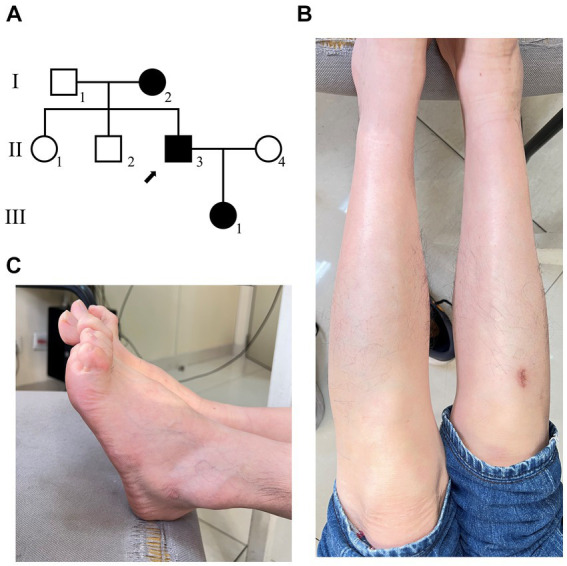 Figure 1
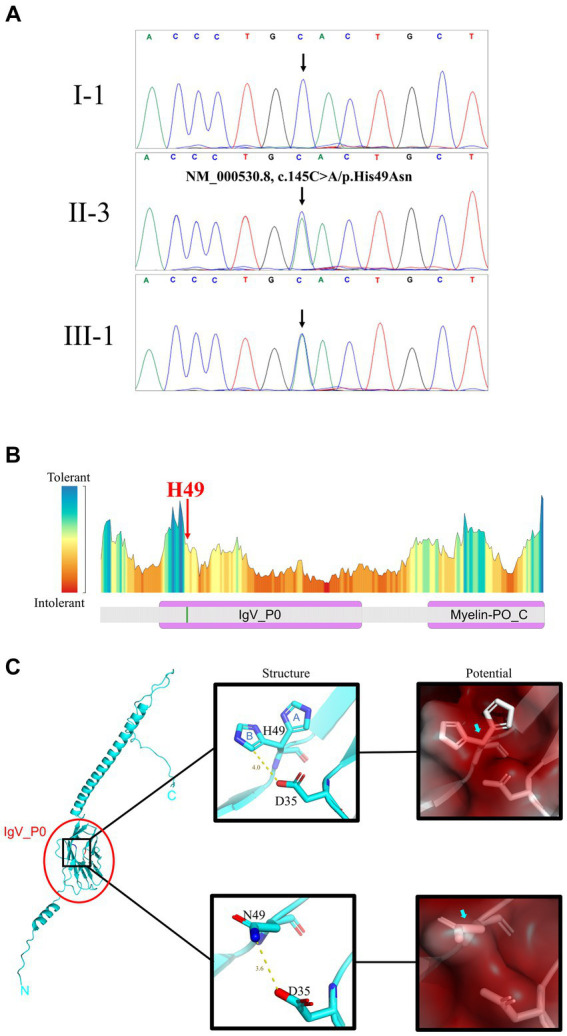 Figure 2
Peer Reviews
No public reviews on file for this paper yet. If you reviewed it on a platform where reviews are public (OpenReview, ICLR, NeurIPS, ICML), you can paste yours below so the community can read it here.
Videos
No videos yet. Explain this paper in a talk, walkthrough, or lecture? Add one.
Taxonomy
TopicsHereditary Neurological Disorders · Neurological diseases and metabolism · Hippo pathway signaling and YAP/TAZ