An Updated Overview of Magnetic Composites for Water Decontamination
Adelina-Gabriela Niculescu, Bogdan Mihaiescu, Dan Eduard Mihaiescu, Tony Hadibarata, Alexandru Mihai Grumezescu

TL;DR
This paper reviews recent advances in magnetic composites for cleaning contaminated water, focusing on their ability to efficiently remove harmful substances.
Contribution
The paper provides an updated overview of various magnetic composite materials and their effectiveness in water decontamination.
Findings
Magnetic composites offer easy removal from water solutions, making them efficient for decontamination.
Carbon-, polymer-, and hydrogel-based magnetic composites show high adsorption capacity for industrial pollutants.
Recent studies highlight the potential of biochar- and metal–organic framework-based composites in water treatment.
Abstract
Water contamination by harmful organic and inorganic compounds seriously burdens human health and aquatic life. A series of conventional water purification methods can be employed, yet they come with certain disadvantages, including resulting sludge or solid waste, incomplete treatment process, and high costs. To overcome these limitations, attention has been drawn to nanotechnology for fabricating better-performing adsorbents for contaminant removal. In particular, magnetic nanostructures hold promise for water decontamination applications, benefiting from easy removal from aqueous solutions. In this respect, numerous researchers worldwide have reported incorporating magnetic particles into many composite materials. Therefore, this review aims to present the newest advancements in the field of magnetic composites for water decontamination, describing the appealing properties of a…
Genes, proteins, chemicals, diseases, species, mutations and cell lines named across the full text — each resolved to its canonical identifier and authoritative record.
Click any figure to enlarge with its caption.
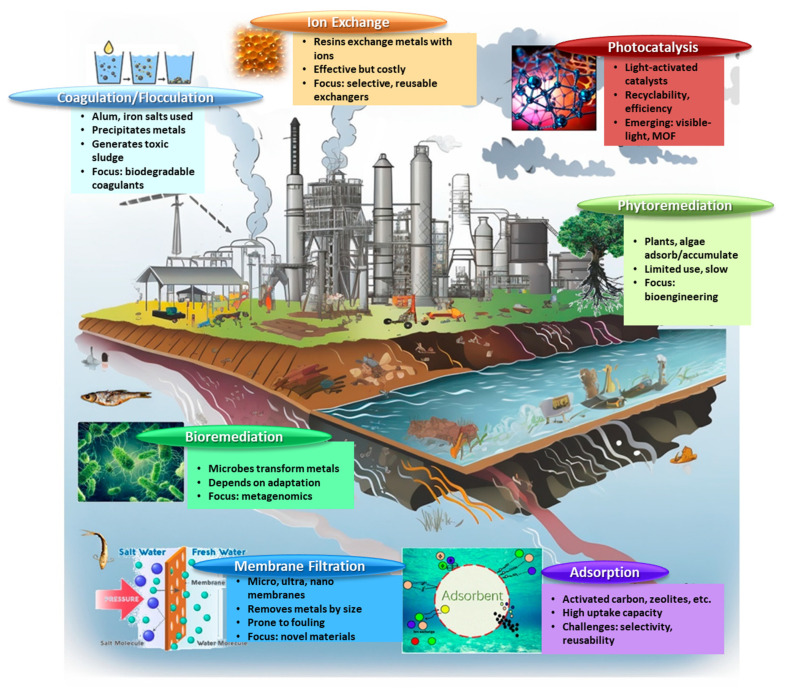 Figure 1
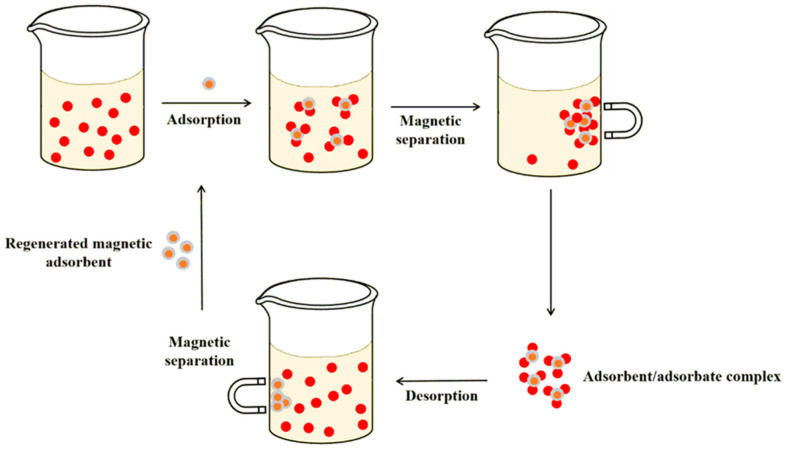 Figure 2
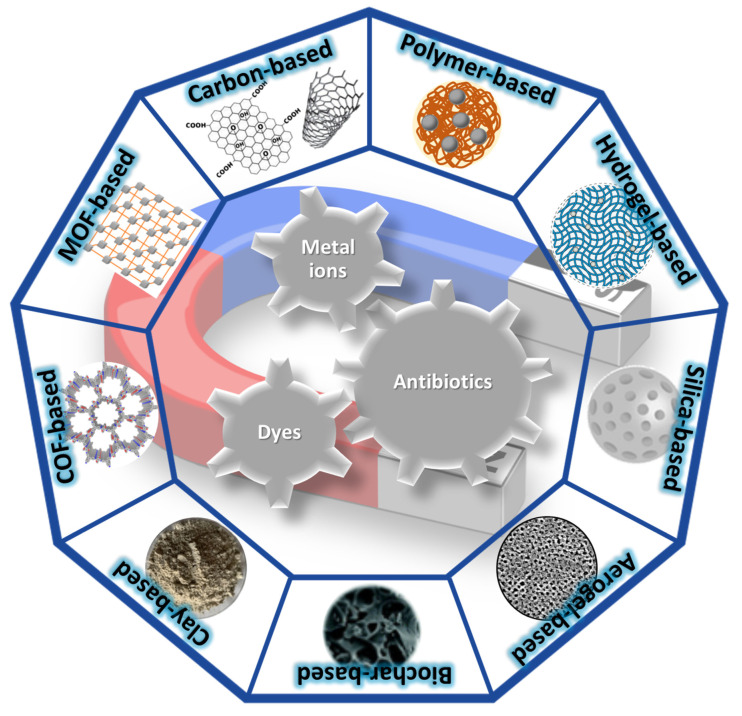 Figure 3
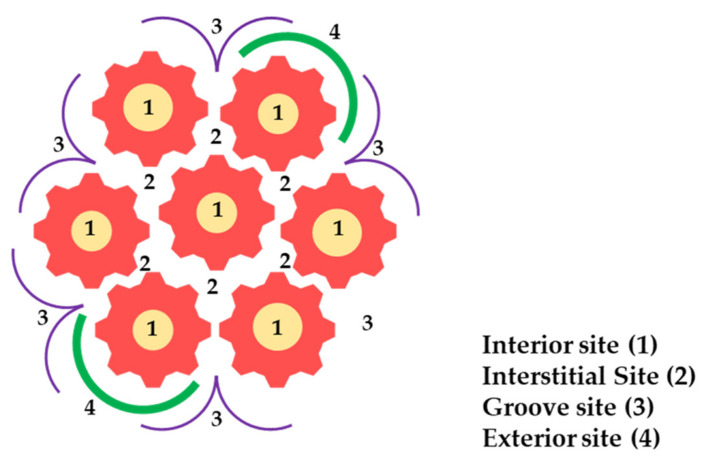 Figure 4
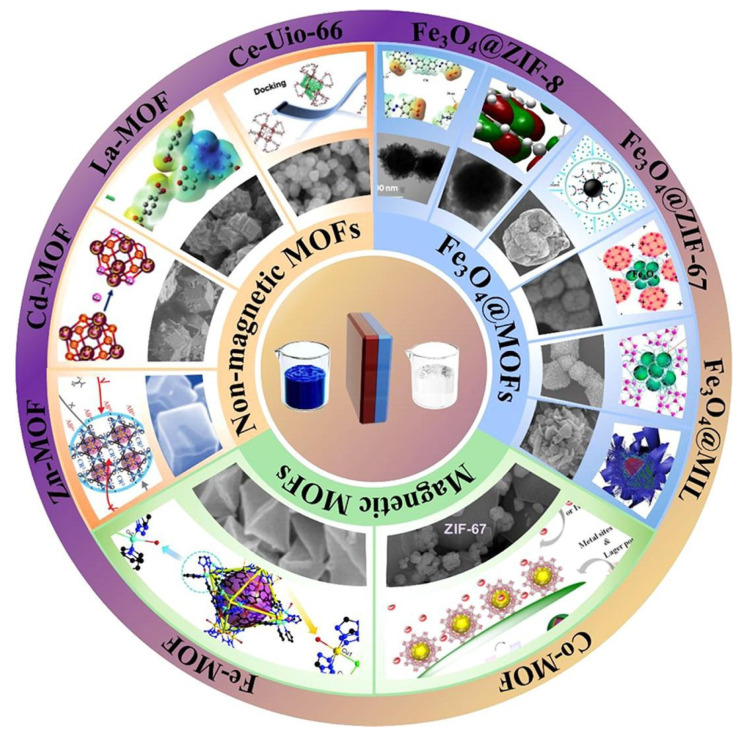 Figure 5
| Adsorbent | Surface Area | Magnetic Saturation | Pollutant | Adsorption Capacity | References |
|---|---|---|---|---|---|
| Carbon dot- and magnetite-modified magnetic CNTs | 184 | 5.6 | Carbamazepine | 65 | [ |
| Magnetic CNTs | - | - |
Metolachlor | 20.53 | [ |
| CNT-incorporated MIL-88B-Fe | 118.10 | - | Phenol | - | [ |
| Nickel nanoparticles encapsulated in porous carbon/CNT hybrids | 999 | 3.66 |
Malachite green |
898 | [ |
| Nickel nanoparticle-decorated graphene oxide CNTs | 71.7 | - | Rhodamine B | 41.5 | [ |
| Magnetic CNT-reduced graphene oxide–silver nanocomposite | - | 6.8 |
Methylene blue | - | [ |
| CNTs/Fe@C hybrids | 186.3 | 3.64 |
Methylene blue |
132.58 | [ |
| Magnetic multiwalled CNT | 108.1 | - | Patent blue V | - | [ |
| Magnetic nanocomposite cobalt multiwalled CNT | 87.1457 | - | Methylene blue | 324.34 | [ |
| N-doped bamboo-like CNT encapsulated with Fe nanoparticles supported by biochar |
194.8 at 700 °C, | - | Rhodamine B | - | [ |
| Core–shell ZIF-67/ZIF-8-derived sea urchin-like cobalt/nitrogen Co-doped CNT hollow frameworks | 269.79 | 41.88 |
Methyl blue |
8862.5 | [ |
| Graphene-templated zeolite-imidazolate framework (ZIF-67) derived, Co nanoparticle embedded, nitrogen-doped CNT | 389 | - | Reactive black 5 | - | [ |
| Magnetic fluorinated CNT | - | 47.7 |
Perfluoroalkyl carboxylic acids | - | [ |
| Magnetic titanium nanotube–CNT nanocomposite | 574.1 | 25.55 | Bisphenol A | - | [ |
| Aminated MIL-53(Al)-functionalized CNT | 811 | - |
Bisphenol AF |
274 | [ |
| Magnetic and N-doped CNT with cobalt encapsulation | 125.5 | 1.61 | Oxalic acid | 5 | [ |
| Multiwalled CNT-functionalized MIL-53(Fe) | 60.17 | - |
Tetracycline hydrochloride |
364.37 | [ |
| Multiwalled CNT–amino-functionalized MIL-53(Fe) composites | - | - |
Tetracycline hydrochloride |
368.49 | [ |
| MIL-100(Fe)-CNT | 1228 | - | Oxytetracycline | 429 | [ |
| Magnetic nanomaterial of surface oxidized nano-cobalt wrapped by nitrogen-doped CNTs | 243.63–277.62 | 4.64 |
Tetracycline |
679.56 | [ |
| Nitrogen-doped CNTs with encapsulated Fe3C nanoparticles | - | 12.6 | Sulfamethoxazole | - | [ |
| Metal–organic framework ZIF-8/magnetic multiwalled CNTs | 127.95 | 53.56 | Profenofos |
3.89 | [ |
| Iron-loaded CNT microfibrous composite | - | - | M-cresol | - | [ |
| Magnetic nitrogen-doped CNT cages | - | - | Okadaic acid | 897.8 µg g−1 | [ |
| Amino-functionalized multiwalled CNTs embedded with magnetic nanoparticles | 202.4 | - | Methylene blue | 178.5 | [ |
| Magnetic CNT–TiO2 composite | - | - | Carbamazepine and Sulfamethoxazole | 1.4 | [ |
| Magnetic CNT composites | - | 35.8 | Methylene blue | - | [ |
| Maghemite nanocrystals decorated multiwalled CNTs | - | - | Methylene blue | 59.4 | [ |
| Magnetic multiwalled CNTs | - | - | Crystal violet |
287 | [ |
| Magnetite/multiwalled CNTs | - | 51.144 | Reactive violet 2 | 52.356 | [ |
| Polyethyleneimine (PEI)-functionalized magnetic CNTs | 127.93 | 27.3 | Alizarin Red S | 196.08 | [ |
| Magnetic multiwalled CNTs modified with chitosan biopolymers | - | - | Bisphenol A | 46.2 | [ |
| Polydopamine-coated Fe3O4 nanoparticles with multiwalled CNTs | - | 37.96 |
Phenytoin | - | [ |
| Magnetic multitemplate molecularly imprinted polymer@MWCNTs | - | 25.6 |
Diethyl phthalate |
1.38 | [ |
| Magnetic single-wall CNTs | - | - | Diclofenac | [ | |
| Oxidized multiwalled CNT-Fe3O4 | 169.0 | - | Diquatdibromide herbicide | 20.9 | [ |
| Oxidized multiwalled CNT–κ-carrageenan–Fe3O4 | 142.2 | - | Diquatdibromide herbicide | 10.7 | [ |
| Magnetic multiwalled CNTs modified with polyaluminum chloride | 215.90 | 7.98 | Humic acid | - | [ |
| Multiwalled carbon nanotube-modified magnetic polyamidoamine dendrimers | - | 47.71 | Heterocyclic aromatic hydrocarbons | - | [ |
| Single-wall CNTs and magnetic nanoparticles | 284.21 | - | Toluene | 49.8 | [ |
| Magnetic multiwalled CNTs/cerium dioxide nanocomposite | - | 8.22 | Methylene blue | [ | |
| Multiwalled CNT-based Fe3O4 | - | - | Maxilon Blue 5G | - | [ |
| Multiwalled CNT–NiFe2O4 composite | - | 33.1 | Sulfamethoxazole | - | [ |
| Cobalt ferrite–CNT nanocomposites | - | 56 | Methylene blue | 8.5178 | [ |
| NiFe2O4/MWCNTs/ZnO hybrid nanocomposite | - | 17.021 | Methylene blue | - | [ |
| Nitrogen-doped CNTs encapsulated with Ni–Co alloy nanoparticles |
445.6 at 700 °C | - |
Methylene blue | - | [ |
| Co0·5Ni0·5FeCrO4 spinel nanoparticles decorated with UiO-66-based metal–organic frameworks grafted onto GO and oxidized SWCNT | - | - | 4-Nitrophenol | - | [ |
| Ag-Fe3O4-CNT composite | 375 | - |
O-nitro phenol | - | [ |
| Iron manganese oxide-modified multiwalled CNT | 211.3 | - |
Basic violet |
165.29 | [ |
| Zn@Cu–Fe2O4–NC–CNT | - | 36.14 | Azure-II | 50.25 | [ |
| CNT/MgO/CuFe2O4 magnetic composite powder | 127.58 | 12.137 |
Methyl violet |
36.46 | [ |
| Co0.5Ni0.5Fe2O4 NPs grafted onto CNTs | 142.93 | - |
Methylene blue |
88.05 | [ |
| Pd–Fe dual-metal nanoparticles anchored in an interface of double-layered carbon nanotubes/nitrogen-doped carbon | 163 | - | 4-Nitrophenol | - | [ |
| Graphene oxide/multiwalled carbon nanotube/Fe3O4/SiO2 | 79.7, | - |
Paracetamol | - | [ |
| Magnetite/multiwalled carbon nanotubes/metal–organic framework composite | - | 21 |
Esters | - | [ |
| CNT–FeNi3/DFNS/Cu(II) magnetic nanocomposite | 341 | 19.7 | Tetracycline | - | [ |
| Fe–Cu-doped multiwalled carbon nanotubes | 237.8–323.5 | - | Paracetamol | - | [ |
| Nitrogen-doped carbon nanotubes encapsulating Fe/Zn nanoparticles | - | - | Sulfamethoxazole | - | [ |
| CNT-COOH/MnO2/Fe3O4 nanocomposite | 114.2 | 0.46 |
Paracetamol |
80.645 | [ |
| Co0.5Mn0.5Fe2O4-CNT | 108.20 | 0.61 | Pentachlorophenol | 43.2 | [ |
| Co0.5Ni0.5Fe2O4-CNT | 95.52 | 0.61 | Pentachlorophenol | 40.8 | [ |
| Co0.5Cu0.5Fe2O4-CNT | 112.04 | 0.42 | Pentachlorophenol | 35.1 | [ |
| Co0.5Zn0.5Fe2O4-CNT | 96.05 | 0.40 | Pentachlorophenol | 33.9 | [ |
| Nitrogen-doped carbon nanotubes modified with magnetic Co0.5Cu0.5Fe2O4 nanoparticles | 85.04–95.64 | 0.415 | Chlorophenol | - | [ |
| Bi2O2CO3/CNT/ZnFe2O4 | - | 25 | 2,4-Dimethyl phenol | - | [ |
| Fe-doped graphitic carbon nitride coupled Ag3VO4 compounded with CNTs | - | - | 2,4-Dimethyl phenol | - | [ |
| FeOx/MnOy-modified oxidized CNTs | 133–140 | - | Rhodamine B | - | [ |
| CNTs/β-cyclodextrin/MnFe2O4 | 166 | 25.706 | Tetracycline | 40.36 | [ |
| Adsorbent | Surface Area | Magnetic Saturation | Pollutant | Adsorption Capacity | References |
|---|---|---|---|---|---|
| Polyoxometalate/CoFe2O4/metal–organic framework magnetic core–shell nanocomposites | 799.56 | 13.7 | Rhodamine B | 153.84 | [ |
| Composite based on metal–organic frameworks and Fe3O4 nanoparticles | - | 30.1 | Anthracene | 12.7 | [ |
| Composite material graphene oxide/MIL-101(Fe) | 888.29 | - | Methyl orange | 186.20 | [ |
| Ag NPs supported on the magnetic Al-MOF/PDA | 54.31 | 26.62 | Ciprofloxacin | - | [ |
| Ce-MOF@Fe3O4@activated carbon composite | - | 21.39 | Methylene blue | 84.9 | [ |
| Magnetic nanocomposite based on Zn/Fe-MIL-88B | 186–216 | - | Chlortetracycline | 11.7–359.2 | [ |
| Magnetic Fe3O4-PSS@ZIF-67 composites with core–shell structure | 1041.90 | - | Methyl orange | 738 | [ |
| Yolk-shell Fe3O4@MOF-5 nanocomposites | 203 | 46.57 | Methylene blue | - | [ |
| La-MOF-NH2@Fe3O4 | 36.1 | 15.54 | Congo Red | 716.2 | [ |
| Superparamagnetic MOF@GO Co-based hybrid nanocomposite | 71.47 | 56.4 | Methylene blue | 67 | [ |
| Superparamagnetic MOF@GO Ni-based hybrid nanocomposite | - | 47.0 | Methylene blue | 54 | [ |
| Fe3O4 NPs incorporated into the zeolitic imidazolate framework lattice (Fe3O4@ZIF-8) | 1206 | 37.87 | Methylene blue | - | [ |
| PPI–Dendrimer-Functionalized Magnetic MOF (Fe3O4@UiO-66@PPI) | 120 | 10.5 | AB92 | 122.5 | [ |
| Magnetically functionalized Zr-MOF (Fe3O4@MOF-525) | 427 | 7.48 | Tetracycline | 277 | [ |
| β-cyclodextrin-modified Fe3O4@MIL-100(Fe) composite | 2.60 | 9.40 | Fungicides | 64.52–102.10 | [ |
| Composites with a magnetic Fe3O4 core and a MIL-101 (Cr) MOF shell | 803 | 19.6 | Polyaromatic hydrocarbons | - | [ |
| Fe3O4/HKUST-1 magnetic copper-based MOFs | 327.9 | 44 | Ciprofloxacin | 538 | [ |
| Magnetic Fe3O4@ZIF-67 composites | - | 60.9 | Tetrabromobisphenol A | - | [ |
| Hydrophobic carboxyl-functionalized ionic liquid encapsulated into Fe3O4@Zr-MOFs | 685 | 48.8 | Ofloxacin | 438.5 | [ |
| Adsorbent | Surface Area | Magnetic Saturation | Pollutant | Adsorption Capacity | References |
|---|---|---|---|---|---|
| Zr-based magnetic metal–organic framework composite (Fe3O4@SiO2@UiO-66-Glu) | 633.5 | 17.40 | Co(II) | 178.6–270.3 | [ |
| Magnetic ZIF-67 MOF@aminated chitosan composite beads | 220.76 | 10.90 | Cr(VI) | 119.05 | [ |
| Magnetic Fe3O4@UiO-66 composite | 33.12 | 26.5 | As(V) | 73.2 | [ |
| Magnetic materials with functionalized titanium-based MOF composite (SNN-MIL-125(Ti)@Fe3O4) | 195.82 | 13.06 | Hg(II) | 511.4 | [ |
| Magnetic Zr-MOF named Ni0.6Fe2.4O4-UiO-66-PEI | 22 | 4.11 | Pb(II) | 273.2 | [ |
| Magnetic MOFs/graphene oxide (Fe3O4@HKUST-1/GO) | 72.23 | - | U(VI) | 202.84–268.82 | [ |
| Surfactant-functionalized magnetic MOF@MOF adsorbent (Fe3O4@UiO-66@UiO-67/CTAB) | 115.94 | 36.05 | Cr(VI) | 932.1 | [ |
| Fe3O4@metal–organic framework@covalent organic framework (Fe3O4@MOF@COF) | - | 16 | Cu(II) | 37.29 | [ |
| Citrate capped Fe3O4@UiO-66-NH2 MOF | 572.13 | 3.07 | Cr(VI) | 743 | [ |
| Fe3O4@ZIF-8 core–shell magnetic composite | 724.7 | 37.26 | Pb(II) | 714.7 | [ |
| Magnet-responsive Fe3O4@ZIF-8 | 896 | 27 | Cu(II) | 345 | [ |
| Magnetic Zr-MOF@polypyrrole (Fe3O4@UiO-66@Ppy) | 52.49 | 19.75 | Cr(VI) | 259.1 | [ |
| Multifunctional composite Fe3O4/MOF/L-cysteine | 413.67 | - | Cd(II) | 248.24 | [ |
| Fe3O4@DTIM-MOF@SH composite | 827 | 13 | Hg(II) | 756.9 | [ |
| Fe3O4@ZIF-8 composite | 1722 | 13.4 | Pb(II) | 276.06 | [ |
| Polyacrylic acid capped Fe3O4–Cu-MOF | 332.07 | - | Pb(II) | 610 | [ |
| Non-core–shell Fe3O4@ZIF-67 composites | - | - | Phosphate | 116.59 | [ |
| Adsorbent | Surface Area | Magnetic Saturation | Pollutant | Adsorption Capacity | References |
|---|---|---|---|---|---|
| Core–shell structured magnetic covalent organic framework nanocomposites | 55.71 | 48.4 | Triclosan | - | [ |
| Bouquet-shaped magnetic porous nanocomposite made of TpPa-1 grafted on surface-modified Fe3O4 nanoparticles | 247.8 | 40.1 | Polycyclic aromatic hydrocarbons | - | [ |
| Porous nanospheres with a magnetic core and a tunable TpBD shell | 272.6 | 22 | Bisphenol A | 160.6 | [ |
| Magnetic porous covalent triazine-based framework composites | 930–1149 | 1.1–5.9 | Methyl orange | 291 | [ |
| Magnetic covalent organic framework (TpPa-1) with β-ketoenamine linkage | 485.2 | 19.5 | Bisphenol A | 1220.97 | [ |
| Fe3O4 particles grown in the pore channels of COFs | 2245 | 5.2 | Diclofenac | 40.4 | [ |
| Fe0 nanoparticles immobilized on porous TpPa-1 covalent organic framework | 102.97 | - | Cr(VI) | 516 | [ |
| Bimetal oxide MnFe2O4 incorporated onto β-ketoenamine linked TpPa-1 | 152.5–450.5 | 11.52 | UO22+ | 1235.01 | [ |
| Magnetic covalent organic framework (TpPa-1) with β-ketoenamine linkage | 485.2 | 19.5 | Cr (VI) | 245.45 | [ |
| Magnetic organic framework adsorbent (Ni0.6Fe2.4O4-HT-COF) | - | 39.83 | Pb(II) | 411.80 | [ |
| Thiol-functionalized magnetic covalent organic frameworks | 181.5 | 19.6 | Hg(II) | 383 | [ |
| Fe3O4 decorated porous melamine-based covalent organic framework | 344–600 | 0.75–3.59 | Hg(II) | 97.65 | [ |
| Magnetic | 538.60 | 6.59 | Au(III) | 1737 | [ |
Peer Reviews
No public reviews on file for this paper yet. If you reviewed it on a platform where reviews are public (OpenReview, ICLR, NeurIPS, ICML), you can paste yours below so the community can read it here.
Videos
No videos yet. Explain this paper in a talk, walkthrough, or lecture? Add one.
Taxonomy
TopicsPlant Growth and Agriculture Techniques
1. Introduction
Only one percent of the water on Earth is usable freshwater, of which about 70% is used in agriculture and other commercial purposes. Over a billion people do not have access to clean freshwater, and this limited resource is becoming scarcer globally due to various factors, including population growth, climate change, deforestation, water pollution, and wasteful water use. Contaminated water by industrial pollutants and pathogens adversely affects human health and the environment. Freshwater contamination can arise from various sources, including sewage, agricultural waste, industrial waste, petroleum slicks, nuclear and thermal pollution, pesticides and fertilizers, the mining industry, and population growth and urbanization [1,2,3].
Latent sources of drinking water still exist in rivers, streams, lakes, and subterranean aquifers. Nonetheless, it is essential to remediate any water obtained from surface sources in order to protect against the risk of ingesting various contaminants [4]. Untreated wastewater often contains hazardous substances that may contaminate land or water where sewage is dumped [5]. Therefore, wastewater treatment and disposal are not only desirable but vital in the current global context.
The main treatment process carried out in wastewater treatment plants follows the standard process train: (i) preliminary treatment (involves screening and grit removal using physical methods and setting the stage for primary treatment); (ii) primary treatment (using sedimentation to reduce the organic load in wastewater); (iii) secondary treatment (employing biological methods such as activated sludge that is further treated or used); and (iv) tertiary treatment (encompasses advanced processes like filtration, chemical coagulation, flocculation, flotation, nutrient removal, adsorption, advanced oxidation processes (AOPs), ion exchange, membrane processes (reverse osmosis, nanofiltration, etc.), constructed wetlands, electrocoagulation, and disinfection) [6,7,8,9,10]. When it comes to wastewater, tertiary treatment (Figure 1) is the one referred to as water decontamination in most studies.
The effectiveness of conventional techniques (e.g., sedimentation, chemical precipitation, solvent extraction, ion exchange, and membrane separation) in eliminating heavy metals from water and wastewater is widely recognized. However, these techniques have certain drawbacks, including the need for expensive equipment, constant monitoring, a considerable volume of sludge or solid wastes, chemical reagents, and an incomplete treatment process [12]. Scientists worldwide have become increasingly interested in finding affordable and environmentally friendly methods of disinfecting water [13]. Particular attention has been drawn to adsorption, a method successfully employed for pollutant removal in water decontamination processes. This approach has an easy-to-understand design and functioning, and it is reasonably priced. Many materials, such as carbon-based materials, various synthetic porous composites, naturally occurring inorganic minerals like clay or zeolites, and functionalized natural and synthetic polymers, have been rendered effective at removing organic and inorganic contaminants from polluted water samples [12].
Recent advancements in nanotechnology can also be exploited for water decontamination applications, with a special focus on multifunctional nanomaterials made from nontoxic and cheap precursors. In particular, magnetic nanostructures hold promise for their use in the development of performant adsorbents of heavy metals and organic pollutants [12,13]. In this respect, the inclusion of intrinsic magnetic metal nanoparticles, such as iron, cobalt, and nickel, into various composites has been extensively explored in recent research [14]. When it comes to the separation and recovery of nanomaterials, magnetic separation is an eco-friendly option compared to filtration or centrifugation since it uses lower amounts of solvents and auxiliaries, takes less time to operate, and is more economical. Hence, magnetic adsorbents have emerged as a new class of materials for decontamination procedures [15]. Thus, numerous water decontamination studies have reported the successful utilization of magnetic nanoparticles in combination with a wide range of materials, extending the knowledge in the field and offering encouraging perspectives for environmental applications.
In this context, this paper aims to briefly present magnetic nanoparticles, providing evidence on their properties of interest for water decontamination applications, and further overviews the recent developments in magnetic composites for pollutant removal from aqueous samples. Several literature reviews have already been published in the field, encompassing certain aspects related to magnetic adsorbents for water depollution [16,17,18,19,20,21,22]. Nonetheless, they were either issued a few years ago or addressed only one category of composites/contaminants. Given the effervescence of the field, an updated, extensive perspective is needed to help researchers optimize current materials and implement better-performing magnetic adsorbents in real-life applications.
Thus, herein, a broader approach is adopted to present the most up-to-date literature with the newest advancements in this interdisciplinary domain. Specifically, the latest studies (published in the last 7 years) are included and comprehensively discussed in several sections according to the base material. Carbon-, polymer-, hydrogel-, silica-, aerogel-, biochar-, clay-, covalent organic framework-, and metal–organic framework-based magnetic composites are considered in this review. Moreover, recent studies corresponding to each category are tabulated, offering a clear image of their most important properties and utility in removing toxic metals, dyes, pesticides, drugs, oils, organic solvents, and other harmful compounds from contaminated water samples.
2. Magnetic Nanoparticles
In addition to established methods for remediating contaminated wastewater, novel approaches that employ magnet-sensitive materials are progressively gaining traction [23]. Integrating composite adsorbents with a magnetic component enables the facile separation of adsorbate complexes from aqueous solutions and easy regeneration and reuse of the material for future decontamination cycles by simply applying an external magnetic field [24] (Figure 2). In more detail, magnetic nanocomposites are dispersed in a sample solution to adsorb contaminants through specific interactions (e.g., electron transfer, chemical bond formation, van der Waals forces, electrostatic interactions, H bonds, and π–π bonds). After adsorption is accomplished, the magnetic material loaded with the captured pollutants is separated from the treated water with an external magnet. Then, with the aid of a desorption solvent, the contaminants are removed from the magnetic composites, and the adsorbent is regenerated (through chemical treatment) and can be used again for decontamination of other water samples. Hence, magnetic solid-phase extraction offers a simple, rapid, eco-friendly, and economical possibility for recycling magnetic composites involved in environmental purification [24,25,26,27].
The selection of magnetic material is a critical step in the magnetic separation process. Different types of magnetic particles have lately been produced, and they have shown considerable promise for separation in water treatment applications [28]. Fe, Ni, and Co are metals recognized for their appealing intrinsic magnetic properties [23]. Exploring their combined potential [29,30,31,32,33,34] or using them in association with different materials to develop valuable composites [35,36,37,38] have been established as promising solutions for water decontamination.
Additionally, different iron oxides have been considered in numerous studies. Particularly, magnetite (Fe_3_O_4_) and maghemite (γ-Fe_2_O_3_) have shown promise in their use for the development of advanced composite materials [23,39,40]. Both maghemite and magnetite have a spinel crystal structure, while the latter contains both divalent and trivalent iron cations. In maghemite, all iron cations are trivalent, and the presence of cation vacancies ensures the cell’s charge neutrality [41]. These iron oxides benefit from easy synthesis routes, eco-friendliness, and high saturation magnetization [15,42]. Magnetite is the most magnetic naturally occurring mineral, having an 84 emu/g saturation magnetization and small magnetic anisotropy at room temperature [41]. Moreover, magnetite nanoparticles exhibit thermal, chemical, and colloidal stability; dispersibility; and functionalization possibility—advantageous features that extend their versatility [42]. Other ferrites that showed good promise in environmental purification applications include barium hexaferrite (BaFe_12_O_19_; excellent electrical, magnetic, optical and photocatalytic properties; remarkable stability; and reusability) [43,44,45], strontium hexaferrite (SrFe_12_O_19_; high saturation magnetization, great stability, and excellent photocatalytic properties) [46], and lead hexaferrite (PbFe_12_O_19_; high saturation magnetization, coercivity, catalytic activity, and stability) [47,48].
Nonetheless, given their elevated surface energy, bare magnetic iron oxide nanoparticles are susceptible to coaggregation and oxidation/dissolution, particularly in acidic solutions. Their chemical stability can be compromised even under environmental conditions, constraining their potential for large-scale implementation. Therefore, improved solutions have been generated by using functionalized magnetic nanoparticles and magnetic nanocomposites, featuring novel surface properties and structures to address the shortcomings of magnetic nanoparticles, increase their number of active sites, enhance their stability in aqueous environments, and increase separation efficiency [15,39,42,49,50].
3. Magnetic Composites for Water Decontamination
Given the appealing properties of magnetic nanoparticles, numerous magnetic composite materials (Figure 3) have been developed with the purpose of providing performant water decontamination solutions. The illustrated categories of materials are detailed in subsequent subsections, including relevant examples of magnetic adsorbents from recent studies in the literature (published since 2018).
3.1. Carbon-Based Composites
Carbon structures are among the most studied materials due to their appealing properties, such as mechanical strength, chemical stability, anisotropy, and high conductivity [22]. Carbon-based materials, including activated carbon, carbon nanotubes, graphene oxide, graphitized carbon black, and porous carbon, have been used for pollutant adsorption. What renders them suitable for application in water decontamination processes is the versatility of their interactions with targeted pollutants, which can be electrostatic, hydrophobic, or π–π interactions [15].
Moreover, combining carbon nanostructures with magnetic nanoparticles leads to synergic composites with exceptional magnetic features [22]. Magnetic nanohybrids are particularly relevant due to their facile separation from aqueous samples after the adsorption of pollutants. In addition to the inherent benefits of magnetic separation (e.g., eco-friendliness, easy operation, and cost-effectiveness), this method facilitates magnetic carbon-based nanocomposite regeneration and reuse for several adsorption/desorption cycles of wastewater treatment [20,22].
Among carbon-based materials, carbon nanotubes (CNTs) have received the most scientific interest in recent years. Given their unique morphology, surface chemistry, and chemical and physical interactions with organic and inorganic compounds, CNTs have been extensively employed in water remediation processes. Thus, CNTs have surfaced as a profitable, efficient, and environmentally sustainable substitute for conventional water treatments, being involved in the elimination of a wide range of water contaminants [51]. Having numerous adsorption sites (Figure 4), CNTs exhibit the ability to remove both organic and inorganic pollutants from aqueous samples. Interstitial and groove sites initiate the adsorption process, which is followed by pollutant adsorption on exterior walls and the accumulation of captured molecules within interior channels [52]. Interstitial sites are particularly fitted for trapping small contaminants depending upon the form of the nanotube, whereas exterior sites and grooves present enough space for the adsorption of both inorganic and organic contaminants [53].
In recent years, CNTs have been investigated as promising solutions for heavy metal removal, and they have been confirmed as strong adsorbents for metal ion adsorption, including water decontamination from Ni^2+^, Sr^2+^, Pb^2+^, Zn^2+^, Cu^2+^, Cd^2+^, Co^2+^, and Cr^2+^ [53,54,55,56]. However, in comparison, much more extensive progress has been made lately in designing CNT-based adsorbents for organic pollutant removal, with numerous recent studies reporting the encouraging outcomes obtained when associating these carbon-based nanomaterials with magnetic components.
An impressive number of papers have revealed the potential of magnetic CNT-based composites in extracting organic dyes from aqueous samples, such as methylene blue [32,36,37,57,58,59,60,61,62,63,64,65,66,67], methyl orange [32,36,37,67], malachite green [36,59], Congo red [32,36], rhodamine B [32,36,63,68,69,70,71], crystal violet [63], acid fuchsin [59], neutral red [37], basic violet [72], azure II [73], acid orange [72], methyl violet [74], patent blue V [75], reactive black 5 [35], reactive violet 2 [76], Nile blue [74], alizarin red S [77], and Maxilon blue 5G [78]. Extensive research has also been carried out to verify the ability of magnetic CNT-based composites to remove drugs/active pharmaceutical ingredients from contaminated water, with encouraging studies being reported for the elimination of carbamazepine [79,80,81], ketoprofen [82], estriol [82], tetracycline and its derivatives [70,83,84,85,86,87], sulfamethoxazole [80,88,89,90], phenytoin [81], oxcarbazepine [81], diclofenac [91], caffeine [92], paracetamol [92,93,94], and ibuprofen [94]. Other organic substances that can be successfully removed from water with the use of magnetic CNT-based materials include herbicides (e.g., metolachlor [82], metribuzin [95], diquatdibromide [96]), insecticides (e.g., profenofos, triazophos, diazinon, phosalone, methidathion, ethoprop, sulfotep, and isazofos) [97], pesticides (e.g., pentachlorophenol) [33], agricultural nutrients (e.g., humic acid) [98], chemical intermediates used in industrial production (e.g., bisphenol A [82,99,100], bisphenol AF [95], perfluoroalkyl carboxylic acids [101], perfluoroalkyl sulfonic acids [101], toluene [102], m-cresol [103], esters [104], and phenol derivatives [57,67,105,106,107,108,109,110,111]), and ingredients from cosmetics (e.g., tonalide [82], triclosan [82], butylparaben [104], methylparaben [104], and phthalates [104,112]).
For a better presentation of the plethora of studies in the field, Table 1 summarizes the magnetic CNT-based composites, some of their relevant properties, and targeted organic pollutants.
Other highly exploited carbon-based materials are graphene and its derivatives, as they present certain appealing features (e.g., excellent mechanical properties, unique pore structure with large specific surface area, and ionic molecular sieving separation capabilities) [113]. Particularly, graphene oxide has attracted interest for its applications related to water decontamination, for both organic and inorganic pollutant removal. In combination with magnetic materials, graphene oxide adsorbents benefit from unique physicochemical characteristics, such as desirable magnetic features, surface active sites, tunable dimension morphology, ease of modification/functionalization, and enhanced chemical stability [15,114]. Adding these advantages to their affordability and magnetic separation possibility, magnetic graphene oxide-based composites have been investigated for the removal of many organic pollutants (e.g., dyes [65,115,116,117,118,119], drugs [120,121,122,123], and pesticides [124]) (Table 2) and heavy metals (e.g., Pb^2+^ [125,126,127,128,129,130], Cr^3+^ [127,129,131], Cr^6+^ [131,132,133,134], Hg^2+^ [119,135], Cu^2+^ [61,127,129,134], Zn^2+^ [127], Ni^2+^ [127,129], As^5+^ [119,136], Cd^2+^ [128,129], Co^2+^ [129], and Ag^+^ [129]) (Table 3) [21,114,137].
Table 1: Magnetic carbon nanotube-based adsorbents for organic pollutant removal from contaminated water.
<table><thead><tr><th align="center" rowspan="1" colspan="1">Adsorbent</th><th align="center" rowspan="1" colspan="1">Surface Area<break/>(m<sup>2</sup> g<sup>−1</sup>)</th><th align="center" rowspan="1" colspan="1">Magnetic Saturation<break/>(emu g<sup>−1</sup>)</th><th align="center" rowspan="1" colspan="1">Pollutant</th><th align="center" rowspan="1" colspan="1">Adsorption Capacity<break/>(mg g<sup>−1</sup>)</th><th align="center" rowspan="1" colspan="1">References</th></tr></thead><tbody><tr><td align="center" rowspan="1" colspan="1">Carbon dot- and magnetite-modified magnetic CNTs</td><td align="center" rowspan="1" colspan="1"> 184 </td><td align="center" rowspan="1" colspan="1"> 5.6 </td><td align="center" rowspan="1" colspan="1"> Carbamazepine </td><td align="center" rowspan="1" colspan="1"> 65 </td><td align="center" rowspan="1" colspan="1">[<xref>79</xref>]</td></tr><tr><td align="center" rowspan="1" colspan="1">Magnetic CNTs</td><td align="center" rowspan="1" colspan="1">-</td><td align="center" rowspan="1" colspan="1">-</td><td align="center" rowspan="1" colspan="1"> Metolachlor<break/>Bisphenol A<break/>Tonalide<break/>Triclosan<break/>Ketoprofen<break/>Estriol </td><td align="center" rowspan="1" colspan="1">20.53<break/>28.55<break/>27.32<break/>19.68<break/>26.67<break/>18.24</td><td align="center" rowspan="1" colspan="1">[<xref>82</xref>]</td></tr><tr><td align="center" rowspan="1" colspan="1">CNT-incorporated MIL-88B-Fe</td><td align="center" rowspan="1" colspan="1"> 118.10 </td><td align="center" rowspan="1" colspan="1">-</td><td align="center" rowspan="1" colspan="1"> Phenol </td><td align="center" rowspan="1" colspan="1">-</td><td align="center" rowspan="1" colspan="1">[<xref>105</xref>]</td></tr><tr><td align="center" rowspan="1" colspan="1">Nickel nanoparticles encapsulated in porous carbon/CNT hybrids</td><td align="center" rowspan="1" colspan="1"> 999 </td><td align="center" rowspan="1" colspan="1"> 3.66 </td><td align="center" rowspan="1" colspan="1"> Malachite green<break/>Congo red<break/>Rhodamine B<break/>Methylene blue<break/>Methyl orange </td><td align="center" rowspan="1" colspan="1"> 898<break/>818<break/>395<break/>312<break/>271 </td><td align="center" rowspan="1" colspan="1">[<xref>36</xref>]</td></tr><tr><td align="center" rowspan="1" colspan="1">Nickel nanoparticle-decorated graphene oxide CNTs</td><td align="center" rowspan="1" colspan="1"> 71.7 </td><td align="center" rowspan="1" colspan="1">-</td><td align="center" rowspan="1" colspan="1"> Rhodamine B </td><td align="center" rowspan="1" colspan="1"> 41.5 </td><td align="center" rowspan="1" colspan="1">[<xref>68</xref>]</td></tr><tr><td align="center" rowspan="1" colspan="1">Magnetic CNT-reduced graphene oxide–silver nanocomposite</td><td align="center" rowspan="1" colspan="1"> - </td><td align="center" rowspan="1" colspan="1"> 6.8 </td><td align="center" rowspan="1" colspan="1"> Methylene blue<break/>4-Nitrophenol </td><td align="center" rowspan="1" colspan="1"> - </td><td align="center" rowspan="1" colspan="1">[<xref>57</xref>]</td></tr><tr><td align="center" rowspan="1" colspan="1">CNTs/Fe@C hybrids</td><td align="center" rowspan="1" colspan="1"> 186.3 </td><td align="center" rowspan="1" colspan="1"> 3.64 </td><td align="center" rowspan="1" colspan="1"> Methylene blue<break/>Methyl orange<break/>Neutral red </td><td align="center" rowspan="1" colspan="1"> 132.58<break/>16.53<break/>98.81 </td><td align="center" rowspan="1" colspan="1">[<xref>37</xref>]</td></tr><tr><td align="center" rowspan="1" colspan="1"> Magnetic multiwalled CNT </td><td align="center" rowspan="1" colspan="1"> 108.1 </td><td align="center" rowspan="1" colspan="1">-</td><td align="center" rowspan="1" colspan="1"> Patent blue V </td><td align="center" rowspan="1" colspan="1"> - </td><td align="center" rowspan="1" colspan="1">[<xref>75</xref>]</td></tr><tr><td align="center" rowspan="1" colspan="1"> Magnetic nanocomposite cobalt multiwalled CNT </td><td align="center" rowspan="1" colspan="1"> 87.1457 </td><td align="center" rowspan="1" colspan="1">-</td><td align="center" rowspan="1" colspan="1"> Methylene blue </td><td align="center" rowspan="1" colspan="1"> 324.34 </td><td align="center" rowspan="1" colspan="1">[<xref>58</xref>]</td></tr><tr><td align="center" rowspan="1" colspan="1">N-doped bamboo-like CNT encapsulated with Fe nanoparticles supported by biochar</td><td align="center" rowspan="1" colspan="1"> 194.8 at 700 °C,<break/>225.4 at 800 °C<break/>205.6 at 900 °C </td><td align="center" rowspan="1" colspan="1">-</td><td align="center" rowspan="1" colspan="1"> Rhodamine B </td><td align="center" rowspan="1" colspan="1"> - </td><td align="center" rowspan="1" colspan="1">[<xref>69</xref>]</td></tr><tr><td align="center" rowspan="1" colspan="1">Core–shell ZIF-67/ZIF-8-derived sea urchin-like cobalt/nitrogen Co-doped CNT hollow frameworks</td><td align="center" rowspan="1" colspan="1"> 269.79 </td><td align="center" rowspan="1" colspan="1"> 41.88 </td><td align="center" rowspan="1" colspan="1"> Methyl blue<break/>Acid fuchsin<break/>Malachite green </td><td align="center" rowspan="1" colspan="1"> 8862.5<break/>8032.5<break/>6043.2 </td><td align="center" rowspan="1" colspan="1">[<xref>59</xref>]</td></tr><tr><td align="center" rowspan="1" colspan="1">Graphene-templated zeolite-imidazolate framework (ZIF-67) derived, Co nanoparticle embedded, nitrogen-doped CNT</td><td align="center" rowspan="1" colspan="1"> 389 </td><td align="center" rowspan="1" colspan="1">-</td><td align="center" rowspan="1" colspan="1"> Reactive black 5 </td><td align="center" rowspan="1" colspan="1"> - </td><td align="center" rowspan="1" colspan="1">[<xref>35</xref>]</td></tr><tr><td align="center" rowspan="1" colspan="1"> Magnetic fluorinated CNT </td><td align="center" rowspan="1" colspan="1"> - </td><td align="center" rowspan="1" colspan="1"> 47.7 </td><td align="center" rowspan="1" colspan="1"> Perfluoroalkyl carboxylic acids<break/>Perfluoroalkyl sulfonic acids </td><td align="center" rowspan="1" colspan="1"> - </td><td align="center" rowspan="1" colspan="1">[<xref>101</xref>]</td></tr><tr><td align="center" rowspan="1" colspan="1"> Magnetic titanium nanotube–CNT nanocomposite </td><td align="center" rowspan="1" colspan="1"> 574.1 </td><td align="center" rowspan="1" colspan="1"> 25.55 </td><td align="center" rowspan="1" colspan="1"> Bisphenol A </td><td align="center" rowspan="1" colspan="1"> - </td><td align="center" rowspan="1" colspan="1">[<xref>99</xref>]</td></tr><tr><td align="center" rowspan="1" colspan="1">Aminated MIL-53(Al)-functionalized CNT</td><td align="center" rowspan="1" colspan="1"> 811 </td><td align="center" rowspan="1" colspan="1">-</td><td align="center" rowspan="1" colspan="1"> Bisphenol AF<break/>Metribuzin </td><td align="center" rowspan="1" colspan="1"> 274<break/>213 </td><td align="center" rowspan="1" colspan="1">[<xref>95</xref>]</td></tr><tr><td align="center" rowspan="1" colspan="1">Magnetic and N-doped CNT with cobalt encapsulation</td><td align="center" rowspan="1" colspan="1"> 125.5 </td><td align="center" rowspan="1" colspan="1"> 1.61 </td><td align="center" rowspan="1" colspan="1"> Oxalic acid </td><td align="center" rowspan="1" colspan="1"> 5 </td><td align="center" rowspan="1" colspan="1">[<xref>138</xref>]</td></tr><tr><td align="center" rowspan="1" colspan="1">Multiwalled CNT-functionalized MIL-53(Fe)</td><td align="center" rowspan="1" colspan="1"> 60.17 </td><td align="center" rowspan="1" colspan="1">-</td><td align="center" rowspan="1" colspan="1"> Tetracycline hydrochloride<break/>Oxytetracycline hydrochloride<break/>Chlortetracycline hydrochloride </td><td align="center" rowspan="1" colspan="1"> 364.37<break/>325.59<break/>180.68 </td><td align="center" rowspan="1" colspan="1">[<xref>83</xref>]</td></tr><tr><td align="center" rowspan="1" colspan="1">Multiwalled CNT–amino-functionalized MIL-53(Fe) composites</td><td align="center" rowspan="1" colspan="1"> - </td><td align="center" rowspan="1" colspan="1">-</td><td align="center" rowspan="1" colspan="1"> Tetracycline hydrochloride<break/>Chlortetracycline hydrochloride </td><td align="center" rowspan="1" colspan="1"> 368.49<break/>254.04 </td><td align="center" rowspan="1" colspan="1">[<xref>84</xref>]</td></tr><tr><td align="center" rowspan="1" colspan="1">MIL-100(Fe)-CNT</td><td align="center" rowspan="1" colspan="1"> 1228 </td><td align="center" rowspan="1" colspan="1">-</td><td align="center" rowspan="1" colspan="1"> Oxytetracycline </td><td align="center" rowspan="1" colspan="1"> 429 </td><td align="center" rowspan="1" colspan="1">[<xref>85</xref>]</td></tr><tr><td align="center" rowspan="1" colspan="1"> Magnetic nanomaterial of surface oxidized nano-cobalt wrapped by nitrogen-doped CNTs </td><td align="center" rowspan="1" colspan="1"> 243.63–277.62 </td><td align="center" rowspan="1" colspan="1">4.64</td><td align="center" rowspan="1" colspan="1"> Tetracycline<break/>Rhodamine B </td><td align="center" rowspan="1" colspan="1"> 679.56<break/>385.60 </td><td align="center" rowspan="1" colspan="1">[<xref>70</xref>]</td></tr><tr><td align="center" rowspan="1" colspan="1">Nitrogen-doped CNTs with encapsulated Fe<sub>3</sub>C nanoparticles</td><td align="center" rowspan="1" colspan="1"> - </td><td align="center" rowspan="1" colspan="1">12.6</td><td align="center" rowspan="1" colspan="1"> Sulfamethoxazole </td><td align="center" rowspan="1" colspan="1"> - </td><td align="center" rowspan="1" colspan="1">[<xref>88</xref>]</td></tr><tr><td align="center" rowspan="1" colspan="1"> Metal–organic framework ZIF-8/magnetic multiwalled CNTs </td><td align="center" rowspan="1" colspan="1"> 127.95 </td><td align="center" rowspan="1" colspan="1"> 53.56 </td><td align="center" rowspan="1" colspan="1">Profenofos<break/>Triazophos<break/>Diazinon<break/>Phosalone<break/>Methidathion<break/>Ethoprop<break/>Sulfotep<break/>Isazofos</td><td align="center" rowspan="1" colspan="1"> 3.89<break/>3.12<break/>2.59<break/>3.80<break/>2.34<break/>2.18<break/>2.84<break/>3.00 </td><td align="center" rowspan="1" colspan="1">[<xref>97</xref>]</td></tr><tr><td align="center" rowspan="1" colspan="1"> Iron-loaded CNT microfibrous composite </td><td align="center" rowspan="1" colspan="1"> - </td><td align="center" rowspan="1" colspan="1">-</td><td align="center" rowspan="1" colspan="1"> M-cresol </td><td align="center" rowspan="1" colspan="1"> - </td><td align="center" rowspan="1" colspan="1">[<xref>103</xref>]</td></tr><tr><td align="center" rowspan="1" colspan="1"> Magnetic nitrogen-doped CNT cages </td><td align="center" rowspan="1" colspan="1"> - </td><td align="center" rowspan="1" colspan="1">-</td><td align="center" rowspan="1" colspan="1"> Okadaic acid </td><td align="center" rowspan="1" colspan="1"> 897.8 µg g<sup>−1</sup> </td><td align="center" rowspan="1" colspan="1">[<xref>139</xref>]</td></tr><tr><td align="center" rowspan="1" colspan="1">Amino-functionalized multiwalled CNTs embedded with magnetic nanoparticles</td><td align="center" rowspan="1" colspan="1"> 202.4 </td><td align="center" rowspan="1" colspan="1">-</td><td align="center" rowspan="1" colspan="1"> Methylene blue </td><td align="center" rowspan="1" colspan="1"> 178.5 </td><td align="center" rowspan="1" colspan="1">[<xref>60</xref>]</td></tr><tr><td align="center" rowspan="1" colspan="1"> Magnetic CNT–TiO<sub>2</sub> composite </td><td align="center" rowspan="1" colspan="1"> - </td><td align="center" rowspan="1" colspan="1">-</td><td align="center" rowspan="1" colspan="1"> Carbamazepine and Sulfamethoxazole </td><td align="center" rowspan="1" colspan="1"> 1.4 </td><td align="center" rowspan="1" colspan="1">[<xref>80</xref>]</td></tr><tr><td align="center" rowspan="1" colspan="1"> Magnetic CNT composites </td><td align="center" rowspan="1" colspan="1"> - </td><td align="center" rowspan="1" colspan="1"> 35.8 </td><td align="center" rowspan="1" colspan="1"> Methylene blue </td><td align="center" rowspan="1" colspan="1"> - </td><td align="center" rowspan="1" colspan="1">[<xref>61</xref>]</td></tr><tr><td align="center" rowspan="1" colspan="1"> Maghemite nanocrystals decorated multiwalled CNTs </td><td align="center" rowspan="1" colspan="1"> - </td><td align="center" rowspan="1" colspan="1">-</td><td align="center" rowspan="1" colspan="1"> Methylene blue </td><td align="center" rowspan="1" colspan="1"> 59.4 </td><td align="center" rowspan="1" colspan="1">[<xref>62</xref>]</td></tr><tr><td align="center" rowspan="1" colspan="1">Magnetic multiwalled CNTs</td><td align="center" rowspan="1" colspan="1"> - </td><td align="center" rowspan="1" colspan="1">-</td><td align="center" rowspan="1" colspan="1">Crystal violet<break/>Methylene blue<break/>Rhodamine B</td><td align="center" rowspan="1" colspan="1"> 287<break/>302<break/>231 </td><td align="center" rowspan="1" colspan="1">[<xref>63</xref>]</td></tr><tr><td align="center" rowspan="1" colspan="1"> Magnetite/multiwalled CNTs </td><td align="center" rowspan="1" colspan="1"> - </td><td align="center" rowspan="1" colspan="1"> 51.144 </td><td align="center" rowspan="1" colspan="1"> Reactive violet 2 </td><td align="center" rowspan="1" colspan="1"> 52.356 </td><td align="center" rowspan="1" colspan="1">[<xref>76</xref>]</td></tr><tr><td align="center" rowspan="1" colspan="1"> Polyethyleneimine (PEI)-functionalized magnetic CNTs </td><td align="center" rowspan="1" colspan="1"> 127.93 </td><td align="center" rowspan="1" colspan="1"> 27.3 </td><td align="center" rowspan="1" colspan="1"> Alizarin Red S </td><td align="center" rowspan="1" colspan="1"> 196.08 </td><td align="center" rowspan="1" colspan="1">[<xref>77</xref>]</td></tr><tr><td align="center" rowspan="1" colspan="1">Magnetic multiwalled CNTs modified with chitosan biopolymers</td><td align="center" rowspan="1" colspan="1"> - </td><td align="center" rowspan="1" colspan="1">-</td><td align="center" rowspan="1" colspan="1"> Bisphenol A </td><td align="center" rowspan="1" colspan="1"> 46.2 </td><td align="center" rowspan="1" colspan="1">[<xref>100</xref>]</td></tr><tr><td align="center" rowspan="1" colspan="1">Polydopamine-coated Fe<sub>3</sub>O<sub>4</sub> nanoparticles with multiwalled CNTs</td><td align="center" rowspan="1" colspan="1"> - </td><td align="center" rowspan="1" colspan="1"> 37.96 </td><td align="center" rowspan="1" colspan="1"> Phenytoin<break/>Oxcarbazepine<break/>Carbamazepine </td><td align="center" rowspan="1" colspan="1"> - </td><td align="center" rowspan="1" colspan="1">[<xref>81</xref>]</td></tr><tr><td align="center" rowspan="1" colspan="1"> Magnetic multitemplate molecularly imprinted polymer@MWCNTs </td><td align="center" rowspan="1" colspan="1"> - </td><td align="center" rowspan="1" colspan="1"> 25.6 </td><td align="center" rowspan="1" colspan="1"> Diethyl phthalate<break/>Dimethyl phthalate<break/>Dibutyl phthalate </td><td align="center" rowspan="1" colspan="1"> 1.38<break/>0.95<break/>7.09 </td><td align="center" rowspan="1" colspan="1">[<xref>112</xref>]</td></tr><tr><td align="center" rowspan="1" colspan="1">Magnetic single-wall CNTs</td><td align="center" rowspan="1" colspan="1"> - </td><td align="center" rowspan="1" colspan="1">-</td><td align="center" rowspan="1" colspan="1"> Diclofenac </td><td align="center" rowspan="1" colspan="1"> </td><td align="center" rowspan="1" colspan="1">[<xref>91</xref>]</td></tr><tr><td align="center" rowspan="1" colspan="1">Oxidized multiwalled CNT-Fe<sub>3</sub>O<sub>4</sub></td><td align="center" rowspan="1" colspan="1"> 169.0 </td><td align="center" rowspan="1" colspan="1">-</td><td align="center" rowspan="1" colspan="1"> Diquatdibromide herbicide </td><td align="center" rowspan="1" colspan="1"> 20.9 </td><td align="center" rowspan="1" colspan="1">[<xref>96</xref>]</td></tr><tr><td align="center" rowspan="1" colspan="1">Oxidized multiwalled CNT–κ-carrageenan–Fe<sub>3</sub>O<sub>4</sub></td><td align="center" rowspan="1" colspan="1"> 142.2 </td><td align="center" rowspan="1" colspan="1">-</td><td align="center" rowspan="1" colspan="1"> Diquatdibromide herbicide </td><td align="center" rowspan="1" colspan="1"> 10.7 </td><td align="center" rowspan="1" colspan="1">[<xref>96</xref>]</td></tr><tr><td align="center" rowspan="1" colspan="1">Magnetic multiwalled CNTs modified with polyaluminum chloride</td><td align="center" rowspan="1" colspan="1"> 215.90 </td><td align="center" rowspan="1" colspan="1">7.98</td><td align="center" rowspan="1" colspan="1"> Humic acid </td><td align="center" rowspan="1" colspan="1"> - </td><td align="center" rowspan="1" colspan="1">[<xref>98</xref>]</td></tr><tr><td align="center" rowspan="1" colspan="1">Multiwalled carbon nanotube-modified magnetic polyamidoamine dendrimers</td><td align="center" rowspan="1" colspan="1"> - </td><td align="center" rowspan="1" colspan="1"> 47.71 </td><td align="center" rowspan="1" colspan="1"> Heterocyclic aromatic hydrocarbons </td><td align="center" rowspan="1" colspan="1"> - </td><td align="center" rowspan="1" colspan="1">[<xref>140</xref>]</td></tr><tr><td align="center" rowspan="1" colspan="1">Single-wall CNTs and magnetic nanoparticles</td><td align="center" rowspan="1" colspan="1"> 284.21 </td><td align="center" rowspan="1" colspan="1">-</td><td align="center" rowspan="1" colspan="1"> Toluene </td><td align="center" rowspan="1" colspan="1"> 49.8 </td><td align="center" rowspan="1" colspan="1">[<xref>102</xref>]</td></tr><tr><td align="center" rowspan="1" colspan="1">Magnetic multiwalled CNTs/cerium dioxide nanocomposite</td><td align="center" rowspan="1" colspan="1"> - </td><td align="center" rowspan="1" colspan="1">8.22</td><td align="center" rowspan="1" colspan="1"> Methylene blue </td><td align="center" rowspan="1" colspan="1"> </td><td align="center" rowspan="1" colspan="1">[<xref>64</xref>]</td></tr><tr><td align="center" rowspan="1" colspan="1">Multiwalled CNT-based Fe<sub>3</sub>O<sub>4</sub></td><td align="center" rowspan="1" colspan="1"> - </td><td align="center" rowspan="1" colspan="1">-</td><td align="center" rowspan="1" colspan="1"> Maxilon Blue 5G </td><td align="center" rowspan="1" colspan="1"> - </td><td align="center" rowspan="1" colspan="1">[<xref>78</xref>]</td></tr><tr><td align="center" rowspan="1" colspan="1">Multiwalled CNT–NiFe<sub>2</sub>O<sub>4</sub> composite</td><td align="center" rowspan="1" colspan="1"> - </td><td align="center" rowspan="1" colspan="1">33.1</td><td align="center" rowspan="1" colspan="1"> Sulfamethoxazole </td><td align="center" rowspan="1" colspan="1"> - </td><td align="center" rowspan="1" colspan="1">[<xref>89</xref>]</td></tr><tr><td align="center" rowspan="1" colspan="1">Cobalt ferrite–CNT nanocomposites</td><td align="center" rowspan="1" colspan="1"> - </td><td align="center" rowspan="1" colspan="1">56</td><td align="center" rowspan="1" colspan="1"> Methylene blue </td><td align="center" rowspan="1" colspan="1"> 8.5178 </td><td align="center" rowspan="1" colspan="1">[<xref>65</xref>]</td></tr><tr><td align="center" rowspan="1" colspan="1">NiFe<sub>2</sub>O<sub>4</sub>/MWCNTs/ZnO hybrid nanocomposite</td><td align="center" rowspan="1" colspan="1"> - </td><td align="center" rowspan="1" colspan="1"> 17.021 </td><td align="center" rowspan="1" colspan="1"> Methylene blue </td><td align="center" rowspan="1" colspan="1"> - </td><td align="center" rowspan="1" colspan="1">[<xref>66</xref>]</td></tr><tr><td align="center" rowspan="1" colspan="1">Nitrogen-doped CNTs encapsulated with Ni–Co alloy nanoparticles</td><td align="center" rowspan="1" colspan="1"> 445.6 at 700 °C<break/>537.5 at 800 °C<break/>801.4 at 900 °C </td><td align="center" rowspan="1" colspan="1">-</td><td align="center" rowspan="1" colspan="1"> Methylene blue <break/>Methylene orange<break/>Phenol </td><td align="center" rowspan="1" colspan="1"> - </td><td align="center" rowspan="1" colspan="1">[<xref>67</xref>]</td></tr><tr><td align="center" rowspan="1" colspan="1">Co<sub>0·5</sub>Ni<sub>0·5</sub>FeCrO<sub>4</sub> spinel nanoparticles decorated with UiO-66-based metal–organic frameworks grafted onto GO and oxidized SWCNT</td><td align="center" rowspan="1" colspan="1"> - </td><td align="center" rowspan="1" colspan="1">-</td><td align="center" rowspan="1" colspan="1"> 4-Nitrophenol </td><td align="center" rowspan="1" colspan="1"> - </td><td align="center" rowspan="1" colspan="1">[<xref>106</xref>]</td></tr><tr><td align="center" rowspan="1" colspan="1">Ag-Fe<sub>3</sub>O<sub>4</sub>-CNT composite</td><td align="center" rowspan="1" colspan="1"> 375 </td><td align="center" rowspan="1" colspan="1">-</td><td align="center" rowspan="1" colspan="1"> O-nitro phenol<break/>P-nitro phenol<break/>2-Methyl-p-nitrophenol <break/>Methylene blue </td><td align="center" rowspan="1" colspan="1"> - </td><td align="center" rowspan="1" colspan="1">[<xref>107</xref>]</td></tr><tr><td align="center" rowspan="1" colspan="1">Iron manganese oxide-modified multiwalled CNT</td><td align="center" rowspan="1" colspan="1"> 211.3 </td><td align="center" rowspan="1" colspan="1">-</td><td align="center" rowspan="1" colspan="1"> Basic violet<break/>Acid orange </td><td align="center" rowspan="1" colspan="1"> 165.29<break/>403.23 </td><td align="center" rowspan="1" colspan="1">[<xref>72</xref>]</td></tr><tr><td align="center" rowspan="1" colspan="1">Zn@Cu–Fe<sub>2</sub>O<sub>4</sub>–NC–CNT</td><td align="center" rowspan="1" colspan="1"> - </td><td align="center" rowspan="1" colspan="1">36.14</td><td align="center" rowspan="1" colspan="1"> Azure-II </td><td align="center" rowspan="1" colspan="1"> 50.25 </td><td align="center" rowspan="1" colspan="1">[<xref>73</xref>]</td></tr><tr><td align="center" rowspan="1" colspan="1">CNT/MgO/CuFe<sub>2</sub>O<sub>4</sub> magnetic composite powder</td><td align="center" rowspan="1" colspan="1"> 127.58 </td><td align="center" rowspan="1" colspan="1"> 12.137 </td><td align="center" rowspan="1" colspan="1"> Methyl violet<break/>Nile blue </td><td align="center" rowspan="1" colspan="1"> 36.46<break/>35.60 </td><td align="center" rowspan="1" colspan="1">[<xref>74</xref>]</td></tr><tr><td align="center" rowspan="1" colspan="1">Co<sub>0.5</sub>Ni<sub>0.5</sub>Fe<sub>2</sub>O<sub>4</sub> NPs grafted onto CNTs</td><td align="center" rowspan="1" colspan="1"> 142.93 </td><td align="center" rowspan="1" colspan="1">-</td><td align="center" rowspan="1" colspan="1"> Methylene blue<break/>Methyl orange<break/>Congo red<break/>Rhodamine B </td><td align="center" rowspan="1" colspan="1"> 88.05<break/>48.60<break/>291.3<break/>120.78 </td><td align="center" rowspan="1" colspan="1">[<xref>32</xref>]</td></tr><tr><td align="center" rowspan="1" colspan="1">Pd–Fe dual-metal nanoparticles anchored in an interface of double-layered carbon nanotubes/nitrogen-doped carbon</td><td align="center" rowspan="1" colspan="1"> 163 </td><td align="center" rowspan="1" colspan="1">-</td><td align="center" rowspan="1" colspan="1"> 4-Nitrophenol </td><td align="center" rowspan="1" colspan="1"> - </td><td align="center" rowspan="1" colspan="1">[<xref>108</xref>]</td></tr><tr><td align="center" rowspan="1" colspan="1">Graphene oxide/multiwalled carbon nanotube/Fe<sub>3</sub>O<sub>4</sub>/SiO<sub>2</sub></td><td align="center" rowspan="1" colspan="1"> 79.7, </td><td align="center" rowspan="1" colspan="1">-</td><td align="center" rowspan="1" colspan="1"> Paracetamol <break/>Caffeine </td><td align="center" rowspan="1" colspan="1"> - </td><td align="center" rowspan="1" colspan="1">[<xref>92</xref>]</td></tr><tr><td align="center" rowspan="1" colspan="1">Magnetite/multiwalled carbon nanotubes/metal–organic framework composite</td><td align="center" rowspan="1" colspan="1"> - </td><td align="center" rowspan="1" colspan="1">21</td><td align="center" rowspan="1" colspan="1"> Esters<break/>Dimethyl phthalate <break/>Diethyl phthalate<break/>Diallyl phthalate<break/>Methylparaben <break/>Butylparaben </td><td align="center" rowspan="1" colspan="1"> - </td><td align="center" rowspan="1" colspan="1">[<xref>104</xref>]</td></tr><tr><td align="center" rowspan="1" colspan="1">CNT–FeNi<sub>3</sub>/DFNS/Cu(II) magnetic nanocomposite</td><td align="center" rowspan="1" colspan="1"> 341 </td><td align="center" rowspan="1" colspan="1"> 19.7 </td><td align="center" rowspan="1" colspan="1"> Tetracycline </td><td align="center" rowspan="1" colspan="1"> - </td><td align="center" rowspan="1" colspan="1">[<xref>86</xref>]</td></tr><tr><td align="center" rowspan="1" colspan="1">Fe–Cu-doped multiwalled carbon nanotubes</td><td align="center" rowspan="1" colspan="1"> 237.8–323.5 </td><td align="center" rowspan="1" colspan="1">-</td><td align="center" rowspan="1" colspan="1"> Paracetamol </td><td align="center" rowspan="1" colspan="1"> - </td><td align="center" rowspan="1" colspan="1">[<xref>93</xref>]</td></tr><tr><td align="center" rowspan="1" colspan="1">Nitrogen-doped carbon nanotubes encapsulating Fe/Zn nanoparticles</td><td align="center" rowspan="1" colspan="1"> - </td><td align="center" rowspan="1" colspan="1">-</td><td align="center" rowspan="1" colspan="1"> Sulfamethoxazole </td><td align="center" rowspan="1" colspan="1"> - </td><td align="center" rowspan="1" colspan="1">[<xref>90</xref>]</td></tr><tr><td align="center" rowspan="1" colspan="1">CNT-COOH/MnO<sub>2</sub>/Fe<sub>3</sub>O<sub>4</sub> nanocomposite</td><td align="center" rowspan="1" colspan="1"> 114.2 </td><td align="center" rowspan="1" colspan="1">0.46</td><td align="center" rowspan="1" colspan="1"> Paracetamol<break/>Ibuprofen </td><td align="center" rowspan="1" colspan="1"> 80.645<break/>103.093 </td><td align="center" rowspan="1" colspan="1">[<xref>94</xref>]</td></tr><tr><td align="center" rowspan="1" colspan="1">Co<sub>0.5</sub>Mn<sub>0.5</sub>Fe<sub>2</sub>O<sub>4</sub>-CNT</td><td align="center" rowspan="1" colspan="1"> 108.20 </td><td align="center" rowspan="1" colspan="1"> 0.61 </td><td align="center" rowspan="1" colspan="1"> Pentachlorophenol </td><td align="center" rowspan="1" colspan="1"> 43.2 </td><td align="center" rowspan="1" colspan="1">[<xref>33</xref>]</td></tr><tr><td align="center" rowspan="1" colspan="1"> Co<sub>0.5</sub>Ni<sub>0.5</sub>Fe<sub>2</sub>O<sub>4</sub>-CNT </td><td align="center" rowspan="1" colspan="1"> 95.52 </td><td align="center" rowspan="1" colspan="1"> 0.61 </td><td align="center" rowspan="1" colspan="1"> Pentachlorophenol </td><td align="center" rowspan="1" colspan="1"> 40.8 </td><td align="center" rowspan="1" colspan="1">[<xref>33</xref>]</td></tr><tr><td align="center" rowspan="1" colspan="1"> Co<sub>0.5</sub>Cu<sub>0.5</sub>Fe<sub>2</sub>O<sub>4</sub>-CNT </td><td align="center" rowspan="1" colspan="1"> 112.04 </td><td align="center" rowspan="1" colspan="1"> 0.42 </td><td align="center" rowspan="1" colspan="1"> Pentachlorophenol </td><td align="center" rowspan="1" colspan="1"> 35.1 </td><td align="center" rowspan="1" colspan="1">[<xref>33</xref>]</td></tr><tr><td align="center" rowspan="1" colspan="1"> Co<sub>0.5</sub>Zn<sub>0.5</sub>Fe<sub>2</sub>O<sub>4</sub>-CNT </td><td align="center" rowspan="1" colspan="1"> 96.05 </td><td align="center" rowspan="1" colspan="1"> 0.40 </td><td align="center" rowspan="1" colspan="1"> Pentachlorophenol </td><td align="center" rowspan="1" colspan="1"> 33.9 </td><td align="center" rowspan="1" colspan="1">[<xref>33</xref>]</td></tr><tr><td align="center" rowspan="1" colspan="1">Nitrogen-doped carbon nanotubes modified with magnetic Co<sub>0.5</sub>Cu<sub>0.5</sub>Fe<sub>2</sub>O<sub>4</sub> nanoparticles</td><td align="center" rowspan="1" colspan="1"> 85.04–95.64 </td><td align="center" rowspan="1" colspan="1"> 0.415 </td><td align="center" rowspan="1" colspan="1"> Chlorophenol </td><td align="center" rowspan="1" colspan="1"> - </td><td align="center" rowspan="1" colspan="1">[<xref>109</xref>]</td></tr><tr><td align="center" rowspan="1" colspan="1">Bi<sub>2</sub>O<sub>2</sub>CO<sub>3</sub>/CNT/ZnFe<sub>2</sub>O<sub>4</sub></td><td align="center" rowspan="1" colspan="1"> - </td><td align="center" rowspan="1" colspan="1">25</td><td align="center" rowspan="1" colspan="1"> 2,4-Dimethyl phenol </td><td align="center" rowspan="1" colspan="1"> - </td><td align="center" rowspan="1" colspan="1">[<xref>110</xref>]</td></tr><tr><td align="center" rowspan="1" colspan="1">Fe-doped graphitic carbon nitride coupled Ag<sub>3</sub>VO<sub>4</sub> compounded with CNTs</td><td align="center" rowspan="1" colspan="1"> - </td><td align="center" rowspan="1" colspan="1">-</td><td align="center" rowspan="1" colspan="1"> 2,4-Dimethyl phenol </td><td align="center" rowspan="1" colspan="1"> - </td><td align="center" rowspan="1" colspan="1">[<xref>111</xref>]</td></tr><tr><td align="center" rowspan="1" colspan="1">FeOx/MnOy-modified oxidized CNTs</td><td align="center" rowspan="1" colspan="1"> 133–140 </td><td align="center" rowspan="1" colspan="1">-</td><td align="center" rowspan="1" colspan="1"> Rhodamine B </td><td align="center" rowspan="1" colspan="1"> - </td><td align="center" rowspan="1" colspan="1">[<xref>71</xref>]</td></tr><tr><td align="center" rowspan="1" colspan="1">CNTs/β-cyclodextrin/MnFe<sub>2</sub>O<sub>4</sub></td><td align="center" rowspan="1" colspan="1"> 166 </td><td align="center" rowspan="1" colspan="1">25.706</td><td align="center" rowspan="1" colspan="1"> Tetracycline </td><td align="center" rowspan="1" colspan="1"> 40.36 </td><td align="center" rowspan="1" colspan="1">[<xref>87</xref>]</td></tr></tbody></table>3.2. Polymer-Based Composites
Polymer-based magnetic composites are generally defined as organic polymer matrices embedded with inorganic magnetic components, mainly Fe_3_O_4_, Fe_2_O_3_/γFe_2_O_3_, CoFe_2_O_4_, ZnFe_2_O_4_, and NiFe_2_O_4_ [22,27]. In addition, polymers can be used as coating layers for magnetic nanoparticles to form chemically or physically anchored core–shell structures. The polymeric covers act as protective layers while also providing active sites for pollutant adsorption, and thus they are valuable materials for improving water decontamination performance [15].
What makes polymers interesting for the formation of various composites is their low weight, easy processing, and inexpensive fabrication [22]. Polymer-functionalized nanocomposites also benefit from more advantageous physicochemical characteristics compared to each of the system components, such as enhanced surface area-to-volume ratio, higher interfacial reactivity, and augmented mechanical properties. In addition, polymers endow composites with a highly tunable adsorption behavior, which makes them appealing for water treatment and purification technologies [27]. Moreover, in combination with magnetic elements, polymer-based composites offer enhanced nanoparticle stability, helping them avoid processes like oxidation and flocculation [22]. Furthermore, the magnetic components enable stable material recovery, providing easy separation from treated water and recycling performance to the polymer-based adsorbents [49,141,142].
With these advantages in mind, several research studies have investigated the potential of ferrite-supported nanocomposite polymers for the removal of different contaminants from aqueous samples [143]. Specifically, various ferrites have been combined with polymers like chitosan [144,145,146,147,148], polypyrrole [149], polyaniline [150], polyimide [151], and polyvinyl alcohol [152] to offer effective solutions for the removal of organic [144,145,146,147,150,151,152,153,154,155,156] and inorganic [148,149] pollutants (Table 4).
3.3. Hydrogel-Based Composites
Hydrogels can be considered a special class of polymeric materials due to their unique network structure and additional advantageous properties that render them suitable for a broad range of applications [157]. Hydrogels present a three-dimensional porous network of hydrophilic polymer chains that create an ideal adsorption and storage medium for large amounts of water, thereby being an appealing option for aqueous pollution remediation. In more detail, water permeates the hydrogel through capillary effect and osmolarity, which are mechanisms correlated with the hydrophilic functional groups, such as hydroxyl, carbonyl, carboxyl, and amino groups [157,158].
Furthermore, hydrogels made of biopolymers exhibit distinct beneficial characteristics, including safety, environmentally friendly nature, easy handling, tunable dimensions, and diverse morphology [158,159]. Moreover, hydrogels are excellent matrixes for the incorporation of different fillers, leading to synergistically acting composites. Embedding magnetic structures into hydrogels has been explored as a particularly effective option for water remediation applications, enhancing the mechanical properties of the composite material, augmenting its stability, and improving the electrical and thermal properties of hydrogels. Moreover, the addition of metallic magnetic particles endows the material with catalytic activity for degrading captured pollutants and provides the possibilities of remotely controlled swelling and the adsorption/desorption of analytes and collection from wastewater systems by adjusting the external magnetic field [157,158,159]. Besides, the endowed magnetism facilitates the separation of hydrogel composite beads after contaminant extraction. Furthermore, the used adsorbents can be conveniently regenerated and recycled through successive adsorption and washing rounds, considerably diminishing the economic costs of water treatment in practical applications [159,160].
Hydrogels have been especially recognized for the adsorptive removal of dyes from contaminated water for nearly two decades since various hydrogel-based composites started being developed [159]. According to the literature, alginate–chitosan hydrogels can reach dye removal capacities of larger than 100 mg/g (sometimes even surpassing 2000 mg/g), while metal absorption capacity can range between 38 mg/g and more than 440 mg/g [161]. Recent studies in the field (Table 5) have uncovered the potential of hydrogel-based magnetic composites for the removal of various organic dyes (e.g., reactive orange 16 [162], methylene blue [163,164,165,166,167,168], rhodamine B [166], methyl orange [168], and malachite green [168]) and environmentally harmful inorganic contaminants (e.g., Cd^2+^ [169], Pb^2+^ [168,170,171], Hg^2+^ [168], Ni^2+^ [168], Mn^2+^ [171], Cu^2+^ [171], Al, K, Se, Na, V, and S [158]).
3.4. Metal–Organic Framework (MOF)- and Covalent Organic Framework (COF)-Based Composites
Metal–organic frameworks (MOFs) and covalent organic frameworks (COFs) represent special classes of polymeric materials that have made great progress in recent years. MOFs are porous coordination polymers that can self-assemble from organic ligands and metal ions or clusters of metal ions to create various geometries (e.g., pyramidal, trigonal bipyramidal, square, octahedral, and tetrahedral). Numerous metal ions have been considered for MOF development, including Cu^2+^, Mg^2+^, Cd^2+^, Zn^2+^, Co^2+^, Ca^2+^, Fe^3+^, Al^3+^, Ti^3+^, Ln^3+^, and Zr^4+^, while organic components are generally amines, carboxylates, sulfonates and phosphates [27,172].
Many MOFs can be formed by different combinations between the aforementioned materials (Figure 5), yet some of them have gained more relevance. For instance, the MIL (Materials of Institut Lavoisier) series of MOFs have been produced from transition metals or metal ions (or clusters) from the lanthanide series and linkers of terephthalic acid or trimesic acid. ZIFs (zeolitic imidazolate frameworks) are another important series of MOFs that are produced through the coordination of metal ions and imidazole ligands. Other interesting MOFs are the UiO (University of Oslo) series, based on zirconium, and Cu-BTC or HKUST, based on copper [172].
Given their versatility, unique structure, and appealing physicochemical properties (e.g., high chemical stability, presence of active metal sites, large surface area, and tunable pore size), MOFs have attracted interest for wastewater treatment [27]. Among the many possible structural compositions, magnetic MOFs can provide particularly promising results, as they can allow for easy and high-efficient recycling [173]. By applying an external magnetic field, the MOF-based adsorbent used can be easily separated from water samples, further regenerated by washing with common solvents (e.g., ethanol), and reused several times without significant loss in its adsorption capacity [27].
The main magnetic component associated with MOFs is iron oxide, due to its superparamagnetism, biocompatibility, and desirable stability against chemicals. Thus, various iron oxide MOFs started to be employed in environmental applications to remove a wide range of organic and inorganic pollutants from contaminated water samples [173].
Magnetic MOFs have been rendered especially valuable for the adsorption of dyes, which has been demonstrated to be effective in numerous recent studies. They have been successfully used for decontaminating water from organic dyes like methylene blue [174,175,176,177,178], rhodamine B [174], methyl orange [179,180,181], indigo carmine [175], Congo red [182], AB92 [183], and DR31 [183]. Moreover, studies have been performed on other organic contaminants as well, with investigations being reported for the removal of an important number of drugs, including but not limited to ciprofloxacin [180,184], norfloxacin [180,184], tetracycline and its derivatives [34,185,186,187], diclofenac sodium [186,188], and ofloxacin [189]. For clarity, an at-glance perspective on MOF-based magnetic composites for organic pollutant removal is presented in Table 6.
In addition, recent articles have also reported on the potential of magnetic MOFs for the adsorption of heavy metal ions, as summarized in Table 7. Studies have shown that magnetic MOFs can be used for the efficient removal of a series of harmful metals from contaminated water samples, such as Co(II) [190], Cr(VI) [191,192,193,194,195], As(V) [196], Hg(II) [197,198], Pb(II) [187,192,199,200], U(VI) [201], Cu(II) [199,202,203], and Cd(II) [204].
Similar to MOFs, COFs have drawn attention to the adsorptive removal of targeted environmental pollutants [172]. Constructively, COFs are ordered crystalline porous polymers containing light elements connected to organic monomers through robust covalent bonds with ordered π structure [15,172,205]. Generally, COFs are MOF derivatives, displaying comparable surface areas; low densities; and well-defined pore size, topology, and framework. Other advantageous properties include their ease of functionalization, thermal and chemical stability, and ordered channel architecture [15,205].
Nonetheless, in most situations, COFs made in powder form have the disadvantages of lengthy operation, a significant agglomeration tendency, and low recyclability, which severely limits their environmental applications. Combining COFs with magnetic components emerged as an interesting solution to address these difficulties. Magnetic COF-based composites have an excellent adsorption capacity due to their well-developed pore structure, and they are endowed with superior magnetic responsiveness that facilitates their separation, recovery, and recycling. Owing to their unique qualities, magnetic COFs hold great promise for water remediation [205], and their potential for the elimination of toxic contaminants has been reported in a series of recent studies (Table 8). Magnetic COF-based composites have proved effective for the removal of various organic (e.g., triclosan [206], triclocarban [206], polycyclic aromatic hydrocarbons [207], bisphenols [208,209], methyl orange [210], diclofenac [211], and sulfamethazine [211]) and inorganic (e.g., Cr(VI) [209,212], Pb(II) [213], Hg(II) [214,215], Au(III) [216], and UO_2_^2+^ [217]) pollutants.
Table 6: Magnetic metal–organic framework-based composite adsorbents for organic pollutant removal from contaminated water.
<table><thead><tr><th align="center" rowspan="1" colspan="1">Adsorbent</th><th align="center" rowspan="1" colspan="1">Surface Area<break/>(m<sup>2</sup> g<sup>−1</sup>)</th><th align="center" rowspan="1" colspan="1">Magnetic Saturation<break/>(emu g<sup>−1</sup>)</th><th align="center" rowspan="1" colspan="1">Pollutant</th><th align="center" rowspan="1" colspan="1">Adsorption Capacity<break/>(mg g<sup>−1</sup>)</th><th align="center" rowspan="1" colspan="1">References</th></tr></thead><tbody><tr><td align="center" rowspan="1" colspan="1">Polyoxometalate/CoFe<sub>2</sub>O<sub>4</sub>/metal–organic framework magnetic core–shell nanocomposites</td><td align="center" rowspan="1" colspan="1">799.56</td><td align="center" rowspan="1" colspan="1">13.7</td><td align="center" rowspan="1" colspan="1">Rhodamine B<break/>Methylene blue</td><td align="center" rowspan="1" colspan="1">153.84<break/>200</td><td align="center" rowspan="1" colspan="1">[<xref>174</xref>]</td></tr><tr><td align="center" rowspan="1" colspan="1">Composite based on metal–organic frameworks and Fe<sub>3</sub>O<sub>4</sub> nanoparticles</td><td align="center" rowspan="1" colspan="1">-</td><td align="center" rowspan="1" colspan="1">30.1</td><td align="center" rowspan="1" colspan="1">Anthracene</td><td align="center" rowspan="1" colspan="1">12.7</td><td align="center" rowspan="1" colspan="1">[<xref>218</xref>]</td></tr><tr><td align="center" rowspan="1" colspan="1">Composite material graphene oxide/MIL-101(Fe)</td><td align="center" rowspan="1" colspan="1">888.29</td><td align="center" rowspan="1" colspan="1">-</td><td align="center" rowspan="1" colspan="1">Methyl orange</td><td align="center" rowspan="1" colspan="1">186.20</td><td align="center" rowspan="1" colspan="1">[<xref>179</xref>]</td></tr><tr><td align="center" rowspan="1" colspan="1">Ag NPs supported on the magnetic Al-MOF/PDA</td><td align="center" rowspan="1" colspan="1">54.31</td><td align="center" rowspan="1" colspan="1">26.62</td><td align="center" rowspan="1" colspan="1">Ciprofloxacin <break/>Norfloxacin<break/>Methyl orange</td><td align="center" rowspan="1" colspan="1">-</td><td align="center" rowspan="1" colspan="1">[<xref>180</xref>]</td></tr><tr><td align="center" rowspan="1" colspan="1">Ce-MOF@Fe<sub>3</sub>O<sub>4</sub>@activated carbon composite</td><td align="center" rowspan="1" colspan="1">-</td><td align="center" rowspan="1" colspan="1">21.39</td><td align="center" rowspan="1" colspan="1">Methylene blue<break/>Indigo carmine</td><td align="center" rowspan="1" colspan="1">84.9<break/>85.5</td><td align="center" rowspan="1" colspan="1">[<xref>175</xref>]</td></tr><tr><td align="center" rowspan="1" colspan="1">Magnetic nanocomposite based on Zn/Fe-MIL-88B</td><td align="center" rowspan="1" colspan="1">186–216</td><td align="center" rowspan="1" colspan="1">-</td><td align="center" rowspan="1" colspan="1">Chlortetracycline</td><td align="center" rowspan="1" colspan="1">11.7–359.2</td><td align="center" rowspan="1" colspan="1">[<xref>185</xref>]</td></tr><tr><td align="center" rowspan="1" colspan="1">Magnetic Fe<sub>3</sub>O<sub>4</sub>-PSS@ZIF-67 composites with core–shell structure</td><td align="center" rowspan="1" colspan="1">1041.90</td><td align="center" rowspan="1" colspan="1">-</td><td align="center" rowspan="1" colspan="1">Methyl orange</td><td align="center" rowspan="1" colspan="1">738</td><td align="center" rowspan="1" colspan="1">[<xref>181</xref>]</td></tr><tr><td align="center" rowspan="1" colspan="1">Yolk-shell Fe<sub>3</sub>O<sub>4</sub>@MOF-5 nanocomposites</td><td align="center" rowspan="1" colspan="1">203</td><td align="center" rowspan="1" colspan="1">46.57</td><td align="center" rowspan="1" colspan="1">Methylene blue</td><td align="center" rowspan="1" colspan="1">-</td><td align="center" rowspan="1" colspan="1">[<xref>178</xref>]</td></tr><tr><td align="center" rowspan="1" colspan="1">La-MOF-NH<sub>2</sub>@Fe<sub>3</sub>O<sub>4</sub></td><td align="center" rowspan="1" colspan="1">36.1</td><td align="center" rowspan="1" colspan="1">15.54</td><td align="center" rowspan="1" colspan="1">Congo Red</td><td align="center" rowspan="1" colspan="1">716.2</td><td align="center" rowspan="1" colspan="1">[<xref>182</xref>]</td></tr><tr><td align="center" rowspan="1" colspan="1">Superparamagnetic MOF@GO Co-based hybrid nanocomposite</td><td align="center" rowspan="1" colspan="1">71.47</td><td align="center" rowspan="1" colspan="1">56.4</td><td align="center" rowspan="1" colspan="1">Methylene blue</td><td align="center" rowspan="1" colspan="1">67</td><td align="center" rowspan="1" colspan="1">[<xref>176</xref>]</td></tr><tr><td align="center" rowspan="1" colspan="1">Superparamagnetic MOF@GO Ni-based hybrid nanocomposite</td><td align="center" rowspan="1" colspan="1">-</td><td align="center" rowspan="1" colspan="1">47.0</td><td align="center" rowspan="1" colspan="1">Methylene blue</td><td align="center" rowspan="1" colspan="1">54</td><td align="center" rowspan="1" colspan="1">[<xref>176</xref>]</td></tr><tr><td align="center" rowspan="1" colspan="1">Fe<sub>3</sub>O<sub>4</sub> NPs incorporated into the zeolitic imidazolate framework lattice (Fe<sub>3</sub>O<sub>4</sub>@ZIF-8)</td><td align="center" rowspan="1" colspan="1">1206</td><td align="center" rowspan="1" colspan="1">37.87</td><td align="center" rowspan="1" colspan="1">Methylene blue</td><td align="center" rowspan="1" colspan="1">-</td><td align="center" rowspan="1" colspan="1">[<xref>177</xref>]</td></tr><tr><td align="center" rowspan="1" colspan="1">PPI–Dendrimer-Functionalized Magnetic MOF (Fe<sub>3</sub>O<sub>4</sub>@UiO-66@PPI)</td><td align="center" rowspan="1" colspan="1">120</td><td align="center" rowspan="1" colspan="1">10.5</td><td align="center" rowspan="1" colspan="1">AB92<break/>DR31</td><td align="center" rowspan="1" colspan="1">122.5<break/>173.7</td><td align="center" rowspan="1" colspan="1">[<xref>183</xref>]</td></tr><tr><td align="center" rowspan="1" colspan="1">Magnetically functionalized Zr-MOF (Fe<sub>3</sub>O<sub>4</sub>@MOF-525)</td><td align="center" rowspan="1" colspan="1">427</td><td align="center" rowspan="1" colspan="1">7.48</td><td align="center" rowspan="1" colspan="1">Tetracycline<break/>Diclofenac sodium</td><td align="center" rowspan="1" colspan="1">277<break/>745</td><td align="center" rowspan="1" colspan="1">[<xref>186</xref>]</td></tr><tr><td align="center" rowspan="1" colspan="1">β-cyclodextrin-modified Fe<sub>3</sub>O<sub>4</sub>@MIL-100(Fe) composite</td><td align="center" rowspan="1" colspan="1">2.60</td><td align="center" rowspan="1" colspan="1">9.40</td><td align="center" rowspan="1" colspan="1">Fungicides</td><td align="center" rowspan="1" colspan="1">64.52–102.10</td><td align="center" rowspan="1" colspan="1">[<xref>219</xref>]</td></tr><tr><td align="center" rowspan="1" colspan="1">Composites with a magnetic Fe<sub>3</sub>O<sub>4</sub> core and a MIL-101 (Cr) MOF shell</td><td align="center" rowspan="1" colspan="1">803</td><td align="center" rowspan="1" colspan="1">19.6</td><td align="center" rowspan="1" colspan="1">Polyaromatic hydrocarbons</td><td align="center" rowspan="1" colspan="1">-</td><td align="center" rowspan="1" colspan="1">[<xref>220</xref>]</td></tr><tr><td align="center" rowspan="1" colspan="1">Fe<sub>3</sub>O<sub>4</sub>/HKUST-1 magnetic copper-based MOFs</td><td align="center" rowspan="1" colspan="1">327.9</td><td align="center" rowspan="1" colspan="1">44</td><td align="center" rowspan="1" colspan="1">Ciprofloxacin<break/>Norfloxacin</td><td align="center" rowspan="1" colspan="1">538<break/>513</td><td align="center" rowspan="1" colspan="1">[<xref>184</xref>]</td></tr><tr><td align="center" rowspan="1" colspan="1">Magnetic Fe<sub>3</sub>O<sub>4</sub>@ZIF-67 composites</td><td align="center" rowspan="1" colspan="1">-</td><td align="center" rowspan="1" colspan="1">60.9</td><td align="center" rowspan="1" colspan="1">Tetrabromobisphenol A</td><td align="center" rowspan="1" colspan="1">-</td><td align="center" rowspan="1" colspan="1">[<xref>221</xref>]</td></tr><tr><td align="center" rowspan="1" colspan="1">Hydrophobic carboxyl-functionalized ionic liquid encapsulated into Fe<sub>3</sub>O<sub>4</sub>@Zr-MOFs</td><td align="center" rowspan="1" colspan="1">685</td><td align="center" rowspan="1" colspan="1">48.8</td><td align="center" rowspan="1" colspan="1">Ofloxacin</td><td align="center" rowspan="1" colspan="1">438.5</td><td align="center" rowspan="1" colspan="1">[<xref>189</xref>]</td></tr></tbody></table>Table 7: Magnetic metal–organic framework-based composite adsorbents for inorganic pollutant removal from contaminated water.
<table><thead><tr><th align="center" rowspan="1" colspan="1">Adsorbent</th><th align="center" rowspan="1" colspan="1">Surface Area<break/>(m<sup>2</sup> g<sup>−1</sup>)</th><th align="center" rowspan="1" colspan="1">Magnetic Saturation<break/>(emu g<sup>−1</sup>)</th><th align="center" rowspan="1" colspan="1">Pollutant</th><th align="center" rowspan="1" colspan="1">Adsorption Capacity<break/>(mg g<sup>−1</sup>)</th><th align="center" rowspan="1" colspan="1">References</th></tr></thead><tbody><tr><td align="center" rowspan="1" colspan="1">Zr-based magnetic metal–organic framework composite (Fe<sub>3</sub>O<sub>4</sub>@SiO<sub>2</sub>@UiO-66-Glu)</td><td align="center" rowspan="1" colspan="1">633.5</td><td align="center" rowspan="1" colspan="1">17.40</td><td align="center" rowspan="1" colspan="1">Co(II)</td><td align="center" rowspan="1" colspan="1">178.6–270.3</td><td align="center" rowspan="1" colspan="1">[<xref>190</xref>]</td></tr><tr><td align="center" rowspan="1" colspan="1">Magnetic ZIF-67 MOF@aminated chitosan composite beads</td><td align="center" rowspan="1" colspan="1">220.76</td><td align="center" rowspan="1" colspan="1">10.90</td><td align="center" rowspan="1" colspan="1">Cr(VI)</td><td align="center" rowspan="1" colspan="1">119.05</td><td align="center" rowspan="1" colspan="1">[<xref>191</xref>]</td></tr><tr><td align="center" rowspan="1" colspan="1">Magnetic Fe<sub>3</sub>O<sub>4</sub>@UiO-66 composite</td><td align="center" rowspan="1" colspan="1">33.12</td><td align="center" rowspan="1" colspan="1">26.5</td><td align="center" rowspan="1" colspan="1">As(V)</td><td align="center" rowspan="1" colspan="1">73.2</td><td align="center" rowspan="1" colspan="1">[<xref>196</xref>]</td></tr><tr><td align="center" rowspan="1" colspan="1">Magnetic materials with functionalized titanium-based MOF composite (SNN-MIL-125(Ti)@Fe<sub>3</sub>O<sub>4</sub>)</td><td align="center" rowspan="1" colspan="1">195.82</td><td align="center" rowspan="1" colspan="1">13.06</td><td align="center" rowspan="1" colspan="1">Hg(II)</td><td align="center" rowspan="1" colspan="1">511.4</td><td align="center" rowspan="1" colspan="1">[<xref>197</xref>]</td></tr><tr><td align="center" rowspan="1" colspan="1">Magnetic Zr-MOF named Ni<sub>0.6</sub>Fe<sub>2.4</sub>O<sub>4</sub>-UiO-66-PEI</td><td align="center" rowspan="1" colspan="1">22</td><td align="center" rowspan="1" colspan="1">4.11</td><td align="center" rowspan="1" colspan="1">Pb(II)<break/>Cr(VI)</td><td align="center" rowspan="1" colspan="1">273.2<break/>428.6</td><td align="center" rowspan="1" colspan="1">[<xref>192</xref>]</td></tr><tr><td align="center" rowspan="1" colspan="1">Magnetic MOFs/graphene oxide (Fe<sub>3</sub>O<sub>4</sub>@HKUST-1/GO)</td><td align="center" rowspan="1" colspan="1">72.23</td><td align="center" rowspan="1" colspan="1">-</td><td align="center" rowspan="1" colspan="1">U(VI)</td><td align="center" rowspan="1" colspan="1">202.84–268.82</td><td align="center" rowspan="1" colspan="1">[<xref>201</xref>]</td></tr><tr><td align="center" rowspan="1" colspan="1">Surfactant-functionalized magnetic MOF@MOF adsorbent (Fe<sub>3</sub>O<sub>4</sub>@UiO-66@UiO-67/CTAB)</td><td align="center" rowspan="1" colspan="1">115.94</td><td align="center" rowspan="1" colspan="1">36.05</td><td align="center" rowspan="1" colspan="1">Cr(VI)</td><td align="center" rowspan="1" colspan="1">932.1</td><td align="center" rowspan="1" colspan="1">[<xref>193</xref>]</td></tr><tr><td align="center" rowspan="1" colspan="1">Fe<sub>3</sub>O<sub>4</sub>@metal–organic framework@covalent organic framework (Fe<sub>3</sub>O<sub>4</sub>@MOF@COF)</td><td align="center" rowspan="1" colspan="1">-</td><td align="center" rowspan="1" colspan="1">16</td><td align="center" rowspan="1" colspan="1">Cu(II)</td><td align="center" rowspan="1" colspan="1">37.29</td><td align="center" rowspan="1" colspan="1">[<xref>202</xref>]</td></tr><tr><td align="center" rowspan="1" colspan="1">Citrate capped Fe<sub>3</sub>O<sub>4</sub>@UiO-66-NH<sub>2</sub> MOF</td><td align="center" rowspan="1" colspan="1">572.13</td><td align="center" rowspan="1" colspan="1">3.07</td><td align="center" rowspan="1" colspan="1">Cr(VI)</td><td align="center" rowspan="1" colspan="1">743</td><td align="center" rowspan="1" colspan="1">[<xref>194</xref>]</td></tr><tr><td align="center" rowspan="1" colspan="1">Fe<sub>3</sub>O<sub>4</sub>@ZIF-8 core–shell magnetic composite</td><td align="center" rowspan="1" colspan="1">724.7</td><td align="center" rowspan="1" colspan="1">37.26</td><td align="center" rowspan="1" colspan="1">Pb(II)<break/>Cu(II)</td><td align="center" rowspan="1" colspan="1">714.7<break/>299.7</td><td align="center" rowspan="1" colspan="1">[<xref>199</xref>]</td></tr><tr><td align="center" rowspan="1" colspan="1">Magnet-responsive Fe<sub>3</sub>O<sub>4</sub>@ZIF-8</td><td align="center" rowspan="1" colspan="1">896</td><td align="center" rowspan="1" colspan="1">27</td><td align="center" rowspan="1" colspan="1">Cu(II)</td><td align="center" rowspan="1" colspan="1">345</td><td align="center" rowspan="1" colspan="1">[<xref>203</xref>]</td></tr><tr><td align="center" rowspan="1" colspan="1">Magnetic Zr-MOF@polypyrrole (Fe<sub>3</sub>O<sub>4</sub>@UiO-66@Ppy)</td><td align="center" rowspan="1" colspan="1">52.49</td><td align="center" rowspan="1" colspan="1">19.75</td><td align="center" rowspan="1" colspan="1">Cr(VI)</td><td align="center" rowspan="1" colspan="1">259.1</td><td align="center" rowspan="1" colspan="1">[<xref>195</xref>]</td></tr><tr><td align="center" rowspan="1" colspan="1">Multifunctional composite Fe<sub>3</sub>O<sub>4</sub>/MOF/L-cysteine</td><td align="center" rowspan="1" colspan="1">413.67</td><td align="center" rowspan="1" colspan="1">-</td><td align="center" rowspan="1" colspan="1">Cd(II)</td><td align="center" rowspan="1" colspan="1">248.24</td><td align="center" rowspan="1" colspan="1">[<xref>204</xref>]</td></tr><tr><td align="center" rowspan="1" colspan="1">Fe<sub>3</sub>O<sub>4</sub>@DTIM-MOF@SH composite</td><td align="center" rowspan="1" colspan="1">827</td><td align="center" rowspan="1" colspan="1">13</td><td align="center" rowspan="1" colspan="1">Hg(II)</td><td align="center" rowspan="1" colspan="1">756.9</td><td align="center" rowspan="1" colspan="1">[<xref>198</xref>]</td></tr><tr><td align="center" rowspan="1" colspan="1">Fe<sub>3</sub>O<sub>4</sub>@ZIF-8 composite</td><td align="center" rowspan="1" colspan="1">1722</td><td align="center" rowspan="1" colspan="1">13.4</td><td align="center" rowspan="1" colspan="1">Pb(II)</td><td align="center" rowspan="1" colspan="1">276.06</td><td align="center" rowspan="1" colspan="1">[<xref>187</xref>]</td></tr><tr><td align="center" rowspan="1" colspan="1">Polyacrylic acid capped Fe<sub>3</sub>O<sub>4</sub>–Cu-MOF</td><td align="center" rowspan="1" colspan="1">332.07</td><td align="center" rowspan="1" colspan="1">-</td><td align="center" rowspan="1" colspan="1">Pb(II)</td><td align="center" rowspan="1" colspan="1">610</td><td align="center" rowspan="1" colspan="1">[<xref>200</xref>]</td></tr><tr><td align="center" rowspan="1" colspan="1">Non-core–shell Fe<sub>3</sub>O<sub>4</sub>@ZIF-67 composites</td><td align="center" rowspan="1" colspan="1">-</td><td align="center" rowspan="1" colspan="1">-</td><td align="center" rowspan="1" colspan="1">Phosphate</td><td align="center" rowspan="1" colspan="1">116.59</td><td align="center" rowspan="1" colspan="1">[<xref>222</xref>]</td></tr></tbody></table>Table 8: Magnetic covalent organic framework-based composite adsorbents for various pollutants’ removal from contaminated water.
<table><thead><tr><th align="center" rowspan="1" colspan="1">Adsorbent</th><th align="center" rowspan="1" colspan="1">Surface Area<break/>(m<sup>2</sup> g<sup>−1</sup>)</th><th align="center" rowspan="1" colspan="1">Magnetic Saturation<break/>(emu g<sup>−1</sup>)</th><th align="center" rowspan="1" colspan="1">Pollutant</th><th align="center" rowspan="1" colspan="1">Adsorption Capacity<break/>(mg g<sup>−1</sup>)</th><th align="center" rowspan="1" colspan="1">References</th></tr></thead><tbody><tr><td align="center" rowspan="1" colspan="1">Core–shell structured magnetic covalent organic framework nanocomposites</td><td align="center" rowspan="1" colspan="1">55.71</td><td align="center" rowspan="1" colspan="1">48.4</td><td align="center" rowspan="1" colspan="1">Triclosan<break/>Triclocarban</td><td align="center" rowspan="1" colspan="1">-</td><td align="center" rowspan="1" colspan="1">[<xref>206</xref>]</td></tr><tr><td align="center" rowspan="1" colspan="1">Bouquet-shaped magnetic porous nanocomposite made of TpPa-1 grafted on surface-modified Fe<sub>3</sub>O<sub>4</sub> nanoparticles</td><td align="center" rowspan="1" colspan="1">247.8</td><td align="center" rowspan="1" colspan="1">40.1</td><td align="center" rowspan="1" colspan="1">Polycyclic aromatic hydrocarbons</td><td align="center" rowspan="1" colspan="1">-</td><td align="center" rowspan="1" colspan="1">[<xref>207</xref>]</td></tr><tr><td align="center" rowspan="1" colspan="1">Porous nanospheres with a magnetic core and a tunable TpBD shell</td><td align="center" rowspan="1" colspan="1">272.6</td><td align="center" rowspan="1" colspan="1">22</td><td align="center" rowspan="1" colspan="1">Bisphenol A<break/>Bisphenol AF</td><td align="center" rowspan="1" colspan="1">160.6<break/>236.7</td><td align="center" rowspan="1" colspan="1">[<xref>208</xref>]</td></tr><tr><td align="center" rowspan="1" colspan="1">Magnetic porous covalent triazine-based framework composites</td><td align="center" rowspan="1" colspan="1">930–1149</td><td align="center" rowspan="1" colspan="1">1.1–5.9</td><td align="center" rowspan="1" colspan="1">Methyl orange</td><td align="center" rowspan="1" colspan="1">291</td><td align="center" rowspan="1" colspan="1">[<xref>210</xref>]</td></tr><tr><td align="center" rowspan="1" colspan="1">Magnetic covalent organic framework (TpPa-1) with β-ketoenamine linkage</td><td align="center" rowspan="1" colspan="1">485.2</td><td align="center" rowspan="1" colspan="1">19.5</td><td align="center" rowspan="1" colspan="1">Bisphenol A</td><td align="center" rowspan="1" colspan="1">1220.97 </td><td align="center" rowspan="1" colspan="1">[<xref>209</xref>]</td></tr><tr><td align="center" rowspan="1" colspan="1">Fe<sub>3</sub>O<sub>4</sub> particles grown in the pore channels of COFs</td><td align="center" rowspan="1" colspan="1">2245</td><td align="center" rowspan="1" colspan="1">5.2</td><td align="center" rowspan="1" colspan="1">Diclofenac<break/>Sulfamethazine</td><td align="center" rowspan="1" colspan="1">40.4<break/>55.24</td><td align="center" rowspan="1" colspan="1">[<xref>211</xref>]</td></tr><tr><td align="center" rowspan="1" colspan="1">Fe<sup>0</sup> nanoparticles immobilized on porous TpPa-1 covalent organic framework</td><td align="center" rowspan="1" colspan="1">102.97</td><td align="center" rowspan="1" colspan="1">-</td><td align="center" rowspan="1" colspan="1">Cr(VI)</td><td align="center" rowspan="1" colspan="1">516</td><td align="center" rowspan="1" colspan="1">[<xref>212</xref>]</td></tr><tr><td align="center" rowspan="1" colspan="1">Bimetal oxide MnFe<sub>2</sub>O<sub>4</sub> incorporated onto β-ketoenamine linked TpPa-1</td><td align="center" rowspan="1" colspan="1">152.5–450.5</td><td align="center" rowspan="1" colspan="1">11.52</td><td align="center" rowspan="1" colspan="1">UO<sub>2</sub><sup>2+</sup></td><td align="center" rowspan="1" colspan="1">1235.01</td><td align="center" rowspan="1" colspan="1">[<xref>217</xref>]</td></tr><tr><td align="center" rowspan="1" colspan="1">Magnetic covalent organic framework (TpPa-1) with β-ketoenamine linkage</td><td align="center" rowspan="1" colspan="1">485.2</td><td align="center" rowspan="1" colspan="1">19.5</td><td align="center" rowspan="1" colspan="1">Cr (VI)</td><td align="center" rowspan="1" colspan="1">245.45</td><td align="center" rowspan="1" colspan="1">[<xref>209</xref>]</td></tr><tr><td align="center" rowspan="1" colspan="1">Magnetic organic framework adsorbent (Ni<sub>0.6</sub>Fe<sub>2.4</sub>O<sub>4</sub>-HT-COF)</td><td align="center" rowspan="1" colspan="1">-</td><td align="center" rowspan="1" colspan="1">39.83</td><td align="center" rowspan="1" colspan="1">Pb(II)</td><td align="center" rowspan="1" colspan="1">411.80</td><td align="center" rowspan="1" colspan="1">[<xref>213</xref>]</td></tr><tr><td align="center" rowspan="1" colspan="1">Thiol-functionalized magnetic covalent organic frameworks</td><td align="center" rowspan="1" colspan="1">181.5</td><td align="center" rowspan="1" colspan="1">19.6</td><td align="center" rowspan="1" colspan="1">Hg(II)</td><td align="center" rowspan="1" colspan="1">383</td><td align="center" rowspan="1" colspan="1">[<xref>214</xref>]</td></tr><tr><td align="center" rowspan="1" colspan="1">Fe<sub>3</sub>O<sub>4</sub> decorated porous melamine-based covalent organic framework</td><td align="center" rowspan="1" colspan="1">344–600</td><td align="center" rowspan="1" colspan="1">0.75–3.59</td><td align="center" rowspan="1" colspan="1">Hg(II)</td><td align="center" rowspan="1" colspan="1">97.65</td><td align="center" rowspan="1" colspan="1">[<xref>215</xref>]</td></tr><tr><td align="center" rowspan="1" colspan="1">Magnetic <italic>β</italic>-ketoenamine COF (MTpPa-1)</td><td align="center" rowspan="1" colspan="1">538.60</td><td align="center" rowspan="1" colspan="1">6.59</td><td align="center" rowspan="1" colspan="1">Au(III)</td><td align="center" rowspan="1" colspan="1">1737</td><td align="center" rowspan="1" colspan="1">[<xref>216</xref>]</td></tr></tbody></table>3.5. Silica-Based Composites
Silica is another material recognized and exploited for its three-dimensional network structure. It consists of SiO_4_ ending with oxygen atoms connected via siloxane or silanol groups. Silanol groups are particularly relevant for water decontamination applications, as they provide beneficial surface chemistry for the adsorption of molecules and metal cations through complex formation (an interaction that can be enhanced by pH modification). Moreover, silica exhibits easy grafting of additional functionalities, including photocatalyst grafting for dye degradation. Hence, plain silica can be successfully employed in removing various pollutants, including aromatic compounds, organic dyes, and heavy metals [15,223].
Nonetheless, even better outcomes can be obtained when combining silica with other materials to create magnetic composites that can be easily removed from wastewater and further reused. From a constructive point of view, similar possibilities to magnetic polymer-based composites are often involved: core–shell structures and dispersed magnetic particles in a silica matrix. Using nonporous or mesoporous silica to cover iron oxide nano-/microparticles is an appealing method for protecting the magnetic core from leaching and oxidation while reducing particle aggregation tendency [15]. Moreover, the application of a solid silica coating on iron oxide particles improves their stability and restricts their dissolution, as silica ring molecules block the diffusion of structures larger than oxygen. Physical damage to the silica layer is the sole method through which the chemical resistance of magnetite nanoparticles coated with solid silica can be diminished [224]. In addition, the augmentation of silica-based composites with magnetic materials enables facile separation from aqueous solutions through the application of external magnetic forces, thus simplifying the adsorption process and enhancing the overall adsorption capacity. After contaminant removal from the treated water, the magnetic adsorbent can be easily regenerated (e.g., acid treatment) and reused for successive decontamination procedures [225].
Given these advantageous properties, it is no surprise that silica-based magnetic composites have been explored as unconventional effective adsorbents, with numerous studies being focused on dye removal from contaminated waters [223,226] (Table 9). Organic compounds (e.g., phenanthrene [227], methylene blue [228,229,230,231,232], Congo red [230], glyphosate [233], methylene red [234], doxycycline [235], acid blue 25 [236], fenpropathrin [237], cyhalothrin [237], S-fenvalerate [237], bifenthrin [237], bisphenol A [238], and methyl orange [239]) have been successfully removed from water in recent studies involving different combinations between silica, magnetic particles, and other materials.
Researchers have recently developed modified magnetic mesoporous materials capable of eliminating heavy metals via charge transfer and electrostatic attraction mechanisms [226]. For instance, EDTA-modified magnetic mesoporous microspheres have been considered for Cr^3+^ removal [240], while iron oxide magnetic nanoparticles coated with silica have been employed in Pb^2+^ adsorption [241].
3.6. Aerogel-Based Composites
Aerogels can be considered a distinctive category of materials with porous structures that can be accomplished from different raw components. Aerogels have a very low density, consisting of 90–99% air. Their unique 3D network of interconnected pores is generally developed by crosslinking polymeric nanoparticles, removing the solvent from the obtained gel, and then filling the pores with air [27,242,243]. Nonetheless, numerous other base materials can be employed for fabricating aerogels due to the progress made in the preparation and drying processes. Currently, these materials include organic aerogels (made from chitosan, gelatin, cellulose, etc.), inorganic aerogels (made from silica, titania, alumina, etc.), carbon aerogels (made from graphene or carbon nanotubes), and others, reflecting the uniqueness, versatility, and potential of aerogel-based materials [242,243].
Silica-, polymer-, and carbon-based aerogels have entered the market in several fields, including transportation, construction, and coatings [242], with interesting prospects also noted for catalysis, adsorption, and biomedicine [243]. These lightweight materials have also attracted renewed interest in water decontamination [27]. Their high surface area, tunability in terms of hydrophobicity/hydrophilicity, and readily recyclability reinforce their potential for water treatment alternatives. In addition, aerogels benefit from their nontoxic characteristic, nonflammability, and easily disposable nature [242,244].
Besides the useful properties of monocomponent aerogels, functionalizing these porous materials with synergistic compounds unveils new avenues for their high-scale utilization. In particular, converting pristine aerogels into magnetic composites has contributed to extending the performance of these materials and endowed them with superparamagnetic properties. Magnetic aerogels can maintain their magnetic properties and adsorption ability throughout several decontamination cycles, as they can be easily recollected from water samples, regenerated, and reused in further treatments [244].
For matrix material, the most employed aerogels are silica-based composites, followed by aerogels based on carbon, natural polymers/cellulose, metals, synthetic polymers, alumina, and clays [244]. Regarding decontamination potential, various recent studies (Table 10) have highlighted the use of magnetic aerogel-based composites to remove both organic and inorganic pollutants. Encouraging results have been obtained for the elimination of organic contaminants, like methylene blue [245,246,247,248,249], acid orange [245], Congo red [246,249,250], crystal violet [246], methyl orange [246,248], malachite green [251,252], reactive black 5 [253], and organic solvents and oils [254]. Few interesting studies have also reported on the possibility of adsorbing heavy metals ions from contaminated water, including Cr(III) [249], Cr(VI) [245], As(V) [245], Cd(II) [249,255], Cu(II) [249], and Pb(II) [249].
3.7. Biochar-Based Composites
Biochar represents a stable substrate obtained from biomass through the combustion of organic materials under low or no oxygen conditions [257]. Various materials can be turned into biochar, with much focus placed on the exploitation of waste products [258]. Biochar-based materials have heterogeneous properties, and their characteristics depend on the raw materials utilized and production conditions [257,258]. Common feedstocks are switchgrass, hardwoods, peanut hulls, corn hulls, pecan shells, bark, rice, sugarcane, leaves, paper sludge, cow manure, poultry manure and litter, sewage sludge, and aquaculture waste. Biochar can assist in decreasing people’s aversion to discarding stream items by reducing both dampness and odor through the process of pyrolysis [257].
Biochar-based materials have numerous attractive physicochemical features, including high surface area, stable structure, microporosity, high carbon content, cation exchange capacity, and charged surface functional groups [257,258]. These properties raised interest in biochar for use in environmental applications, as they enable the immobilization or removal of contaminants from soil, water, and air [259].
Although biochar can be used to absorb organic pollutants such as pesticides and herbicides from contaminated water, it also hinders bacteria’s ability to decompose these substances, extending their environmental persistence. Metals can also be chemically or physically adsorbed onto biochar-based materials, unlike organic compounds. Biochar does not impede the microbial degradation of inorganic contaminants [257]. To further improve their adsorbent potential in decontamination applications, biochars can be tailored through various chemical and physical modification methods, the incorporation of different materials, and magnetic functionalization [260].
Recent studies have particularly investigated the incorporation of metal ions (e.g., magnesium, silver, zinc, and copper) onto the surface and within the pores of biochar. The resulting materials exhibited a considerably enhanced adsorption capacity compared to pristine biochar due to the presence of two solid phases (i.e., metal oxide nanocrystals and biochar matrix) that contribute to contaminant removal ability through mechanisms like hydrogen bonding, precipitation, electrostatic precipitation, and ligand exchange [259].
When the metal oxides introduced in the porous carbon platform possess magnetic properties, the obtained composite may display permanent magnetism after pyrolysis, leading to improved decontamination efficiency [260]. Moreover, magnetic biochar-based adsorbents can be easily separated from water samples with the aid of a permanent magnet. After recovery, contaminants like heavy metal ions can be desorbed from the composite through treatment with a strong base, and the adsorbent can be further regenerated through HCl treatment [261].
Unlike unmodified biochar, magnetic biochar-based composites offer better outcomes in the removal of water pollutants, including heavy metals, dyes, drugs, and pesticides [262]. For clarity, Table 11 summarizes recently reported magnetic biochar-based adsorbents that have shown good promise for eliminating various organic [263,264,265,266,267,268,269,270] and inorganic [271,272,273,274,275,276,277,278] contaminants.
3.8. Clay-Based Composites
Another upcoming direction for water and wastewater treatment consists of developing clay-based composite materials. Clays are naturally occurring absorbents found abundant in sedimentary rocks in the form of hydrated phyllosilicates. The base unit of these materials is SiO_4_^4−^. Three of each tetrahedron’s apical oxygen atoms are shared with another tetrahedron, placing the fourth apical oxygen vertically on the sheet [15,27,279,280].
Clay minerals have the advantages of being cheap and widely available, features that allow them to be explored and exploited for environmental applications. They also benefit from high porosity, high surface area, hydrophilic character, and natural net negative charge on their configuration. Additionally, clays have great adsorption capability, swelling capacity, and ability to interleave and/or graft different moieties. These properties make clays valuable materials for water decontamination purposes, with a special focus on the removal of cationic particles and heavy metals from aqueous solutions [15,279].
Different types of nanoclays can be involved in water treatment, including kaolin, bentonite, montmorillonite, illite, micas, and kaolinite [279]. Moreover, these materials can be further modified by incorporating magnetic components to optimize the systems toward more proficient and economical adsorption platforms [27]. The obtained magnetic clay-based composites exhibit improved physicochemical characteristics, such as high electrical and chemical resistance, strong mechanical properties, superparamagnetism, saturation magnetization, and enhanced specific surface area [279]. These magnetic adsorbents also allow for easy separation via an external magnetic field without affecting water turbidity, and their stability and reusability make them versatile materials for removing cationic and anionic pollutants individually or concurrently [281].
Furthermore, other components can be added to the composite (e.g., surfactants, polymers, and other substances with functional groups of interest) to attract the adsorbate more effectively [280]. With their additional properties, magnetic clay-based composite materials can be used to eliminate diverse pollutants, including heavy metals, dyes, drugs, and other organic contaminants, through various processes (e.g., adsorption, chemical treatment, oxidation, and photo-oxidation) [279,280].
In more detail, recent studies (Table 12) have demonstrated the capacity of magnetic clay-based composites to remove organic (e.g., direct red 23 [282], crystal violet [283], acid red [283], Congo red [284], methylene blue [285,286,287], sunset yellow [288], Nile blue [288], naphthol blue-black [289], enrofloxacin [290], tetracycline [291], ciprofloxacin [291], phenol [292], p-nitrophenol [292], p-cresol [292], atrazine [293], and bisphenol A [294]) and inorganic (Cr(VI) [284], Cu(II) [284,295,296], Pb(II) [284,295], Cd(II) [285], Ni(II) [295], F [297], and Sr(II) [298]) pollutants from water and wastewater.
3.9. Summative Discussion and Remaining Challenges
In recent years, extensive interest has been directed toward developing carbon- and polymer-based composite materials combined with magnetic particles to act upon numerous organic and inorganic contaminants, which may pose significant environmental problems. These composites provide facile separation from tested solutions; are chemically stable; and have good recyclability, enhanced porosity, high surface area, and great adsorption capacity, properties well found on the list of requirements for an ideal adsorbent.
However, several limitations remain and must be addressed before coming onto the market with better-performing water remediation solutions.
Magnetic composites are widely used in wastewater treatment, especially due to their high flocculating and ferromagnetic properties [49]. However, depending on the material they are associated with (Table 13), the magnetism of metallic particles may be shielded by the covering layers, leading to overall poorer magnetic properties. Hence, special attention must be given when choosing the materials to optimize targeted properties while preserving enough magnetism to enable efficient separation.
High variability can be observed between the adsorption capacity of the reviewed magnetic adsorbents, a property that depends not only on the matrix material but also on the target contaminants. Considering the tabulated composites for which data were available, the variation in the adsorption capacity could range between several orders of magnitude for each base material. For instance, for CNT-based magnetic composites, an adsorption capacity of 0.95 mg g^−1^ was registered for dimethyl phthalate in the case of magnetic multitemplate molecularly imprinted polymer@MWCNTs [112], while a more complex-structured adsorbent (i.e., core–shell ZIF-67/ZIF-8-derived sea urchin-like cobalt/nitrogen Co-doped CNT hollow framework) allowed for the adsorption of 8862.5 mg g^−1^ for methylene blue [59]. For graphene-based magnetic composites, the highest reported adsorption capacity of 1590 mg g^−1^ was observed for tetracycline adsorbed by magnetic graphene oxide/ZnO nanocomposites [120], whereas a maximum of 3 mg g^−1^ was reported for chromium ions removed by magnetic graphene oxide [133]. However, this does not necessarily imply that graphene-based magnetic composites are bad adsorbents for inorganic contaminants, as other compositions could lead to better adsorption properties (e.g., Fe_3_O_4_/SiO_2_–graphene oxide had a 385 mg g^−1^ adsorption capacity for Pb(II) [128]). For polymer-based magnetic structures, the adsorption capacities ranged between 6.7 mg g^−1^ for fluoride ions captured by cobalt ferrite–chitosan magnetic composites [148] and 23 g g^−1^ for spill oils adsorbed by magnetic mesoporous lignin [156], indicating the exceptional potential of the latter material in water decontamination. For hydrogel-based composites, the lowest reported adsorption capacity value was 1.83 mg g^−1^ for Mn(II) (i.e., magnetic sodium alginate/carboxymethyl cellulose composite hydrogel [171]), while the highest was 1603 mg g^−1^ for methylene blue (i.e., polyacrylamide/chitosan/Fe_3_O_4_ composite hydrogels [163]). MOF-based composites ensured the highest adsorption capacity for Cr(VI) (i.e., 932 mg g^−1^ for Fe_3_O_4_@UiO-66@UiO-67/CTAB [193]), while the lowest was reported for anthracene (i.e., 12.7 mg g^−1^ composite based on MIL-101 and Fe_3_O_4_ [218]). In a similar fashion, the highest adsorption capacity reported for COF-based magnetic adsorbents was 1734 mg g^−1^ for metallic ions (i.e., Au(III) gold removal via magnetic β-ketoenamine COF (MTpPa-1) [216]) whereas the lowest was 40.4 mg g^−1^ for an organic compound (i.e., diclofenac removal via Fe_3_O_4_ particles grown in the pore channels of COFs [211]). In the case of silica-based magnetic composites, the available data for adsorption capacity ranged between ~2.45 mg g^−1^ for pyrethroid pesticides and 909 mg g^−1^ for acid blue 25, removed by mesoporous composite Fe_3_O_4_@SiO_2_@KIT-6 [237] and magnetic-SBA-15 crosslinked poly(acrylic acid) [236], respectively. Magnetic aerogels offer an exceptional adsorption capacity in general, regardless of contaminant type, with the numerical values starting from 83.5 mg g^−1^ for methyl orange (i.e., Fe_3_O_4_@PDA/CMC aerogel [246]) and reaching up to 537 g g^−1^ for organic solvents and oils (i.e., magnetic carbon nanosphere/graphene composite aerogels [256]). Biochar-based magnetic composites exhibited adsorption capacities in the range between 29.4 mg g^−1^ and 680 mg g^−1^ for tetracycline removal by magnetic Fe_3_O_4_ biochar [268] and Pb(II) removal by halloysite and coconut shell biochar magnetic composites [273], respectively. For clay-based materials, the lowest reported adsorption capacity value was ~9 mg g^−1^ for Cd(II) (i.e., magneto-carbon black-clay composite [285]), whereas the highest adsorption capacity was 368 mg g^−1^ for Pb(II) (i.e., EDTA-modified magnetic attapulgite chitosan gel beads [295]).
In addition, certain specific limitations have been encountered for each material. For instance, composites developed by combining carbon-based materials and magnetic particles were noted to improve the adsorption properties compared to the pristine carbon material, due to more available adsorption sites and enhanced porosity [15]. Nonetheless, graphene is still quite expensive and is not a feasible alternative for large-scale experimentation [22]. Certain improvements must also be made to reduce the cost of aerogel production to ensure their entrance into the market availability [242]. Similarly, despite promising laboratory-scale results, magnetic COF-based materials are difficult to scale up for industrial production, as they require complex and costly synthesis processes. Moreover, the introduction of magnetic nanoparticles in the structure of COFs may affect their crystalline structure, further impacting the specific surface area and adsorption capacity [205].
Several limitations have also been observed for the use of silica-based composites. Specifically, a proper assessment of the effects of the large-scale utilization of these materials and the implied environmental risks depending on other compounds introduced in their structure is lacking [226]. Similar considerations are warranted for all the tabulated magnetic composites, given that the materials were only tested in small-scale studies [15,279].
Another important aspect to be considered is the regeneration of developed unconventional adsorbents so that they do not become waste materials and lead to secondary pollution [22,205,280]. In this respect, after capturing the targeted contaminants and being separated from an aqueous solution, carbon- and polymer-based magnetic composites can be subjected to processes like thermal regeneration, ultrasonic treatment, chemical treatment, gamma irradiation, and microwave irradiation, ensuring their suitability for another decontamination cycle [22].
Moreover, most of the reviewed studies have been carried out on synthetic wastewater solutions, leaving a gap for how they would function in real-life applications, where samples generally present a mixture of pollutants. In addition to its more complicated composition, industrial water exhibits a wide pH range, significant water quality fluctuation, and variable chemical and biological stability [27,279,280,299].
4. Conclusions and Future Perspectives
In summary, magnetic composites hold great promise for water decontamination applications, increasing research interest in developing newer and better water remediation systems. The versatility, tunability, surface properties, and ease of separation of different magnetic nanoparticles have led to increased attention directed toward their inclusion in various composite materials. Numerous magnetic-based composites have been fabricated and tested to remove various organic and inorganic contaminants from aqueous solutions, offering encouraging prospects for replacing conventional water treatment methods.
Magnetic nano- and micromaterials based on iron, cobalt, nickel, magnetite, and maghemite have been explored in association with a wide range of other materials, either as matrices or as coatings for metallic cores. The most studied magnetic composites involved carbon- and polymer-based structures. Specifically, an impressive number of papers have reported the potential of carbon nanotube- and graphene oxide-based magnetic composites. Concerning polymers, there is broad material variability, with recent studies pointing to the potential of conventional natural and synthetic polymers, hydrogels, aerogels, MOFs, and COFs. Moreover, several important advancements have been reported in the use of silica-, biochar-, and clay-based magnetic composite materials, offering extensive possibilities for removing dyes, drugs, pesticides, heavy metal ions, and other contaminants from polluted water samples.
Despite the significant progress in the field, there is a need to bridge the gap between laboratory performance and real-world effects, necessitating the conversion of reported achievements to low-cost scalable technology. Thus, future studies should focus on composite materials that have shown the most promising results for synthetic samples and test them on real wastewater in a broader context to ensure their advancement to higher technological maturity levels. Moreover, extensive tests should also be performed on the environmental impact of utilizing recently developed materials (i.e., the pollution resulting from their production, implementation, and destruction/recycling). Minimizing environmental impact should be a priority when deciding the materials and synthesis routes for the water remediation systems to avoid falling under the trap of replacing current contamination with secondary pollution. Moreover, the economic dimension must be considered. In this respect, the feasibility of the developed magnetic composites depends on the cost of raw materials, the equipment and energy requirements for production, the possibility for the successive use of fabricated adsorbents, and the capacity to remove multiple contaminants simultaneously.
To conclude, remarkable progress has been registered in developing a wide range of magnetic composite materials that, through thorough further evaluation and testing, can soon become performant alternatives to conventional decontamination methods.
The reference list from the paper itself. Each links out to its DOI / PubMed record.
- 1Ingrao C. Strippoli R. Lagioia G. Huisingh D. Water scarcity in agriculture: An overview of causes, impacts and approaches for reducing the risks Heliyon 20239 e 1850710.1016/j.heliyon.2023.e 1850737534016 PMC 10392093 · doi ↗ · pubmed ↗
- 2Gleick P.H. Cooley H. Freshwater Scarcity Annu. Rev. Environ. Resour.20214631934810.1146/annurev-environ-012220-101319 · doi ↗
- 3Alotaibi B.A. Baig M.B. Najim M.M.M. Shah A.A. Alamri Y.A. Water Scarcity Management to Ensure Food Scarcity through Sustainable Water Resources Management in Saudi Arabia Sustainability 2023151064810.3390/su 151310648 · doi ↗
- 4Ghernaout D. Water treatment challenges towards viruses removal Open Access Libr. J.2020712210.4236/oalib.1106408 · doi ↗
- 5Topare N.S. Attar S.J. Manfe M.M. Sewage/wastewater treatment technologies: A review Sci. Revs. Chem. Commun.201111824
- 6Biswas P. Bose P. Tare V. Optimal choice of wastewater treatment train by multi-objective optimization Eng. Optim.20073912514510.1080/03052150600985000 · doi ↗
- 7Boer J. Blaga P. Optimizing Production Costs by Redesigning the Treatment Process of the Industrial Waste Water Procedia Technol.20162241942410.1016/j.protcy.2016.01.071 · doi ↗
- 8Dhangar K. Kumar M. Tricks and tracks in removal of emerging contaminants from the wastewater through hybrid treatment systems: A review Sci. Total Environ.202073814032010.1016/j.scitotenv.2020.14032032806367 · doi ↗ · pubmed ↗