Molecular World Today and Tomorrow: Recent Trends in Biological Sciences 2.0
Wajid Zaman

Abstract
Genes, proteins, chemicals, diseases, species, mutations and cell lines named across the full text — each resolved to its canonical identifier and authoritative record.
Click any figure to enlarge with its caption.
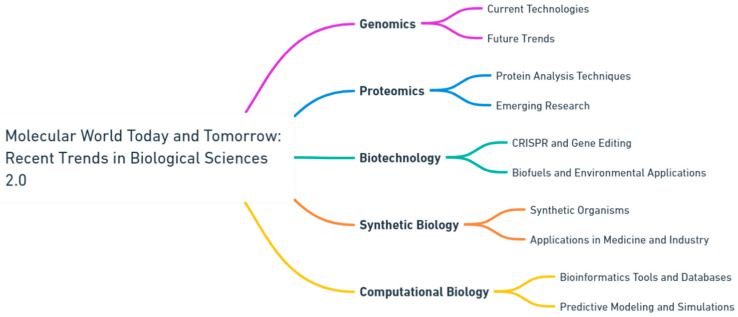 Figure 1
Peer Reviews
No public reviews on file for this paper yet. If you reviewed it on a platform where reviews are public (OpenReview, ICLR, NeurIPS, ICML), you can paste yours below so the community can read it here.
Videos
No videos yet. Explain this paper in a talk, walkthrough, or lecture? Add one.
Taxonomy
TopicsGenetics, Bioinformatics, and Biomedical Research · Bioinformatics and Genomic Networks · Nutrition, Genetics, and Disease
Molecular techniques have become influential instruments in biological study, transforming our comprehension of life at the cellular and genetic levels [1]. The Special Issue "Molecular World Today and Tomorrow: Recent Trends in Biological Sciences 2.0" examines current trends in biological sciences and the impact of advanced techniques on scientific advancements. The problem highlights how molecular techniques can greatly aid in the advancement of focused medication creation and disease diagnostics. Combining molecular phylogenetic and omics approaches with expression and pathway analysis, we seek to improve our comprehension of molecular mechanisms and stress responses in biological systems [2]. This collaboration represents significant progress in genomics, proteomics, and phylogenetic methods, providing new opportunities for study and innovation.
Advancements in omics technologies, including transcriptomics, proteomics, and genomics, have significantly improved our capacity to recognize and describe biological entities [2,3]. Researchers currently use systematic methods to uncover genetic variations, forecast ecological habitats, and clarify taxonomic intricacies [4,5]. Omics data offer a thorough perspective on the molecular world, ranging from analyzing microbial populations to uncovering the genetic foundations of diseases. Integrating molecular phylogenetics with omics techniques enhances our comprehension of evolutionary connections. Researchers investigate molecular pathways across many taxonomic groups by integrating sequence data with expression profiles [6,7]. This synergy influences both evolutionary history and functional adaptations, as well as stress responses.
Molecular data drives precision medicine [8,9]. Genomics and proteomics play a crucial role in guiding individualized treatments by identifying therapeutic targets and predicting medication responses [10,11]. Furthermore, diagnostic tests utilizing molecular markers improve the diagnosis and prediction of diseases. As we decode the complexities of individual genomes, the future shows potential for personalized interventions. The study in this Special Issue highlights the significance of interdisciplinary approaches in addressing intricate biological issues through collaboration. It unites specialists from several disciplines, such as molecular biology, genetics, biochemistry, biophysics, and computational biology, to promote a comprehensive comprehension of life at the molecular scale. This collaborative effort is crucial for the integration of knowledge and the acceleration of scientific discoveries (Figure 1).
The edition features 20 papers, including 3 comprehensive review articles, a brief report, 1 communication, and 15 research articles. The articles in the Special Issue emphasize the importance of molecular data in promoting targeted medicines, highlighting the vital significance of molecular sciences in medicine. This interdisciplinary method highlights the significant impact of molecular approaches in research and clinical environments, presenting new opportunities for customized medicine and treatments.
In conclusions, this Special Issue demonstrates the dynamic and interdisciplinary nature of molecular sciences. It motivates researchers to expand the current knowledge and investigate new areas, assuring the ongoing development of the biological sciences field and its contribution to our understanding of life’s molecular foundation. The compilation showcases the present status of molecular sciences and paves the way for future progress, encouraging further inquiry and invention in this captivating discipline.
The reference list from the paper itself. Each links out to its DOI / PubMed record.
- 1Hartwell L.H. Hopfield J.J. Leibler S. Murray A.W. From molecular to modular cell biology Nature 1999402 C 47C 5210.1038/3501154010591225 · doi ↗ · pubmed ↗
- 2Misra B.B. Langefeld C. Olivier M. Cox L.A. Integrated omics: Tools, advances and future approaches J. Mol. Endocrinol.201962 R 21R 4510.1530/JME-18-005530006342 · doi ↗ · pubmed ↗
- 3Veenstra T.D. Omics in systems biology: Current progress and future outlook Proteomics 202121200023510.1002/pmic.20200023533320441 · doi ↗ · pubmed ↗
- 4Johnson M.D. Freeland J.R. Parducci L. Evans D.M. Meyer R.S. Molano-Flores B. Davis M.A. Environmental DNA as an emerging tool in botanical research Am. J. Bot.2023110 e 1612010.1002/ajb 2.1612036632660 · doi ↗ · pubmed ↗
- 5Waldvogel A.-M. Feldmeyer B. Rolshausen G. Exposito-Alonso M. Rellstab C. Kofler R. Mock T. Schmid K. Schmitt I. Bataillon T. Evolutionary genomics can improve prediction of species’ responses to climate change Evol. Lett.2020441810.1002/evl 3.15432055407 PMC 7006467 · doi ↗ · pubmed ↗
- 6Borisov N. Sorokin M. Garazha A. Buzdin A. Quantitation of molecular pathway activation using RNA sequencing data Nucleic Acid Detection and Structural Investigations: Methods and Protocols Humana New York New York, NY, USA 202018920610.1007/978-1-0716-0138-9_1531667772 · doi ↗ · pubmed ↗
- 7Graw S. Chappell K. Washam C.L. Gies A. Bird J. Robeson M.S. Byrum S.D. Multi-omics data integration considerations and study design for biological systems and disease Mol. Omics 20211717018510.1039/D 0MO 00041 H 33347526 PMC 8058243 · doi ↗ · pubmed ↗
- 8Subramanian M. Wojtusciszyn A. Favre L. Boughorbel S. Shan J. Letaief K.B. Pitteloud N. Chouchane L. Precision medicine in the era of artificial intelligence: Implications in chronic disease management J. Transl. Med.20201847210.1186/s 12967-020-02658-533298113 PMC 7725219 · doi ↗ · pubmed ↗