The complete plastome genome sequence of Cynanchum otophyllum (Asclepiadaceae), a unique medicinal species in China
Bosen Li, Haobin Wang, Junling Zhang, Bin Qiu, Congwei Yang, Yaqiong Li

TL;DR
This paper presents the complete chloroplast genome sequence of Cynanchum otophyllum, a medicinal plant in China, and explores its genetic structure and evolutionary relationships.
Contribution
The study provides the first complete plastome sequence of Cynanchum otophyllum and its phylogenetic analysis within the Asclepiadaceae family.
Findings
The complete plastome genome of C. otophyllum is 160,874bp in size.
The genome contains 84 protein-coding genes, 8 rRNA, and 37 tRNA genes.
C. otophyllum is phylogenetically closely related to Gomphocarpus and Asclepias genera.
Abstract
Cynanchum otophyllum Schneid is an important medicinal plant in China. In this paper, the chloroplast genome of C. otophyllum was sequenced based on high-throughput technology, and the chloroplast genome structure characteristics and phylogenetic relationship of C. otophyllum were analyzed. The results showed the complete plastome genome size of C. otophyllumis 160,874bp, including one small single copy (SSC, 19,851bp) and one large single copy (LSC, 92,009bp) regions isolated by a pair of inverted repeat regions (IRs, 24,507bp). The whole plastome genome including 84 protein encoding genes, 8 rRNA and 37 tRNA. Based on the phylogenetic topologies, C. otophyllum shows close association with additional Gomphocarpus and Asclepias genus. This study contributes to an enhanced understanding of the genetic information of C. otophyllum and provides a theoretical basis for the development of…
Genes, proteins, chemicals, diseases, species, mutations and cell lines named across the full text — each resolved to its canonical identifier and authoritative record.
Click any figure to enlarge with its caption.
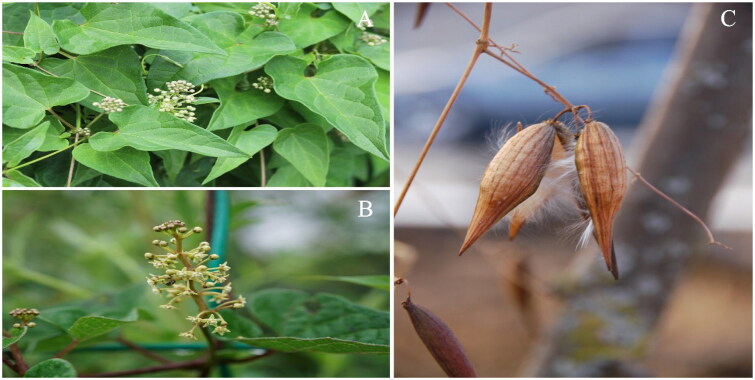 Figure 1
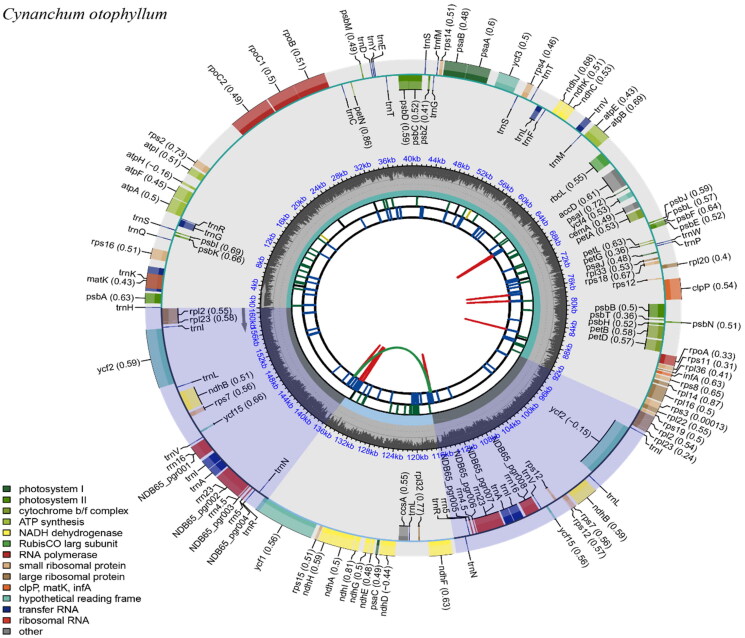 Figure 2
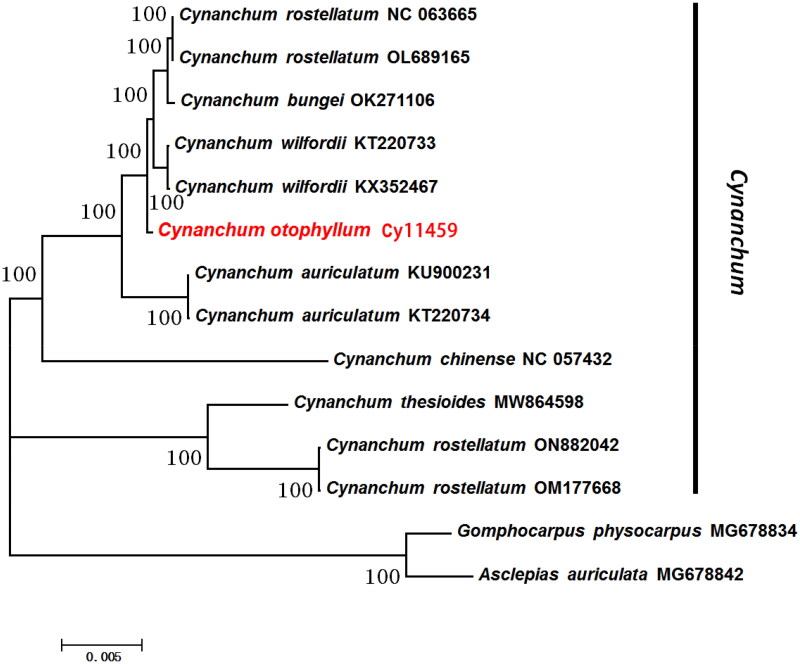 Figure 3
Peer Reviews
No public reviews on file for this paper yet. If you reviewed it on a platform where reviews are public (OpenReview, ICLR, NeurIPS, ICML), you can paste yours below so the community can read it here.
Videos
No videos yet. Explain this paper in a talk, walkthrough, or lecture? Add one.
Taxonomy
TopicsPhytochemistry and Bioactive Compounds · Plant Pathogens and Fungal Diseases · Mycorrhizal Fungi and Plant Interactions
Introduction
Chloroplasts are photosynthetic plastids in green plants. The plastome genome (cpDNA) is generally a circular double-stranded and typical tetrad junction. The chloroplast genome contains a large single copy region (LSC), a small single-copy region (SSC), and two reverse repeat regions with the same sequence and opposite directions (Jansen et al. 2005). In angiosperms, the plastome genome is mostly maternally inherited. Compared with the nuclear genome and ribosomal genome, the plastome genome is smaller, only 120–220 kb in higher plants.Because the plastome genome contains a small number of functional genes and low mutation rate, it is often used as an excellent genetic variation marker in plant phylogenetic and phylogenetic geography (Palmer 1985; Wolfe et al. 1987;Wang and Hong 1997). Based on the analysis of the structure and composition of the plastome genome of species, it will lay a foundation for further research on bioinformatics and population genetics (Guisinger et al. 2011, Yu et al. 2022; Liang et al. 2019).
Cynanchum otophyllum Schneid. (in Sarg. Pl. Wils. 1916), a perennial herbaceous vine of the Cynanchum genus of the Asclepiadaceae family (Figure 1), is a Chinese unique species, distributed within an extremely limited range only in China, at altitude range of 1500–2800 m (Li et al. 1995). It has been found to contain several components with bio-active effects, including steroids saponin, benzene derivatives, organic acid, monosaccharide,oligosaccharide, and trace mineral elements (Shen et al. 2014; Yang et al. 2015; Li et al. 2016). Its rhizomes areregarded as the medicinal parts of the plant, and have been used extensively to treat diseases such as epilepsy, hysteromyoma, lumbar bone pain, tubercle and nourishing strong (Kuang et al. 1991; Zhan et al. 2019). This species is one of the most important Chinese traditional herb also called Qingyangshen, it had been widely used in Chinese nationalities of Bai, Naxi and Yi to treat epilepsy and anti-hepatitis for a long time. C. otophyllum has been recognized as the endangerd medicinal plant because resources of this herb are diminishing due to uncontrolled harvesting (Wang et al. 2009). Therefore, it is necessary for us to learn more about its genetic data and pay more attentionto it. Notably, the chloroplast genome-wide for C. otophyllum would help to conserve the precious natural populations.
The morphological characteristics of Cynanchum otophyllum A, B, C showing the photo of plants, flowers and fruits respectively (photos taken by Congwei Yang).
Materials and methods
In this study, fresh leaves of C. otophyllum were collected from Shi lin County, Kunming City, Yunnan Province (24°77.176′ N; 103°35.201′E), and a voucher specimen of C. otophyllum was deposited in the Herbarium of Yunnan College of Traditional Chinese Medicine (Certificate No.: CO20220812: Li Yaqiong; liyaqiong6 @ 126.com). Total genome DNA was extracted with CTAB method from the fresh and healthy leaves of C. otophyllum (Li et al. 2013). Illumina paired-end libraries (150 bp read length) were prepared from sheared genomic DNA (fragment size ≤800 bp) and the complete plastome genome sequencing was taken on an Ilumina Hiseq × Ten platform (Illumina, San Diego, CA, USA). The raw reads with the adapters trimmed were filtered by quality with Phred scores of 30 or less implemented in the CLC-quality trim tool(Li et al. 2022), and the filtered reads were assembled using GetOrganelle v1.7.5 (Jin et al. 2020). Reference-guided connecting and annotation was subsequently conducted using Geneious 9.1.4 (Kearse et al. 2012) and Bandage 0.8.1 (Wick et al. 2015). In addition, the GeSeq (https://chlorobox.mpimp-golm.mpg.de/geseq.html) (Tillich et al. 2017) was utilized for annotation with the reference of Cynanchum wilfordii (KT220733) as a reference sequence, and the boundaries were manually corrected. Then a Maximum likelihood (ML) was performed to estimate the phylogeny for 14 plastome sequences of Asclepiadaceae species, with two Gomphocarpus R. Br. and Asclepias Linn. species as outgroups. ML analysis was implemented using RAxML v8.1.11 (Stamatakis 2014), so as to examine the C. otophyllum position in the phylogenetic tree.
Result
The complete plastome genome of C. otophyllum is a typical circular double-stranded DNA molecule with a length of 160,874 bp. The cp genome has the usual quadripartite structure of most angiosperms(Figure 2), containing a small single copy (SSC) region of 19,851 bp and a large single copy (LSC) region of 92,009 bp, which is separated by a pair of inverted repeat (IRs) regions of 24,507 bp and the base compositions of the cp genome were uneven (30.7% A,19.2% C, 18.6% G, and 31.5% T). The overall GC and AT content of the whole genome is 37.80% and 62.20%, respectively. GC content in the IR region (43.3%) is higher than that in the SSC region (32.0%) and LSC region (36.1%). A total of 129 genes are annotated, including 84 protein-coding genes (PCGs), eight ribosomal RNA genes (rRNAs), and 37 transfer RNA genes (tRNAs). In total, seventeen genes replicate in the IR region, repeating inversely with each other, including seven tRNA genes (trnA-UGC, trnI-CAU, trnI-GAU, trnL-CAA, trnN-GUU, trnR-ACG, trnV-GAC), six PCGs (rpl23, rpl2, rps7, ycf15, ycf2, ndhB), and four rRNA genes. Fourteen plastome genomes were used for constructing maximum likelihoob (bootstrap repeat is 1000). According to the phylogenetic trees, a monophyletic clade is formed among C. otophyllum together with the remaining Cynanchum species in the Cynanchum genus, and the bootstrap support value is 100% (Figure 3).
Chloroplast complete genome map of Cynanchum otophyllum. The map consists of several circles, each with the following information from the center outward: the circles closest to the center are indicated by red and green arcs for forward and reverse repeats, respectively. The second and third circles are indicated by short bars for tandem repeats and microsatellite sequences, respectively. The fourth circle indicates the positions of the LSC, SSC, IRA, and IRB regions, respectively. The fifth circle indicates the GC content. The outer circle indicates the function of the gene. Different colors are used to show different functional categories, as shown in the lower left of the picture.
Fourteen plastome genomes were used for constructing maximum likelihoob (ML, bootstrap repeat is 1000). the sequences used for the tree structure are coding sequences, and the bootstrap support values are shown on the nodes. The used sequences and their references were listed in Table S1.
Specifically, the complete plastome genome for C. otophyllum would help to understanding the genetic information. The chloroplast genome structure of C. otophyllum was reported for the first time, which enriches the gene diversity, and this study provided new information for the phylogenetic relationship of the Cynanchum family.
Supplementary Material
Supplemental Material
Supplemental Material
Supplemental Material
Supplemental Material
Supplemental Material
The reference list from the paper itself. Each links out to its DOI / PubMed record.
- 1Guisinger MM, Kuehl JV, Boore JL, Jansen RK. 2011. Extreme reconfiguration of plastid genomes in the angiosperm family geraniaceae: rearrangements, repeats, and codon usage. Mol Biol Evol. 28(1):583–600. doi: 10.1093/molbev/msq 229.20805190 · doi ↗ · pubmed ↗
- 2Jansen RK, Raubeson LA, Boore JL, de Pamphilis CW, Chumley TW, Haberle RC, Wyman SK, Alverson AJ, Peery R, Herman SJ, et al. 2005. Methods for obtaining and analyzing whole chloroplast genome sequences, Method. Methods Enzymol. 395:348–384. doi: 10.1016/S 0076-6879(05)95020-9.15865976 · doi ↗ · pubmed ↗
- 3Jin JJ, Yu WB, Yang JB, et al. 2020. Get Organelle: a fast and versatile toolkit for accurate de novo assembly of organelle genomes. Genome Biol. 21(1):241. doi:10.1186/s 13059-020-02154-5.PMC 748811632912315 · doi ↗ · pubmed ↗
- 4Kearse M, Moir R, Wilson A, Stones-Havas S, Cheung M, Sturrock S, Buxton S, Cooper A, Markowitz S, Duran C, et al. 2012. Geneious basic: an integrated and extendable desktop software platform for the organization and analysis of sequence data. Bioinformatics. 28(12):1647–1649. doi: 10.1093/bioinformatics/bts 199.22543367 PMC 3371832 · doi ↗ · pubmed ↗
- 5Kuang PG, Lang SY, Liu XJ, et al. 1991. The investigation of antiepileptic action of qingyangshen (QYS) – Effect of qingyangshen on the concentration of neuropeptides in rat brain. J Tradit Chin Med. 11(1):40–46.1713632 · pubmed ↗
- 6Liang C, Wang L, Lei J, Duan B, Ma W, Xiao S, Qi H, Wang Z, Liu Y, Shen X, et al. 2019. A comparative analysis of the chloroplast genomes of four Salvia medicinal plants. Engineering. 5(5):907–915. doi: 10.1016/j.eng.2019.01.017. · doi ↗
- 7Li J, Wang S, Yu J, Wang L, Zhou S. 2013. A modified CTAB protocol for plant DNA extraction. Chinese Bull. Bot. 48(1):72–78.
- 8Li PT, Gilbert MG, Stevens WD. 1995. Flora of China . Bei-Jing: Science Press and st. Louis Missouri Botanical Garden:p. 189–270.