Plastid genome of Chenopodium petiolare from Trujillo, Peru
Flavio Aliaga, Mario Zapata-Cruz, Silvia Ana Valverde-Zavaleta

TL;DR
This paper reports the plastid genome of Chenopodium petiolare from Peru, providing insights into its genetic makeup and evolutionary relationships.
Contribution
The study provides the first plastid genome sequence of Chenopodium petiolare, enhancing genetic resources for conservation and breeding.
Findings
The plastid genome has 130 genes, including 86 protein-coding genes and 36 tRNA-coding genes.
The genome has a GC content of 37.24% and is closely related to Chenopodium quinoa based on phylogenetic analysis.
Abstract
The Peruvian Andean region is an important center for plant domestication. However, to date, there have been few genetic studies on native grain, which limits our understanding of their genetic diversity and the development of new genetic studies for their breeding. Herein, we revealed the plastid genome of Chenopodium petiolare to expand our knowledge of its molecular markers, evolutionary studies, and conservation genetics. Total genomic DNA was extracted from fresh leaves (voucher: USM < PER > :MHN333570). The DNA was sequenced using Illumina Novaseq 6000 (Macrogen Inc., Seoul, Republic of Korea) and reads 152,064 bp in length, with a large single-copy region of 83,520 bp and small single-copy region of 18,108 bp were obtained. These reads were separated by a pair of inverted repeat regions (IR) of 25,218 bp, and the overall guanine and cytosine (GC) was 37.24%. The plastid genome…
Genes, proteins, chemicals, diseases, species, mutations and cell lines named across the full text — each resolved to its canonical identifier and authoritative record.
Click any figure to enlarge with its caption.
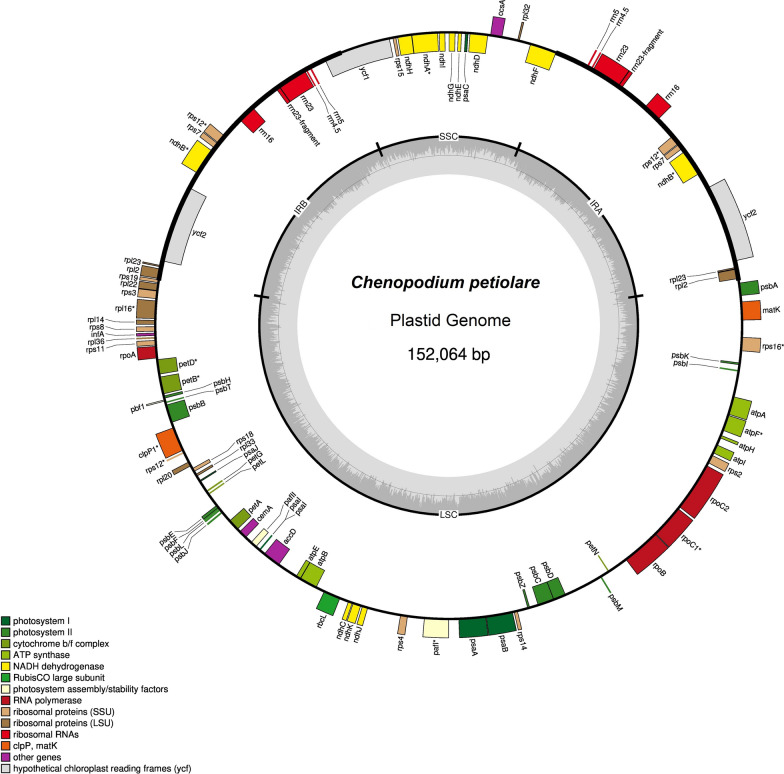 Figure 1
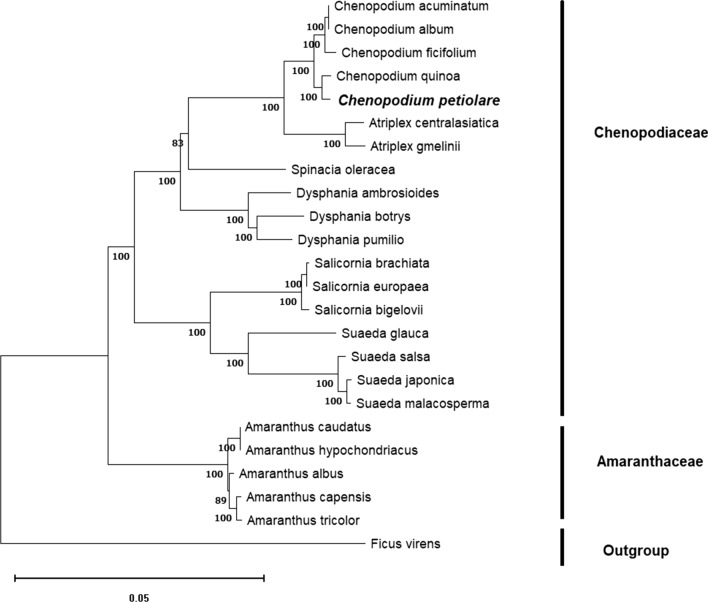 Figure 2
- —Plant Science Laboratory (PSL)
Peer Reviews
No public reviews on file for this paper yet. If you reviewed it on a platform where reviews are public (OpenReview, ICLR, NeurIPS, ICML), you can paste yours below so the community can read it here.
Videos
No videos yet. Explain this paper in a talk, walkthrough, or lecture? Add one.
Taxonomy
TopicsGenomics and Phylogenetic Studies · Chromosomal and Genetic Variations · Microbial Community Ecology and Physiology
Objective
Chenopodium petiolare Kunth is a native grain of the Andean region, this annual herb grows in the Peruvian Andean formations at altitudes of 200–3,900 m.a.s.l., and its grains are small and black with high concentration of saponins [1, 2]. It is a diploid species with a small number of chromosomes (2n = 2x = 18) belonging to the Chenopodiaceae family. Its outstanding features are drought stress tolerance and resistance to diseases [1, 3]. Chenopodium petiolare has multiple uses including being used as cattle feed, in cooking local dishes such as quispiño (dark muffin), and in traditional medicine mainly for bone fractures [1].
The plastid genome has a quadripartite structure: a large single-copy (LSC) of 80–90 kilobase pairs (kb), a small single-copy (SSC) of 16–27 kb, and two sets of inverted repeats (IRs) of 20–28 kb, with 110–130 unique genes, including protein-coding genes, transfer RNA (tRNA), and ribosomal RNA (rRNA) [4, 5]. In recent years, declining genome sequencing costs resulted in more than 790 complete plant genomes of different species becoming available [6, 7]. Recently, some Chenopodium plastid genomes such as Chenopodium acuminatum [8], Chenopodium album [9], Chenopodium quinoa [10], Chenopodium ficifolium [11], became publicly available. However, despite the few genetic data available, we have only begun to investigate the genomics of native grains of great importance for plant breeding programs. In the present study, we report the first plastid genome sequence submitted for an isolate of Chenopodium petiolare, which will expand our knowledge about its plant molecular breeding, molecular markers, evolutionary studies, and conservation genetics.
Data description
Total genomic DNA was extracted from approximately 100 mg of fresh leaves (from voucher number USM < PER > :MHN333570) (Data file 1) using a cetyl-trimethyl ammonium bromide (CTAB) protocol [12]. Genomic DNA quality was assessed using a fluorometry-based Qubit (Thermo Fisher Scientific, USA) coupled to a Broad Range Assay kit (Thermo Fisher Scientific, USA). High-quality DNA (230/260 and 260/280 ratios > 1.8) was normalized (20 ng/μL) to examine its integrity using 1% (w/v) agarose gel electrophoresis. Qualified DNA was fragmented, and the TruSeq Nano DNA kit (Illumina, San Diego, CA, USA) was used to construct an Illumina paired-end (PE) library. PE sequencing (2 × 150 bp) was performed using the Illumina NovaSeq 6000 platform (Macrogen, Inc., Seoul, Republic of Korea) [13]. All adapters and low-quality reads were removed using the FastQC [14] and Cutadapt [15] programs. PE reads (2 × 150 bp) were evaluated for quality using QUAST [16] analysis, and subsequent steps used clean data. Then, clean reads obtained were assembled into a circular contig using NOVOPlasty (version.4.3) [17], with C. quinoa (NC_034949) as the reference. Data can be accessed from NCBI GenBank under the accession number OQ957163 [30]. The plastid genome was annotated using the Dual Organellar GenoMe Annotator GeSeq [18] and CpGAVAS2 [19]. A circular genome map was constructed using OGDRAW (version 1.3.1) [20] (Fig. 1). The plastid genome encoded 130 genes, of which 111 were unique, and 19 were duplicated in the inverted repeat (IR) region. The chloroplast genome contained 86 protein-coding genes, 36 tRNA-coding genes, eight rRNA-coding genes, and 25 genes with introns (21 genes with one intron and four genes with two introns), as shown in Data file 3.Fig. 1. Circular map of Chenopodium petiolare chloroplast genome. The thick lines indicate the IR1 and IR2 regions, which separate the large single-copy (LSC) and small single-copy (SSC) regions. Genes marked inside the circle are transcribed clockwise, and genes marked outside the circle are transcribed counterclockwise. Genes are color-coded based on their function, shown at the bottom left. The inner circle indicates the inverted boundaries and guanine and cytosine (GC) content
The plastome contained 111 unique genes, of which there were 28 tRNA genes, four rRNA genes, and 79 protein-coding genes. The latter comprised 21 ribosomal subunit genes (nine large subunits and 12 small subunit), four DNA-directed RNA polymerase genes, 45 genes were involved in photosynthesis (11 encoded subunits of the NADH oxidoreductase, seven for photosystem I, 14 for photosystem II, six for the cytochrome b6/f complex, six for different subunits of ATP synthase, and one for the large chain of ribulose biphosphate carboxylase), eight genes were involved in different functions, and one gene was of unknown function (Data file 4). Phylogenetic analysis reconstruction was performed using 24 complete chloroplast genome sequences to infer the phylogenetic relationships among Chenopodium species, and Ficus virens was used as an outgroup (Fig. 2). Single-copy orthologous genes were identified using the Orthofinder pipeline (version 2.2.6) [21]. For each gene family, the nucleotide sequences were aligned using the L-INS-i algorithm in MAFFT (version 7.453) [22]. A phylogenetic tree based on maximum likelihood (ML) was constructed using RAxML (version 8.2.12) [23] with the GTRCAT model. A phylogenetic ML tree was reconstructed and edited using MEGA (version 11) [24] with 1000 replicates. The phylogenetic tree illustrated that Chenopodium petiolare is closely related to Chenopodium quinoa [10].Fig. 2. Phylogenetic tree of 24 plastid genomes. Maximum likelihood analysis based on single-copy orthologous protein. Bootstrap values on the branches were calculated from 1000 replicates
Limitations
This study used leaf samples of Chenopodium petiolare from the Lomas del Cerro Campana Private Conservation Area in Trujillo, Peru. Administratively, this process takes longer than necessary to obtain the corresponding access permit for plant sample collection.
The reference list from the paper itself. Each links out to its DOI / PubMed record.
- 1Mujica A Jacobsen S Moraes RØllgaard B Kvist L Borchsenius F Balslev H La Quinua (Chenopodium quinoa Willd.) y sus parientes silvestres Botánica Económica de los Andes Centrales 2006 La Paz Universidad Mayor de San Andrés 453456
- 2Tropicos. Missouri Botanical Garden. 2024. https://www.tropicos.org/collection/1924364. Accessed 29 Jan 2024.
- 3Romero M Mujica A Pineda E Ccamapaza Y Zavalla N Genetic identity based on simple sequence repeat (SSR) markers for Quinoa (Chenopodium quinoa Willd.)Cienc Investig Agrar 20194616617810.7764/rcia.v 46i 2.2144 · doi ↗
- 4Ozeki H Umesono K Inokuchi H Kohchi T Ohyama K The chloroplast genome of plants: a unique origin Genome 19893116917410.1139/g 89-029 · doi ↗
- 5Wang W Lanfear R Long-reads reveal that the chloroplast genome exists in two distinct versions in most plants Genome Biol Evol 201911337233813175090510.1093/gbe/evz 256PMC 7145664 · doi ↗ · pubmed ↗
- 6Marks RA Hotaling S Frandsen PB Van Buren R Representation and participation across 20 years of plant genome sequencing Nat Plants 202171571157810.1038/s 41477-021-01031-834845350 PMC 8677620 · doi ↗ · pubmed ↗
- 7Sun Y Shang L Zhu QH Fan L Guo L Twenty years of plant genome sequencing: achievements and challenges Trends Plant Sci 20222739140110.1016/j.tplants.2021.10.00634782248 · doi ↗ · pubmed ↗
- 8Wariss HM Qu XJ The complete chloroplast genome of Chenopodium acuminatum Willd. (Amaranthaceae)Mitochondrial DNA B Resour 2021617417510.1080/23802359.2020.186071633537433 PMC 7832583 · doi ↗ · pubmed ↗