Impact of employment and income support interventions on the health of young adults with episodic disability: Findings from a systematic review
Arif Jetha, Lahmea Navaratnerajah, Sebastian Kondratowski, Meagan Parmassar, Lori B Tucker, Monique AM Gignac

TL;DR
This study reviews how employment and income support interventions affect the health of young adults with episodic disabilities.
Contribution
The study provides a systematic review of interventions targeting health outcomes in young adults with episodic disabilities.
Findings
Five studies showed that employment interventions improved health outcomes for young adults with episodic disabilities.
Supported employment interventions were particularly beneficial for work and health outcomes.
Most studies focused on mental health conditions and showed medium-quality evidence.
Abstract
Young adults living with episodic disabilities face unpredictable disruptions to their employment and health. Our study aimed to examine the impact of employment and income support interventions on the health and well-being of young adults living with episodic disabilities. We conducted a systematic review of peer-reviewed intervention studies published in 2001–2021 in industrialized contexts. Two independent reviewers screened titles, abstracts and full-texts. We undertook a narrative synthesis of eligible articles. Our search yielded 15,269 published articles, of which only five studies were eligible for evidence synthesis. All articles were appraised as being of medium quality. Four interventions focused on young adults living with mental health conditions. Two were based in clinical settings; three were based in community-based settings. Each employment intervention exhibited…
Genes, proteins, chemicals, diseases, species, mutations and cell lines named across the full text — each resolved to its canonical identifier and authoritative record.
Click any figure to enlarge with its caption.
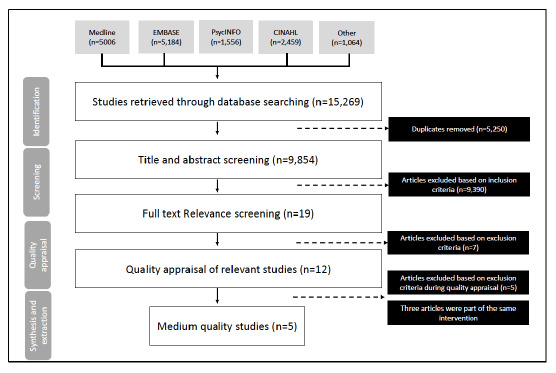 Figure 1
| PICO category | Inclusion criteria | Exclusion criteria |
|---|---|---|
| Population | Young adults (sample mean age 16-35 years and age
range 16 and 45 years) | Study sample not classified as a young adult or
with an episodic disability |
| Intervention | Any intervention that targeted employment or income support | Intervention with no employment or income support component |
| Comparison | Any comparator group (population not taking part or exposed to the intervention) | No comparison group |
| Outcome | Any physical or mental health outcome, measure of health-related quality of life or assessment of well-being | Studies evaluating the effectiveness of an intervention which did not assess outcomes of interest |
| Author, | Study objectives | Study design, length of data collection, and setting | Sample size description | Episodic disability group | Employment and income outcomes (measures utilized) | Health and well-being outcomes (measures utilized) |
|---|---|---|---|---|---|---|
| Geenen | To examine whether youth who participated in the Better Future’s project showed improved outcomes when compared to youth randomized to a control group who were offered standard services. | Randomized | N=67 (36 | Youth with mental health challenges in foster care | Employment status | Improvements in mental health (Youth
Efficacy/Empowerment Scale- Mental Health) |
| Liljeholm et al,
| To determine how the Södertälje Supported Employment and Education model, an integrated mental health and vocational support intervention, can impact mental health among young adults with mood disorders. | Prospective Longitudinal pre-post
intervention study | N=42 | Young adults with major depressive (93%) or bipolar disorder (7%) | Engagement in everyday life (Profiles of Occupational Engagement in people with Severe mental illness [POES]) | Mental health symptomology and
recovery (Montgomery-Asberg Depression Rating
Scale) |
| Menrath | To study the efficacy and impact of the Modular Transition (ModuS-T) patient education program, designed to support young adults living with chronic conditions manage their disease and transition to adulthood, when compared to young adults in usual care. | Quasi-randomized control
study | N=300 | Young people with chronic conditions: asthma (5.3%), attention deficit disorder /hyperactivity disorder (18.7%), type 1 diabetes (19.7%), phenylketonuria (2.3%), inflammatory bowel disease (16.0%), cystic fibrosis (2.7%), chronic kidney disease (4.0%), epilepsy (7.7%), organ transplantation (7.3%), juvenile idiopathic arthritis (7.7%), esophagus atresia (12.0%), Ehlers-Danlos syndrome (2.7%) | Work preparedness (Transition Competency Scale) | Health-related quality of life
(DISABKIDS Chronic Generic Measure; SF-8) |
| Kane et al,
2016 | To compare the NAVIGATE coordinated specialty care program on receipt of disability income support benefits, employment, treatment and first-episode psychosis outcomes when compared to usual community care. | Clustered randomized
trial | N=404 (223 intervention; 181
community care) | Individuals with first episode of psychosis | Work participation | Schizophrenia symptom severity
(Positive and Negative Syndrome Scale) |
| Sveindottir et al, | To study the role of the Individual placement and support (IPS) approach for young adults with mental and behavioural conditions, at risk of early work disability when compared to traditional vocational rehabilitation. | Two-armed randomized control trial | N=96 (50 intervention group; 46 control
group) | Individuals with mental and behavioral conditions | Paid competitive employment | Disability (World Health Organization Disability
Assessment Schedule [WHODAS] 2.0) |
| Study | Description of intervention | Intervention’s impact on income and employment outcomes | Intervention’s impact on health and well-being outcomes | Quality appraisal |
|---|---|---|---|---|
| Geenen | The Better Futures project is a personalized coaching intervention program that provides foster youth with mental health challenges to identify and work on their personal, education or career goals, build self-determination skills through mentorship workshops with advisory peers who have had similar experience in foster care and dealing with their mental health challenges. | No significant difference in the proportion of
participants who were employed at follow-up when comparing the
intervention group to the control group. | Over the study period, the intervention group
reported significantly greater efficacy in mental health care
management when compared to the control group F(3, 118)=9.07;
P<0.0001). | Moderate |
| Lijeholm | The Södertälje Supported Employment and Education model is an integrated intervention targeted towards young adults with major depressive or bipolar disorders to improve their mental health and support employment. Intervention included integrated vocational services with mental health services, personalized benefit counselling and employer relationship building. All services were delivered by a case manager and aligned with the client’s preferences and needs. | Participants reported statistically significant improvements to engagement in everyday life activities at 12-months when compared to baseline (P=0.002). | Although depression symptomology
decreased at follow-up when compared to baseline, the
relationship was not statistically significant
(P=0.241). | Moderate |
| Menrath | The Modular transition (ModuS-T) education program aims at empowering patients with chronic conditions to take responsibility in managing their disease. Modules on insurance, the health care system, career, social networking, coping and stress management, health promotion behaviours, were delivered participants and their parents/caregivers. Group discussions, role playing, and case studies were utilized to deliver the training. | Young adults in the intervention group observed significantly greater scores for work preparedness (TC-a) over the duration of the study when compared to those in the control group F=27.3 (p < 0.001). | No significant difference existed
when comparing the intervention group to the control group on
health-related quality of life when using the
DISABKIDS. | Moderate |
| Kane et al,
2016 | NAVIGATE intervention is a four-component training approach that includes: 1) customized medication management training; 2) family psychoeducation 3) self-management training focused on building resilience and 4) supported employment and education. | Compared to community care,
intervention participants were significantly more likely to
report work participation. However, the main effect by time was
most significant for those who participated in >3 supported
employment/education sessions (t=0.16, P<0.05). | Intervention participants
experienced significantly greater improvement in quality of life
over the study period than those in community care (t=2.45,
P=0.015). | Moderate |
| Sveindottir et al, 2020 | The individual placement and support (IPS) model of supported employment is an intervention approach that is targeted towards enhancing competitive employment outcomes for patients with severe mental health illness through focusing on patient goals and preferences, providing long-term personalized support, access to integrated services and counselling. The intervention was facilitated by a job specialist who matched the candidate with a job and provided ongoing support following a job through established IPS principles. | IPS participants were significantly more likely to
hold competitive employment at 12-month follow-up compared to
the traditional vocational rehabilitation group (OR=10.39, 95%
CI 2.79-38.68). | Participants in the intervention group reported
significantly less health complaints (P=0.017), helplessness
(P=0.017) and hopelessness (P=0.006), and drug use (P=0.036)
when compared to the traditional vocational rehabilitation group
at 12-months. | Moderate |
- —the Arthritis Society (Canada)
- —Ontario Ministry of Labour, Immigration, Training and Skills Develop- ment (MLITSD)
Peer Reviews
No public reviews on file for this paper yet. If you reviewed it on a platform where reviews are public (OpenReview, ICLR, NeurIPS, ICML), you can paste yours below so the community can read it here.
Videos
No videos yet. Explain this paper in a talk, walkthrough, or lecture? Add one.
Taxonomy
TopicsEmployment and Welfare Studies · Retirement, Disability, and Employment · Adolescent and Pediatric Healthcare
Young adults living with episodic disabilities can experience unpredictable disruptions to their employment as they enter and advance within the labor market. The most prevalent physical (e.g., juvenile arthritis, inflammatory bowel disease) and mental health (e.g., anxiety, depression) chronic conditions are often categorized as episodic, with periods of good health interrupted by flares of poor health (1). Some estimates suggest one out of six of working-aged adults with disabilities report fluctuating and unpredictable limitations (2).
The unpredictability of an episodic disability can be stressful and impact the health and quality of life of young adults. Finding and sustaining employment can also be challenging, especially managing fluctuations in symptoms while also navigating the changing demands of work (3–5). Many episodic conditions have few visible signs creating challenges communicating about work support needs (6, 7). Living and working with an episodic disability may have different impacts at various life stages; difficulties at the early career phase can have an economic scarring effect that impact both employment opportunities and health across the life course (8, 9).
To manage their health and well-being, many young adults with episodic disabilities rely on employment not only for income but also for resources (e.g., extended health benefits, drug coverage) that may improve or sustain good health (9). To examine this further, our study reviewed employment and income support interventions and their impact on the health and well-being of young adults living with episodic disabilities.
Methods
A systematic review addressed the study aim (10). To inform the search strategy and synthesize key findings, consultations with knowledge users were held. The review was registered with PROSPERO (CRD42021268354) and met 2020 PRISMA Guidelines.
Literature search
The search strategy captured employment or income support intervention studies for young adults [i.e., sample mean age 16–35 (range 16–45) years] living with any episodic disability (Table 1). Our search was restricted to intervention studies conducted in OECD countries, those that used quantitative methodologies, and were published in the last 20 years in English, French or Spanish. We examined the effect of employment or income support inteventions on any health outcome. Medline, Embase, PsycINFO, CINAHL, Sociological Abstracts, ASSIA, ABI Inform, and Econ lit were searched using database-specific controlled vocabulary terms and keywords (Supplementary material, www.sjweh.fi/article/4133, Table S1).
Table 1: Inclusion and exclusion criteria using PICO framework
Relevance screening
Two reviewers independently screened titles and abstracts and full-texts for relevancy using DistillerSR (11). Disagreements were discussed in meetings. Reference lists of included articles were checked to identify additional relevant articles.
Quality appraisal and data extraction
A quality appraisal tool for studies in work and health was used to assess the internal, external, and statistical validity of eligible articles (10). The tool assessed risk of bias in study design and objectives, recruitment procedures, outcome and exposure measurement and analysis (Supplementary Table S2). Two reviewers appraised each relevant article. A final weighted sum score of the quality criteria was generated, converted to a percentage score, and categorized as high (≥85% of quality appraisal score), medium (50–84% of total quality appraisal score) or low quality (<50% of quality appraisal total score). Consensus on scores was reached in a team meeting.
Evidence synthesis
The limited number of eligible studies identified by the review coupled with variability in the observation length, intervention type, sample characteristics, outcomes meant that we were unable to calculate pooled effect estimates. Instead, a narrative synthesis described the findings.
Results
Our search yielded 15,269 articles published between years 2001–2021. Only five eligible employment interventions focused on young adults with an episodic disability and assessed health impacts (Figure 1). All articles were appraised as medium quality. A summary of each study is provided in Table 2.
Table 2: Description of studies identified in systematic review examining income and employment interventions on health
Systematic review flowchart.
The five employment interventions found improvements in health outcomes (Table 3). A randomized controlled trial (RCT) of a personalized coaching initiative in the United States offered mentorship to young adults with mental health conditions to meet career and educational goals and build career self-determination. Although the intervention did not contribute to a change in employment over the six months following the ten-month intervention period, it was associated with improved career self-efficacy. Intervention recipients reported greater mental health but no difference in quality of life when compared to the control group (12).
Table 3: Description of study interventions and their impact on income and employment outcomes and health outcomes
Three supported employment interventions in community and clinical settings for young adults with mental health conditions were identified (13–15). The interventions provided employment placement services, career counselling and health-related self-management assistance. Findings highlighted improved occupational engagement, participation in employment, and hours worked (13–15), as well as improvements in quality of life and well-being, declines in depressive symptom severity, fewer health complaints, and less disability. Supported employment embedded within a specialty health care program for individuals with psychosis and their families showed a dose–response relationship such that attending a greater number of sessions increased the likelihood of participating in employment (16). Intervention participants also reported greater quality of life and a decrease in mental health symptoms when compared to the control group.
Finally, a German patient education program within a clinical setting for young adults with diverse chronic health care conditions (a majority were episodic) included a specific career development module (17). Intervention participants were more likely to report greater work-preparedness as well as better health-related quality of life when compared to the control group.
Discussion
The unpredictable and dynamic nature of an episodic disability in young adulthood can contribute to early and sustained exclusion from the labor market and intermittently disrupt the pathway between employment and health. Past research has highlighted the health-related benefits attributed to promoting employment (18). This systematic review examined whether employment or income support interventions could benefit the health and well-being of young adults with episodic disabilities.
We found an absence of high-quality evidence-based employment or income support interventions for young adults living with episodic disability that focuses on health-related impacts. Only five studies were identified which met our eligibility criteria, despite a large body of research highlighting the importance of employment as a critical social determinant of health in young adults with and without disabilities (19, 20). Results underscore the need to elaborate on the health and well-being implications of employment interventions for young adults with different episodic health conditions. Most interventions identified in our review focused on young adults with mental health conditions. Findings could reflect a growing acknowledgment of the relationship between poor mental health and difficulties participating in employment among young adults (21, 22). Episodic disabilities like juvenile arthritis or inflammatory bowel disease are among the most prevalent among young adults and are characterized by variable physical symptoms (e.g., pain, fatigue, and activity limitations) and can considerably impact employment (3). Moving forward, tailored interventions should be designed to account for the employment challenges of young people living with diverse episodic health conditions.
Although we uncovered a small body of evidence, our review suggests that involvement in employment interventions could provide benefits for the health of young adults with episodic disabilities, all interventions included employment and disability-specific support components which may have explained the health-related benefits. Interventions that promote employment for young adults with episodic disabilities may benefit from providing specific training on balancing health and work demands. Additional longer-term research is needed to better understand the elements of employment interventions that may be valuable to health, as well as the reciprocal relationship between work and health outcomes that can emerge over time. Participation in supported employment offers a promising practice which may foster employment engagement and improve health. Supported employment interventions aid with finding work and they offer regular counselling and job-related training which has been previously shown to be beneficial for the employment of young adults with disabilities (23). As our findings suggest, the benefits of supported employment interventions could extend to health and well-being of young adults with episodic disabilities at the early career phase.
The fluctuating nature of episodic disabilities represents a unique challenge to sustaining employment (6). Interventions in our systematic review did not explicitly address the varying activity limitations and employment restrictions that can emerge. There is a need to study the unpredictable employment challenges related to an episodic disability and develop relevant programing tailored to those at the early career phase. Additionally, most interventions focused on helping participants find employment. There was limited focus on employment conditions, including managing jobs of different quality, access to support and job accommodations, and health and safety which may shape health outcomes. For instance, young adults with an episodic health condition may experience challenges finding full-time permanent employment that offers income and resources that are beneficial to health (16). There is a need to expand employment interventions to ensure young adults living with episodic disabilities can navigate aspects of the work environment which could pose challenges to sustained employment and also adversely impact health.
A study strength includes a rigorous systematic review methodology. A limitation of our systematic review is that we did not include qualitative studies or grey literature. Capturing broader forms of evidence can be used to elaborate on the different employment intervention that can promote health.
Concluding remarks
Our systematic review highlights the need to elaborate on the impact employment programs can have on the health and well-being of young adults living with diverse episodic disabilities. Additional insights are needed to understand how interventions can be designed to tailor and expand employment services to young adults living with episodic health conditions to fully optimize the pathways to better health.
Supplementary material
Supplementary material
The reference list from the paper itself. Each links out to its DOI / PubMed record.
- 1Accommodating and Communicating about Episodic Disabilities (ACED), Institute for Work & Health (IWH). Project overview: what are episodic disabilities? [online]. 2023 Available from: https://aced.iwh.on.ca/project-overview
- 2Jetha A, Gignac MA, Bowring J, Tucker S, Connelly CE, Proulx L et al. Supporting arthritis and employment across the life course: a qualitative study. Arthritis Care Res (Hoboken) 2018 Oct;70(10):1461–8. 10.1002/acr.2352329381838 · doi ↗ · pubmed ↗
- 3Gmitroski T, Bradley C, Heinemann L, Liu G, Blanchard P, Beck C et al. Barriers and facilitators to employment for young adults with mental illness: a scoping review. BMJ Open 2018 Dec;8(12):e 024487. 10.1136/bmjopen-2018-02448730567825 PMC 6303634 · doi ↗ · pubmed ↗
- 4O’Brien KK, Davis AM, Strike C, Young NL, Bayoumi AM. Putting episodic disability into context: a qualitative study exploring factors that influence disability experienced by adults living with HIV/AIDS. J Int AIDS Soc 2009 Nov;12(1):5. 10.1186/1758-2652-2-519900284 PMC 2788343 · doi ↗ · pubmed ↗
- 5Gignac MA, Jetha A, Ginis KA, Ibrahim S. Does it matter what your reasons are when deciding to disclose (or not disclose) a disability at work? The association of workers’ approach and avoidance goals with perceived positive and negative workplace outcomes. J Occup Rehabil 2021 Sep;31(3):638–51. 10.1007/s 10926-020-09956-133523376 PMC 8298367 · doi ↗ · pubmed ↗
- 6Jetha A, Tucker L, Backman C, Kristman VL, Bowring J, Hazel EM et al. Rheumatic disease disclosure at the early career phase and its impact on the relationship between workplace supports and presenteeism. Arthritis Care Res (Hoboken) 2022 Oct;74(10):1751–60. 10.1002/acr.2462033973368 PMC 9796415 · doi ↗ · pubmed ↗
- 7Strandh M, Winefield A, Nilsson K, Hammarström A. Unemployment and mental health scarring during the life course. Eur J Public Health 2014 Jun;24(3):440–5. 10.1093/eurpub/cku 00524567295 · doi ↗ · pubmed ↗
- 8Institute for Work & Health (IWH). Systematic review program: how we do systematic reviews [online]. 2005 Available from: https://www.iwh.on.ca/systematic-review-program/methods