Complete genome sequences of bacteriophages Guetzie and SirVictor, isolated from Microbacterium foliorum
Zefanias Ngove, Raegen Matthews, Jack Goedken, Sophia Huntington, Lauren Kirkle, Sean T. Coleman

TL;DR
This paper reports the complete genome sequences of two new bacteriophages, Guetzie and SirVictor, isolated from soil using a specific bacterial host.
Contribution
The novelty lies in the discovery and sequencing of two new bacteriophages with identical genome lengths and gene counts.
Findings
Guetzie and SirVictor are lytic siphoviral bacteriophages with identical genome lengths of 39,758 bp.
Each phage genome contains 58 predicted protein-coding genes and one tRNA gene.
Abstract
Cluster EA4 Guetzie and SirVictor are lytic siphoviral bacteriophages that were isolated from soil in Waverly, Iowa, using Microbacterium foliorum NRRL B-24224 as the host. The Guetzie and SirVictor genomes are both 39,758 bp each, and both contain 58 predicted protein-coding genes with one tRNA gene each.
Genes, proteins, chemicals, diseases, species, mutations and cell lines named across the full text — each resolved to its canonical identifier and authoritative record.
Click any figure to enlarge with its caption.
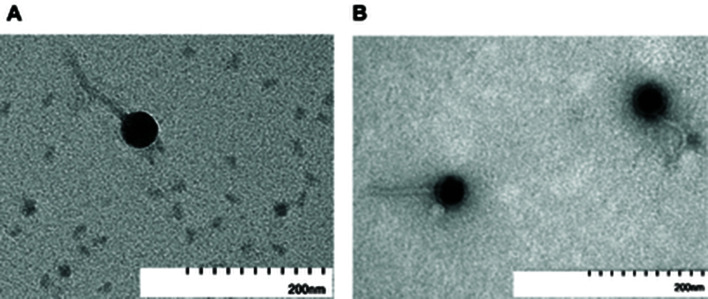 Fig 1
Fig 1| Phage name | GenBank accession no. | SRA accession no. | Location (GPS coordinates) | Genome size (bp) | Cluster | G+C content (%) | Genome ends | Average nucleotide % identity | No. of CDSs | No. of genes assigned a function | No. of tRNAs |
|---|---|---|---|---|---|---|---|---|---|---|---|
|
|
|
| 42.730129 N, 92.482883 W | 39,758 | EA4 | 64.2 | Circularly permuted | 99.9 | 59 | 26 | 1 (Phe) |
|
|
|
| 42.73104 N, 92.48409 W | 39,758 | EA4 | 64.2 | Circularly permuted | 99.9 | 59 | 26 | 1 (Phe) |
Peer Reviews
No public reviews on file for this paper yet. If you reviewed it on a platform where reviews are public (OpenReview, ICLR, NeurIPS, ICML), you can paste yours below so the community can read it here.
Videos
No videos yet. Explain this paper in a talk, walkthrough, or lecture? Add one.
Taxonomy
TopicsBacteriophages and microbial interactions · Genomics and Phylogenetic Studies · RNA and protein synthesis mechanisms
ANNOUNCEMENT
Bacterial species of the genus Microbacterium are Gram-positive rod-shaped aerobic organisms that are found on plants, in soil, and in water and are of human interest due to their potential to cause opportunistic infections (1, 2). Isolating and characterizing bacteriophages that cause infection, Microbacterium offers insight into bacteriophage evolution and diversity and the development of phages as a therapeutic for controlling infections (3, 4). Here, we present the genome sequences of two bacteriophages that infect Microbacterium foliorum NRRL B-24224.
Bacteriophages Guetzie and SirVictor were isolated from semi-arid soil near Wartburg College, Waverly, Iowa, USA (Table 1), using standard protocols (5). Soil specimens were collected, subjected to a wash utilizing peptone-yeast extract-calcium (PYCa) liquid medium, and subsequently filtered using 0.22-µm filters to extract the bacteriophages from the soil. The filtrate was inoculated with M. foliorum, and the resulting mixture was plated in a soft agar overlay onto separate PYCa plates and incubated at 30°C for 24 hours. The bacteriophages successfully replicated during this incubation period, yielding small, discernible clear plaques. The bacteriophages were purified through three rounds of plating. Transmission electron microscopy using negative staining was conducted on purified lysate, revealing siphoviral morphologies for both bacteriophages. Guetzie and SirVictor had a tail length of 136 to 141 nm and an isometric capsid of 55 to 64 nm in diameter (n = 3) and a tail length of 145 to 151 nm and an isometric capsid of 48 to 55 nm in diameter (n = 3) respectively (Fig. 1).
Transmission electron micrographs of Guetzie (A) and SirVictor (B) High-titer lysates were placed on Formvar-coated grids, negatively stained with Uranyless (5), and imaged at 60 kV and 100 kV, respectively. Guetzie has a tail length diameter of 136 to 141 nm and an isometric capsid of 55 to 64 nm in diameter (n = 3), and SirVictor has a tail length of 145 to 151 nm and an isometric capsid 48 to 55 nm in diameter (n = 3)
DNA was isolated from both Guetzie and SirVictor lysates using the Promega Wizard DNA cleanup kit. The genome was sequenced using an Illumina MiSeq sequencer (v3) reagent after the library was prepared using the NEBNext Ultra II FS kit, yielding 3,754,519 and 537,197 single-end 150-bp reads for Guetzie (14,165-fold genome coverage) and SirVictor (2,026-fold coverage), respectively. Raw reads were assembled and checked for completeness using Newbler v2.9 with default parameters and Consed v29 as described previously (7). Information regarding GenBank/SRA numbers, GPS coordinates, and the genome information can be seen in Table 1. The G+C content for both Guetzie and SirVictor is similar to that of the host M. foliorum (68.7%) (8) and was assigned to cluster EA4 based on a gene content similarity of ≥35% to phages in the Actinobacteriophage Database (8, 9).
The genomes were annotated using DNA Master (http://cobamide2.bio.pitt.edu), PECAAN (https://blog.kbrinsgd.org), Glimmer v3.02 (10), GeneMark v2.5 (11), Starterator v1.1 (http://phages.wustl.edu/starterator), and Phamerator (12). Predicted gene functions were determined using BLASTp v2.9 (13), HHpred (14), TMHMM2 (https://services.healthtech.dtu.dk/service.php ?TMHMM-2.0), and SOSUI (15), and tRNAs were identified using ARAGORN v1.2.38 (16) and tRNAscan-SE v3.0 (17). Default settings were used for all programs. Annotation revealed 58 protein-coding genes and one tRNA in both genomes. The genomes of Guetzie and SirVictor showed 99.9% nucleotide identity via OrthoAni (6) including at least two nucleotide differences. There are eight EA subclusters (EA1-8). Interestingly, most EA3, EA4, EA5, and EA6 phages have a single tRNA-Ala (3) while Guetzie and SirVictor have a single tRNA-Phe.
The reference list from the paper itself. Each links out to its DOI / PubMed record.
- 1Laffineur K, Avesani V, Cornu G, Charlier J, Janssens M, Wauters G, Delmée M. 2003. Bacteremia due to a novel Microbacterium species in a patient with leukemia and description of Microbacterium paraoxydans sp.nov. J Clin Microbiol 41:2242–2246. doi:10.1128/JCM.41.5.2242-2246.200312734292 PMC 154712 · doi ↗ · pubmed ↗
- 2Gneiding K, Frodl R, Funke G. 2008. Identities of Microbacterium spp. encountered in human clinical specimens. J Clin Microbiol 46:3646–3652. doi:10.1128/JCM.01202-0818799696 PMC 2576590 · doi ↗ · pubmed ↗
- 3Jacobs-Sera D, Abad LA, Alvey RM, Anders KR, Aull HG, Bhalla SS, Blumer LS, Bollivar DW, Bonilla JA, Butela KA, et al.. 2020. Genomic diversity of bacteriophages infecting Microbacterium spp. P Lo S ONE 15:e 0234636. doi:10.1371/journal.pone.023463632555720 PMC 7302621 · doi ↗ · pubmed ↗
- 4Hatfull GF. 2022. Mycobacteriophages: from petri dish to patient. PLOS Pathog 18:e 1010602. doi:10.1371/journal.ppat.101060235797343 PMC 9262239 · doi ↗ · pubmed ↗
- 5Poxleitner M, Pope W, Jacobs-Sera D, Sivanathan V, Hatfull GF. 2018. HHMI SEA-PHAGES phage discovery guide. Howard Hughes Medical Institute, Chevy Chase, MD. Available from: https://seaphagesphagediscoveryguide.helpdocsonline.com/home
- 6Lee I, Ouk Kim Y, Park S-C, Chun J. 2016. Ortho ANI: an improved algorithm and software for calculating average nucleotide identity. Int J Syst Evol Microbiol 66:1100–1103. doi:10.1099/ijsem.0.00076026585518 · doi ↗ · pubmed ↗
- 7Russell DA, Hatfull GF. 2018. Sequencing, assembling, and finishing complete bacteriophage genomes. Methods Mol Biol 1681:109–125. doi:10.1007/978-1-4939-7343-9_929134591 · doi ↗ · pubmed ↗
- 8Russell DA, Garlena RA, Hatfull GF, Maresca JA. 2019. Complete genome sequence of Microbacterium foliorum NRRL B-24224, a host for bacteriophage discovery. Microbiol Resour Announc 8:e 01467-18. doi:10.1128/MRA.01467-1830714032 PMC 6357638 · doi ↗ · pubmed ↗