Complete genome sequence of a Chinese Pseudomonas syringae pv. actinidiae strain Yunnan3.2
Guanglu Yao, Fenghuan Yang, Chao Yu, Qin Wang, Yijuan Yang, Huamin Chen

TL;DR
This paper presents the full genome sequence of a Pseudomonas syringae strain causing kiwifruit disease in China.
Contribution
The study provides the complete genome sequence of a new Pseudomonas syringae pv. actinidiae strain from China.
Findings
The genome consists of a 6,564,315-bp chromosome with 58.41% GC content.
A circular plasmid of 74,466 bp was also identified.
Abstract
Here, we report the complete genome sequence for Pseudomonas syringae pv. actinidiae strain Yunnan3.2, which was isolated from diseased kiwifruit grown in Yunnan province, China. The complete genome of Yunnan3.2 comprises a 6,564,315-bp chromosome with a GC content of 58.41% and a circular plasmid (74,466 bp).
Genes, proteins, chemicals, diseases, species, mutations and cell lines named across the full text — each resolved to its canonical identifier and authoritative record.
Click any figure to enlarge with its caption.
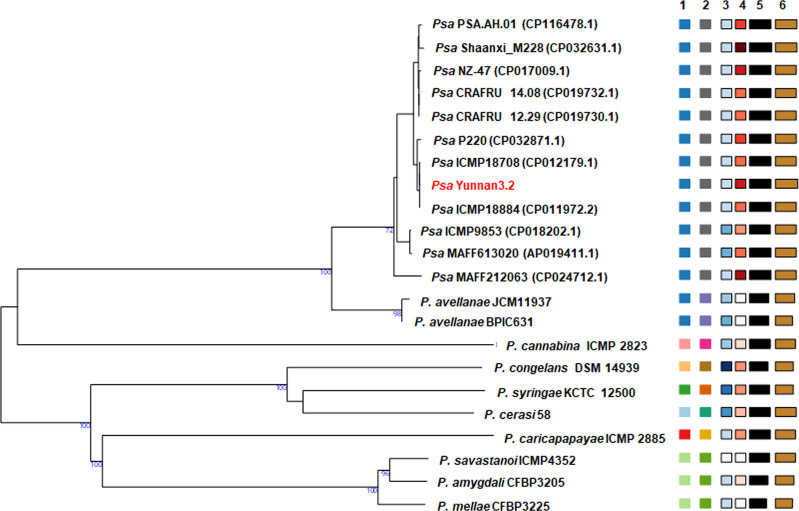 Fig 1
Fig 1| Characteristic | Yunnan3.2 |
|---|---|
| Total bases (bp) | 6,564,315 |
| GC (%) | 58.41 |
| Genes | 6,001 |
| CDSs | 5,918 |
| Complete rRNAs (5S, 16S, 23S) | 6, 5, 5 |
| tRNA | 63 |
| ncRNA | 4 |
| Pseudo genes | 480 |
| CRISPR | 44 |
- —MOST | National Natural Science Foundation of China (NSFC)
- —The Agricultral Science and Technology Innovation Program
Peer Reviews
No public reviews on file for this paper yet. If you reviewed it on a platform where reviews are public (OpenReview, ICLR, NeurIPS, ICML), you can paste yours below so the community can read it here.
Videos
No videos yet. Explain this paper in a talk, walkthrough, or lecture? Add one.
Taxonomy
TopicsPlant Pathogenic Bacteria Studies · Plant-Microbe Interactions and Immunity · Plant and Fungal Species Descriptions
ANNOUNCEMENT
Pseudomonas syringae pv. actinidiae (Psa) causes bacterial canker of kiwifruit (Actinidia deliciosa and A. chinensis), one of the most devastating bacterial diseases of kiwifruit (1). Since Psa was first isolated in Japan (2), it has been found in several countries, including Korea, Italy, France, New Zealand, and Spain (1, 3–7). In China, this disease has been reported in multi-provinces including Sichuan, Hunan, Anhui, and Shaanxi (8–10). Here, we presented a high-quality, complete genome sequence of Psa strain Yunnan3.2.
Psa strain was isolated from diseased kiwifruit branches grown in Zhaotong (N27°, E103°), Yunnan province, China. Branch tissues were sterilized using 70% ethanol and ground with sterile water. The diluted solution was plated onto Luria-Bertani (LB) agar plate (11) and incubated at 28°C. Multiple single colonies were identified as Psa strain through PCR amplification using specific primer pair Psa-F/Psa-R (12). Among them, Yunnan3.2 strain was chosen for sequencing. A single colony of Yunnan3.2 strain was cultured in LB liquid medium for 12 h, and 5 mL of the bacterial suspension was centrifuged to collect bacterial cells. Then, the bacterial cells were submitted to Beijing Novogene Bioinformatics Technology Co., Ltd. (Beijing, China), for sequencing. Genomic DNA was extracted using STE method (13) and quantified with Qubit fluorometer (Thermo Scientific, USA). The whole genome of Yunnan3.2 was sequenced on both the PacBio platform and Illumina PE150 platform, using SMRT bell TM Template kit (version 2.0) and NEBNextUltra DNA Library Prep Kit for Illumina (NEB, USA), respectively. Low-quality reads were filtered using SMRT Link v8.0, and the filtered reads were assembled by software Canu (https://github.com/marbl/canu/, version 2.0) (14). A total of 762,396 reads with an N50 length of 7,919 bp and average read length of 4,972 bp were obtained through PacBio sequencing, which provided approximately 570-fold genome coverage. For Illumina sequencing, paired-end reads (2 × 150 bp), totaling 7,573,333 reads covering a total of 2.272 Gb clean data (Q20, 97.61; Q30, 93.43) with 424-fold genome coverage, were obtained. Pilon v1.23 was employed to correct the assembled genome using Illumina sequence data, resulting in a final genome with high accuracy (15). BLASTN was employed to assess the genomic loops (overlap >2 kb), and the overlapping parts were cut off (16). GeneMarkS was employed to predict and filter genes of the genome (17), while the publicly accessible version of the genome was annotated by NCBI Prokaryotic Genome Annotation Pipeline (PGAP) (18). All tools were run with default parameters unless otherwise specified.
The genomic features for strain Yunnan3.2 are summarized in Table 1. The genome-based classification of strain Yunnan3.2 was conducted using the Type Strain Genome Server (TYGS) web server (19). Phylogenetic analysis revealed that Yunnan3.2 clustered together with two New Zealand Psa strains ICMP18708 (GenBank: CP012179) (20) and ICMP18884 (GenBank: CP011972) (21) (Fig. 1). The average nucleotide identity (ANI) values between strain Yunnan3.2 and ICMP18708, Yunnan3.2 and ICMP18884, and Yunnan3.2 and a Chinese Psa strain Shannxi_M228 (GenBank: CP048810) (22) were 99.95, 99.95, and 99.75, respectively. The analysis of ANI was performed by using EzBioCloud (https://www.ezbiocloud.net/tools/ani) (23).
Phylogenetic tree of Pseudomonas syringae pv. actinidiae strain Yunnan3.2. The phylogenetic analysis was performed by the Type Strain Genome Server (TYGS) based on genome blast distance phylogeny (GBDP) distances calculated from genome sequences. The complete genome sequences of 10 Pseudomonas species were automatically deposited by TYGS. The genome sequences of the other 11 Psa strains were downloaded from the GenBank database. Notably, Yunnan3.2 strain is highlighted in red. The numbers below branches represent GBDP pseudo-bootstrap support values from 100 replications. Leaf labels are annotated according to (1) species cluster, (2) subspecies cluster, (3) percent G + C, (4) delta statistics, (5) genome size (in bp), and (6) protein count, respectively.
The reference list from the paper itself. Each links out to its DOI / PubMed record.
- 1Vanneste JL. 2017. The scientific, economic, and social impacts of the New Zealand outbreak of bacterial canker of kiwifruit (Pseudomonas syringae pv. actinidiae). Annu Rev Phytopathol 55:377–399. doi:10.1146/annurev-phyto-080516-03553028613977 · doi ↗ · pubmed ↗
- 2Takikawa Y, Serizawa S, Ichikawa T, Tsuyumu S, Goto M. 1989. Pseudomonas syringae pv. actinidiae pv. nov.: the causal bacterium of canker of kiwifruit in Japan. Jpn J Phytopathol 55:437–444. doi:10.3186/jjphytopath.55.437 · doi ↗
- 3Kim GH, Kim KH, Son KI, Choi ED, Lee YS, Jung JS, Koh YJ. 2016. Outbreak and spread of bacterial canker of kiwifruit caused by Pseudomonas syringae pv. actinidiae biovar 3 in Korea. Plant Pathol J 32:545–551. doi:10.5423/PPJ.OA.05.2016.012227904461 PMC 5117863 · doi ↗ · pubmed ↗
- 4Renzi M, Copini P, Taddei AR, Rossetti A, Gallipoli L, Mazzaglia A, Balestra GM. 2012. Bacterial canker on kiwifruit in Italy: anatomical changes in the wood and in the primary infection sites. Phytopathology 102:827–840. doi:10.1094/PHYTO-02-12-0019-R 22713076 · doi ↗ · pubmed ↗
- 5Ferrante P, Scortichini M. 2009. Identification of Pseudomonas syringae pv. actinidiae as causal agent of bacterial canker of yellow kiwifruit (actinidia chinensis planchon) in central Italy. Journal of Phytopathology 157:768–770. doi:10.1111/j.1439-0434.2009.01550.x · doi ↗
- 6Vanneste JL, Poliakoff F, Audusseau C, Cornish DA, Paillard S, Rivoal C, Yu J. 2011. First report of Pseudomonas syringae pv. actinidiae, the causal agent of bacterial canker of kiwifruit in France. Plant Dis 95:1311. doi:10.1094/PDIS-03-11-019530731682 · doi ↗ · pubmed ↗
- 7Abelleira A, López MM, Peñalver J, Aguín O, Mansilla JP, Picoaga A, García MJ. 2011. First report of bacterial canker of kiwifruit caused by Pseudomonas syringae pv. actinidiae in Spain. Plant Dis 95:1583. doi:10.1094/PDIS-06-11-053730731983 · doi ↗ · pubmed ↗
- 8Wang Z, Tang X, Liu S. 1992. Identification of the pathogenic bacterium for bacterial canker on Actinidia in Sichuan. Journal of Southwest Agricultural University: unpaginated 14:500–503.