Complete coding genome sequence of a Teschovirus A genotype strain
Yanbin Ding, Xiaofang Xie, Jiefeng Huang, Can Yin, Taotao Yang

TL;DR
Researchers identified and sequenced a new strain of Teschovirus A from a pig's fecal sample in China.
Contribution
The study provides the complete coding genome sequence of a novel Teschovirus A genotype strain.
Findings
A novel Teschovirus A genotype strain, SG2, was isolated from a pig fecal sample in western Jiangxi, China.
The complete coding genome sequence of the SG2 strain was determined.
Abstract
This study reports the complete coding genome sequence of a novel Teschovirus A genotype strain, SG2, isolated from the fecal sample of an infected indigenous pig in western Jiangxi, China.
Genes, proteins, chemicals, diseases, species, mutations and cell lines named across the full text — each resolved to its canonical identifier and authoritative record.
Click any figure to enlarge with its caption.
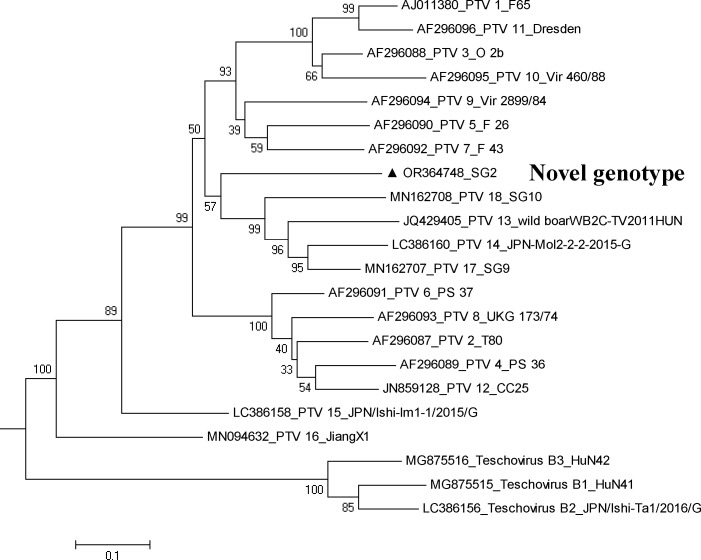 Fig 1
Fig 1| Virus isolate | Genotype | Collection date | GenBank accession No. | Geographic origin | Sequence length |
|---|---|---|---|---|---|
| F65 | 1 | 1967 |
| UK | 7117 |
| T80 | 2 | 1958 |
| UK | 7017 |
| O 2b | 3 | 1965 |
| USA | 7012 |
| PS 36 | 4 | 1965 |
| USA | 7014 |
| F 26 | 5 | 1958 |
| USA | 7008 |
| PS 37 | 6 | 1965 |
| USA | 7018 |
| F 43 | 7 | 1958 |
| Germany | 7014 |
| UKG 173/74 | 8 | 1974 |
| UK | 7017 |
| Vir 2899/84 | 9 | 1984 |
| Germany | 7006 |
| Vir 460/88 | 10 | 1988 |
| Germany | 7009 |
| Dresden | 11 | 1965 |
| Germany | 7111 |
| CC25 | 12 | 2006 |
| Spain | 6952 |
| Wild boar/WB2C-TV/2011/HUN | 13 | 2011 |
| Hungary | 7123 |
| JPN/MoI2-2-2/2015/G | 14 | 2015 |
| Japan | 3342 |
| JPN/Ishi-Im1-1/2015/G | 15 | 2015 |
| Japan | 6820 |
| JiangX1 | 16 | 2019 |
| China | 6799 |
| SG9 | 17 | 2019 |
| China | 6773 |
| SG10 | 18 | 2019 |
| China | 6776 |
| HuN41 | B1 | 2017 |
| China | 6931 |
| JPN/Ishi-Ta1/2016/G | B2 | 2016 |
| Japan | 7163 |
| HuN42 | B3 | 2017 |
| China | 6922 |
- —江西省科学技术厅 | Natural Science Foundation of Jiangxi Province (Jiangxi Natural Science Foundation)
- —Scientific research project of the education department of Jiangxi province
Peer Reviews
No public reviews on file for this paper yet. If you reviewed it on a platform where reviews are public (OpenReview, ICLR, NeurIPS, ICML), you can paste yours below so the community can read it here.
Videos
No videos yet. Explain this paper in a talk, walkthrough, or lecture? Add one.
Taxonomy
TopicsPlant Virus Research Studies · Bacteriophages and microbial interactions · Viral gastroenteritis research and epidemiology
ANNOUNCEMENT
Porcine teschovirus (PTV) causes poliencephalomyelitis in pigs (1). Belonging to the Picornaviridae family, Teschovirus genus, and comprising two species, Teschovirus A and Teschovirus B, PTV genomes consist of a single positive-stranded RNA whose classification is based on sequencing of complete coding genome, also known as polyprotein genome (2). The International Committee on Taxonomy of Viruses (ICTV) described 19 PTV genotypes (Teschovirus A: teschovirus A1 to -A14, Teschovirus B: teschovirus B1 to -B3; recombinant viruses: teschovirus A15_CP_-B_Pol_, teschovirus A16 CP-B_Pol_) in latest published Teschovirus taxonomy information (3). Here, we report the complete coding genome sequence for reference strain SG2, a putative novel Teschovirus A genotype.
SG2 was isolated from the PCR-positive fecal sample of an infected indigenous pig in Yichun village (western Jiangxi, China) in March 2019. The supernatants of the homogenized fecal sample were incubated with porcine kidney (PK-15) cells. Cultures were freeze-thawed three times and centrifuged at 4,000 × g for 5 min. The clarified supernatants were then passaged two times in fresh PK-15 cells. The viral stocks of SG2 strain propagated in PK-15 cell monolayers were used for RNA extraction with FastPure Viral DNA/RNA Mini Kit (Vazyme, Nanjing, China) and cDNA synthesis with RevertAid First Strand cDNA Synthesis Kit (Thermo Scientific, Waltham, MA, USA). First, SG2 cDNA was identified as PTV using a previously developed qRT-PCR method (4). Then, five primer sets designed from our previous work (5) were used to amplify overlapping regions of the complete coding genome sequence of the SG2 strain. The PCR products were purified and then Sanger sequenced (BioSune, Shanghai, China). In all, 12 sequencing reads of about 900 bp with overlapped at least 30 match sizes were obtained. The sequenced results were trimmed by the SeqMan program using a minimum match percentage of 80% within DNAStar software (6).
The near complete genome of 6,815 nucleotides (44.67% G-C content) containing a complete polyprotein coding sequence was obtained. Alignment of the coding sequences of the SG2 strain with those of PTV reference strains (Table 1) revealed that the SG2 strain contains a polyprotein coding genome with 6,627 nucleotides, encoding a polyprotein with 2,209 amino acids. Identity analyses of the polyprotein coding genome sequence of SG2 strain with those of Teschovirus A genotypes reference strains using MegAlign program within DNAStar software (6) revealed higher deduced aa sequence homology of 87.6 to 90.4%, while showed lower aa homology (76.1 to 76.4%) to the Teschovirus B genotypes. A similar result was obtained when analyzing P1 and 2C + 3 CD genes. These results verify SG2 strain belonged to Teschovirus A. To further confirm the genotype of the SG2 strain, the phylogenetic tree of P1 (structural protein coding region, commonly used for PTV genotyping) was constructed using the ML method within MEGA 6.06 software (7). The topological structure of the phylogenetic tree revealed the SG2 strain was found in a separate branch distinct from the other known PTV genotype strains, indicating SG2 strain belonged to a novel PTV genotype (Fig. 1).
Phylogenetic tree based on the amino acid (aa) sequences of the P1 gene. The sequences were aligned by the MUSCLE program within MEGA 6.06 software (7). The tree was constructed using the maximum likelihood in the Jones-Taylor-Thornton model with gamma-distributed rates and proportions of invariant sites (G + I) in MEGA 6.06 software (bootstrap test of 1,000 replicates) (7). The scale bar indicates aa substitutions per site. The reference sequences were collected from the NCBI database. The strain isolated in the present study is indicated by a triangle.
In the present study, a putative novel Teschovirus A genotype was identified. The novel genotype sequence will enrich the knowledge of Teschovirus taxonomy.
The reference list from the paper itself. Each links out to its DOI / PubMed record.
- 1OIE. 2017. Teschovirus encephalomyelitis. In OIE standards commission (ed), manual of diagnostic tests and vaccines for terrestrial animals 2017. Office International des Epizooties, Paris, France.
- 2Zell R, Delwart E, Gorbalenya AE, Hovi T, King AMQ, Knowles NJ, Lindberg AM, Pallansch MA, Palmenberg AC, Reuter G, Simmonds P, Skern T, Stanway G, Yamashita T, Ictv Report Consortium. 2017. ICTV virus taxonomy profile: picornaviridae. J Gen Virol 98:2421–2422. doi:10.1099/jgv.0.00091128884666 PMC 5725991 · doi ↗ · pubmed ↗
- 3ICTV. 2022. International committee on taxonomy of viruses. Available from: https://ictv.global/taxonomy
- 4Yang T, Zhang L, Xie M, Li X, Zhong T. 2019. Development of a SYBR green I-based real-time RT-PCR method for the detection of porcine teschovirus. Chin Vet Sci 49:639–643. doi:10.16656/j.issn.1673-4696.2019.0097 · doi ↗
- 5Yang T, Yu X, Luo B, Yan M, Li R, Qu T, Ren X. 2018. Epidemiology and molecular characterization of porcine teschovirus in Hunan, China. Transbound Emerg Dis 65:480–490. doi:10.1111/tbed.1272829034572 · doi ↗ · pubmed ↗
- 6Burland TG. 2000. DNASTAR's Lasergene sequence analysis software. Methods Mol Biol 132:71–91. doi:10.1385/1-59259-192-2:7110547832 · doi ↗ · pubmed ↗
- 7Tamura K, Stecher G, Peterson D, Filipski A, Kumar S. 2013. MEGA 6: molecular evolutionary genetics analysis version 6.0. Mol Biol Evol 30:2725–2729. doi:10.1093/molbev/mst 19724132122 PMC 3840312 · doi ↗ · pubmed ↗