IncA/C plasmid encoding blaCTX-M-55 in non-O1 Vibrio cholerae isolates from the edible river fish Mastacembelus sp
Takahiro Yamaguchi, Michio Jinnai, Doan Tran Nguyen Minh, Oanh Nguyen Hoang, Hien Le Thi, Phong Ngo Thanh, Phuong Hoang Hoai, Phuc Nguyen Do, Chinh Dang Van, Daisuke Motooka, Shota Nakamura, Yuko Kumeda, Atsushi Hase, Tatsuya Nakayama

TL;DR
A type of Vibrio cholerae found in edible fish in Vietnam was found to carry antibiotic resistance genes on a large plasmid.
Contribution
The discovery of blaCTX-M-55 and blaTEM-1 on an IncA/C plasmid in non-O1 V. cholerae from fish.
Findings
Non-O1 Vibrio cholerae isolates from edible fish in Vietnam were found to produce extended-spectrum β-lactamases.
A plasmid of approximately 183-kb was identified, encoding blaCTX-M-55 and blaTEM-1 genes.
The plasmid belongs to the IncA/C incompatibility group.
Abstract
Extended-spectrum β-lactamase-producing non-O1 Vibrio cholerae was isolated from edible Mastacembelus sp. in Vietnam. The genome sequence was sequenced using DNBSEQ-G400 and MinION Mk1b. A plasmid of approximately 183-kb encoding blaCTX-M-55 and blaTEM-1 was detected.
Genes, proteins, chemicals, diseases, species, mutations and cell lines named across the full text — each resolved to its canonical identifier and authoritative record.
Click any figure to enlarge with its caption.
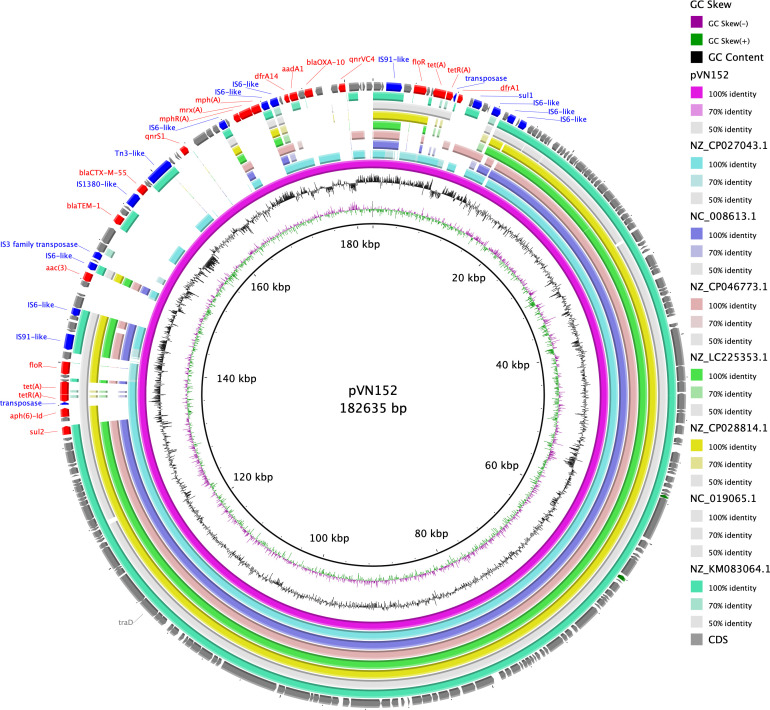 Fig 1
Fig 1| Name | Accession no. | Length (bp) | Gc (%) | Antibiotic resistance gene |
|---|---|---|---|---|
| Chromosome 1 |
| 2,873,080 | 47.9 | – |
| Chromosome 2 |
| 1,202,571 | 46.7 |
|
| pVN152 (plasmid) |
| 182,635 | 52.6 |
- —MEXT | Japan Society for the Promotion of Science (JSPS)
Peer Reviews
No public reviews on file for this paper yet. If you reviewed it on a platform where reviews are public (OpenReview, ICLR, NeurIPS, ICML), you can paste yours below so the community can read it here.
Videos
No videos yet. Explain this paper in a talk, walkthrough, or lecture? Add one.
Taxonomy
TopicsVibrio bacteria research studies · Aquaculture disease management and microbiota · Antibiotic Resistance in Bacteria
ANNOUNCEMENT
The spread of antimicrobial resistance (AMR) is a global threat that needs to be discussed from the perspective of the “One Health” concept. As AMR ha reportedly been found in food microbiomes, the spread of plasmid-mediated AMR through food products should be of concern (1). Sequencing the genomes of antibiotic-resistant bacteria isolated is expected to contribute to infer the origin and to prevent the spread of antibiotic-resistant bacteria. To date, few reports have been made on the complete genome of Vibrio cholerae encoding the extended-spectrum β-lactamase (ESBL)-related gene. Here, we report the whole genome sequence (WGS) of ESBL-producing non-O1 Vibrio cholerae isolated from purchased edible fish from retail stores in Ho Chi Minh City, Vietnam, in March 2020.
Five grams of fresh Mastacembelus sp. fish gut contents were mixed with 45 mL of buffered peptone water (Merck, Darmstadt, Germany). After incubation at 37°C for 24 h, 100 µL of bacterial broth was spread on thiosulfate citrate bile saccharose agar (Shimadzu Diagnostics, Tokyo, Japan) containing cefotaxime (2 µg/mL) and incubated at 37°C for 24 h. Several typical colonies were selected, and Vibrio spp. isolates were investigated for antibiotic susceptibility using previously published approaches (2). As a result of analysis, VN152 was identified as non-O1 V. cholerae. After subculturing in trypticase soy broth medium at 37°C for 18 h, bacterial DNA was extracted using NucleoBond HMW DNA (Takara Bio, Shiga, Japan) for long- read sequencing and smart DNA prep (Analytik Jena, Kanagawa, Japan) for short-read sequencing according to the manufacturer’s instructions, respectively. The extracted DNA was checked using a Qubit dsDNA HS Assay Kit (Thermo Fisher Scientific, Waltham, USA). The library for short- and long-read sequencing was prepared with MGIEasy FS DNA Library Prep Kit V2.0 (MGI Tech, Shenzhen, China) and Rapid Barcoding Sequencing (SQK-RBK004) kit according to the manufacturer’s protocol, respectively. Short-read sequencing and long-read sequencing were performed using DNBSEQ-G400 (MGI Tech, Shenzhen, China) with a 2 × 200 bp paired-end protocol and Oxford Nanopore MinION Mk1b (Oxford Nanopore Technologies, Oxford, UK) with flow cell R9.4.1 according to the manufacturer’s instructions, respectively. After obtaining short-read sequences (total reads 11,708,392; mean length after filtering 2 × 199 bp reads; total bases 2.33 Gb; coverage 568×), trimming and quality checks were conducted using fastp v0.20.0 (3). Short- and long-read quality checks were performed with fastqc v0.11.9 (4) and NanoPlot v1.38.0 (5), respectively. The long-read sequencing data (total reads 41,730; read length N_50_ 17,270 bp; total bases 421 Mb; coverage 105×) were trimmed and then assembled using flye v2.9.2 (6). Short-read sequencing data were used for polishing the long-read assembly with polypolish v.0.5.0. Annotation was performed using DFAST. The assembled WGS was analyzed for non-O1 V. cholerae using TYGS (https://tygs.dsmz.de), MLST2.0, and ResFinder4.1. Default parameters were used except where otherwise noted.
The assembly resulted in three contigs, carrying two chromosomes (2,873,080 and 1,202,571 bp) and plasmid IncA/C blaCTX-M-55 (182,635 bp) (Table 1). The assembled hybrid genome was analyzed using TYGS to confirm that Vibrio cholerae had been isolated, and this isolate did not have the O1 antigen. The results of ResFinder analysis showed blaCTX-M-55, blaTEM-1, blaOXA-10, floR, tet(A), dfrA1, 14, sul1, 2, aph(3″)-Ib, aph(6)-Id, aac (3)-IId, mph(A), cmlA1, qnrS1, and qnrVC4 on plasmid (coverage >95%, identity >95%) (Table 1). The pVN152 was compared with plasmids with high similarity as a result of BLAST (Fig. 1). None of the compared plasmids had blaCTX-M-55.
TABLE 1: Genome information of non-O1 V. cholerae VN152
<table><colgroup><col/><col/><col/><col/><col/></colgroup><thead><tr><th align="left" colspan="1" rowspan="1">Name</th><th align="left" colspan="1" rowspan="1">Accession no.</th><th align="left" colspan="1" rowspan="1">Length (bp)</th><th align="left" colspan="1" rowspan="1">Gc (%)</th><th align="left" colspan="1" rowspan="1">Antibiotic resistance gene</th></tr></thead><tbody><tr><td align="left" colspan="1" rowspan="1">Chromosome 1</td><td align="left" colspan="1" rowspan="1"> <ext-link xmlns:xlink="http://www.w3.org/1999/xlink">AP028804</ext-link> </td><td align="left" colspan="1" rowspan="1">2,873,080</td><td align="left" colspan="1" rowspan="1">47.9</td><td align="left" colspan="1" rowspan="1">–<xref><sup><italic>a</italic></sup></xref></td></tr><tr><td align="left" colspan="1" rowspan="1">Chromosome 2</td><td align="left" colspan="1" rowspan="1"> <ext-link xmlns:xlink="http://www.w3.org/1999/xlink">AP028806</ext-link> </td><td align="left" colspan="1" rowspan="1">1,202,571</td><td align="left" colspan="1" rowspan="1">46.7</td><td align="left" colspan="1" rowspan="1"> <italic>qnrVC4</italic> </td></tr><tr><td align="left" colspan="1" rowspan="1">pVN152 (plasmid)</td><td align="left" colspan="1" rowspan="1"> <ext-link xmlns:xlink="http://www.w3.org/1999/xlink">AP028805</ext-link> </td><td align="left" colspan="1" rowspan="1">182,635</td><td align="left" colspan="1" rowspan="1">52.6</td><td align="left" colspan="1" rowspan="1"><italic>bla</italic><sub>CTX-M-55</sub>, <italic>bla</italic><sub>TEM-1</sub>, <italic>bla</italic><sub>OXA-10</sub>, <italic>floR</italic>, <italic>tet(A</italic>), <italic>dfrA1</italic>, <italic>14</italic>, <italic>sul1</italic>, <italic>2</italic>, <italic>aph(3'')-Ib</italic>, <italic>aph(6)-Id</italic>, <italic>aac (3)-Iid</italic>, <italic>mph(A</italic>), <italic>ant(3″)-Ia</italic>, <italic>cmlA1</italic>, <italic>qnrS1</italic>, <italic>qnrVC4</italic></td></tr></tbody></table>Complete plasmid map of pVN152 from non-O1 Vibrio cholerae VN152. Comparison with seven highly similar plasmids (GenBank accession no. NZ_CP027043.1, NC_008613.1, NZ_CP046773.1, NZ_LC225353.1, NZ_CP028814.1, NC_019065.1, and NZ_KM083064.1). Plasmid maps were designed using BLAST Ring Image Generator v0.95.
The reference list from the paper itself. Each links out to its DOI / PubMed record.
- 1Nakayama T, Yamaguchi T, Jinnai M, Kawahara R, Asakura H, Kumeda Y, Hase A. 2021. Wide spread of plasmid-mediated antibiotic resistant bacteria in imported fishery products. Jpn J Food Microbiol 38:1–11. doi:10.5803/jsfm.38.67 · doi ↗
- 2Nakayama T, Yamaguchi T, Jinnai M, Kumeda Y, Hase A. 2023.ESBL-producing Vibrio vulnificus and V. alginolyticus harbour a plasmid encoding IS Ec 9 upstream of bla CTX-M-55 and qnr S 2 isolated from imported seafood. Arch Microbiol 205:241–241. doi:10.1007/s 00203-023-03569-x 37198473 · doi ↗ · pubmed ↗
- 3Chen S, Zhou Y, Chen Y, Gu J. 2018. fastp: an ultra-fast all-in-one FASTQ preprocessor. Bioinformatics 34:i 884–i 890. doi:10.1093/bioinformatics/bty 56030423086 PMC 6129281 · doi ↗ · pubmed ↗
- 4De Coster W, D’Hert S, Schultz DT, Cruts M, Broeckhoven CV. 2018. Nano Pack: visualizing and processing long-read sequencing data. Bioinformatics 34:2666–2669. doi:10.1093/bioinformatics/bty 14929547981 PMC 6061794 · doi ↗ · pubmed ↗
- 5Wick RR, Judd LM, Gorrie CL, Holt KE. 2017. Unicycler: resolving bacterial genome assemblies from short and long sequencing reads. P Lo S Comput Biol 13:e 1005595. doi:10.1371/journal.pcbi.100559528594827 PMC 5481147 · doi ↗ · pubmed ↗