Complete genome of Escherichia phages Carena and JoYop
Audrey A. Addablah, Solange E. Ngazoa-Kakou, Emmanuella A. Adioumani, Simon J. Labrie, Denise M. Tremblay, Damitha Gunathilake, Sylvain Moineau

TL;DR
This paper reports the complete genomes of two Escherichia phages, Carena and JoYop, isolated from water in Abidjan.
Contribution
The study provides new genomic sequences and identifies close relatives for these phages.
Findings
Carena has a 39,283 bp genome with 44 predicted genes.
JoYop has a 169,193 bp genome with 246 predicted genes.
Carena and JoYop show high nucleotide identity with known phage species.
Abstract
Escherichia phages Carena and JoYop were isolated from water samples in Abidjan (Cote d’Ivoire). Their genomes comprise 39,283 and 169,193 bp, encoding 44 and 246 predicted genes, respectively. Carena shares 93.4% nucleotide identity with Escherichia podophage CarlSpitteler (Berlinvirus), and JoYop shows 95.6% identity with Escherichia myophage ADUt (Tequatrovirus).
Genes, proteins, chemicals, diseases, species, mutations and cell lines named across the full text — each resolved to its canonical identifier and authoritative record.
Click any figure to enlarge with its caption.
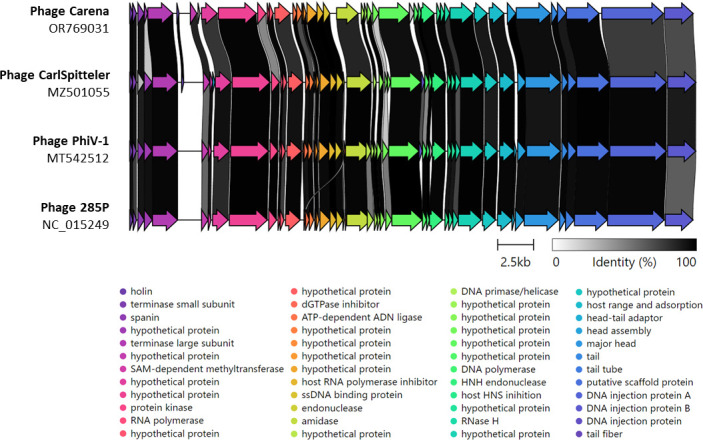 Fig 1
Fig 1- —University of Lomé in Togo
- —West African Research Association
- —Canada Research Chairs (Chaires de recherche du Canada)
Peer Reviews
No public reviews on file for this paper yet. If you reviewed it on a platform where reviews are public (OpenReview, ICLR, NeurIPS, ICML), you can paste yours below so the community can read it here.
Videos
No videos yet. Explain this paper in a talk, walkthrough, or lecture? Add one.
Taxonomy
TopicsBacteriophages and microbial interactions · Plant Virus Research Studies · Genomics and Phylogenetic Studies
ANNOUNCEMENT
To establish a phage biobank for biocontrol purposes in Côte d’Ivoire, new phages are being isolated and characterized (1–3). Escherichia phages Carena and JoYop were previously isolated from the samples collected in Ebrié Lagoon (latitude 5.356322; longitude −4.091498) and in wastewater of Yopougon (latitude 5.327334; longitude −4.028653), respectively (1). Filtered water samples were added to Escherichia coli C in LB (Luria-Bertani) medium and incubated at 37°C for 48 h. Plaques were purified (double-agar layer method) and reamplified with their host in LB at 37°C for 8 h. Observations of phosphotungstic acid-stained phage preparations with a transmission electron microscope (4, 5) revealed that Carena is a podophage and JoYop is a myophage.
DNA was purified from high-titer (>10e^9^ pfu/mL) lysate using phenol-chloroform (6). Illumina DNA Prep kit and IDT 10 bp UDI indices were used for library preparation for genome sequencing. Paired-end reads (2 × 151 bp) were generated with NextSeq 2000 (SeqCenter, Pittsburgh, PA, USA). A total of 10,096,099 and 4,212,638 reads were generated for Carena and JoYop, respectively. Demultiplexing, read quality control, and adapter trimming were performed with bcl-convert (v3.9.3). Assembly was separately performed with Spades v3.13.0 (7) and Ray (8). Both assemblers gave the same contig for each phage. Viral genes were identified with Prodigal v2.6.3 (Prokka) and Glimmer v1.5 (Geneious v11.0.5). Functional annotation was performed with Prokka Galaxy v1.14.5 (9) with NCBI domain searches (10) and blastp (11). Comparisons with other phage genomes were made using NCBI megablast to confirm completeness (11). Tools were run with default parameters.
Carena has a dsDNA genome of 39,283 bp (11,338× coverage), while JoYop contains 169,193 bp (1,741× coverage) with a GC content of 49% and 35.5%, respectively. Homology searches indicated that Carena is related to coliphage CarlSpitteler (Bas68) (12) with an average nucleotide identity (ANI, http://enve-omics.ce.gatech.edu/ani/) of 93.2% and to Escherichia phages 285P (ANI 91.2%) (13) and PhiV-1 (ANI 93.2%) (14) (Fig. 1). Thus, Carena belongs to the Berlinvirus genus of the Autographiviridae family. Forty-four genes were predicted, and 30 deduced proteins (68%) had a predicted function, including proteins involved in DNA replication and packaging, regulation, morphogenesis, and cell lysis. The least conserved proteins are the tail fibers (car1b_044) and two hypothetical proteins (car1b_011 and car1b_026).
Genome alignment of phage Carena with the genomes of phages CarlSpitter, PhiV-1, and 285P. This analysis was performed using Clinker (15). The identity regions in amino acids are represented in shades of gray.
Phage JoYop is related to Escherichia phages ADUt (ANI 94.7%) (16), vB_EcoM_R5505 (ANI 94.5%) (17), and HP3 (ANI 94.2%) (18). Thus, it belongs to the Tequatrovirus genus of the Straboviridae family. We predicted 276 genes, including 147 deduced proteins (53%) with predicted functions. Notable proteins include beta-glucosyl-HMC-alpha-glucosyltransferase (cm3_154), alpha-glucosyltransferase (cm3_171), and restriction-modification evasion (cm3_091, cm3_235, cm3_236, cm3_239, and cm3_255) (19). In addition to lysis inhibition proteins rIIA (cm3_110) and rIIB (cm3_109), JoYop encodes for immunity to superinfection (cm3_156) (20). This genome also contains nine tRNAs (Arg, Asn, Tyr, Met, Thr, Ser, Pro, Gly, and Leu), which may compensate for host’s tRNAs due to the differences in GC content or to counteract depletion as an early response to phage infection (21, 22).
The reference list from the paper itself. Each links out to its DOI / PubMed record.
- 1Addablah AYA, Kakou-Ngazoa S, Akpa EE, M’Bourou Ndombi F, Adioumani E, Koudou A, Coulibaly N’Golo D, Kouame Sina M, Kouassi SK, Aoussi S, Dosso M. 2021. Investigation of phages infecting Escherichia coli strains B and C, and Enterobacter cloacae in sewage and Ebrié lagoon, Côte d’Ivoire. Phage 2:104–111. doi:10.1089/phage.2020.004736161244 PMC 9041496 · doi ↗ · pubmed ↗
- 2Ngazoa-Kakou S, Philippe C, Tremblay DM, Loignon S, Koudou A, Abole A, Ngolo Coulibaly D, Kan Kouassi S, Kouamé Sina M, Aoussi S, Dosso M, Moineau S. 2018. Complete genome sequence of Ebrios, a novel T 7-virus isolated from the lagoon Ebrie in Abidjan Côte d’Ivoire. Genome Announc 6:e 00280-18. doi:10.1128/genome A.00280-1829930030 PMC 6013611 · doi ↗ · pubmed ↗
- 3Ngazoa-Kakou S, Shao Y, Rousseau GM, Addablah AA, Tremblay DM, Hutinet G, Lemire N, Plante P-L, Corbeil J, Koudou A, Soro BK, Coulibaly DN, Aoussi S, Dosso M, Moineau S. 2019. Complete genome of Escherichia coli siphophage BRET. Microbiol Resour Announc 8:e 01644-18. doi:10.1128/MRA.01644-1830714038 PMC 6357644 · doi ↗ · pubmed ↗
- 4Fortier L-C, Moineau S. 2007. Morphological and genetic diversity of temperate phages in Clostridium difficile. Appl Environ Microbiol 73:7358–7366. doi:10.1128/AEM.00582-0717890338 PMC 2168219 · doi ↗ · pubmed ↗
- 5Dion MB, Oechslin F, Moineau S. 2020. Phage diversity, genomics, and phylogeny. Nat Rev Microbiol 18:125–138. doi:10.1038/s 41579-019-0311-532015529 · doi ↗ · pubmed ↗
- 6Moineau S, Pandian S, Klaenhammer TR. 1994. Evolution of a lytic bacteriophage via DNA acquisition from the Lactococcus lactis chromosome. Appl Environ Microbiol 60:1832–1841. doi:10.1128/aem.60.6.1832-1841.199416349277 PMC 201570 · doi ↗ · pubmed ↗
- 7Bankevich A, Nurk S, Antipov D, Gurevich AA, Dvorkin M, Kulikov AS, Lesin VM, Nikolenko SI, Pham S, Prjibelski AD, Pyshkin AV, Sirotkin AV, Vyahhi N, Tesler G, Alekseyev MA, Pevzner PA. 2012. SP Ades: a new genome assembly algorithm and its applications to single-cell sequencing. J Comput Biol 19:455–477. doi:10.1089/cmb.2012.002122506599 PMC 3342519 · doi ↗ · pubmed ↗
- 8Boisvert S, Laviolette F, Corbeil J. 2010. Ray: simultaneous assembly of reads from a mix of high-throughput sequencing technologies. J Comput Biol 17:1519–1533. doi:10.1089/cmb.2009.023820958248 PMC 3119603 · doi ↗ · pubmed ↗