Draft genome sequences of Pseudomonas strains zfem001–005 isolated from the intestine of larval zebrafish Danio rerio
Sabona B. Simbassa, Justin Clark, Keiko Salazar, Anthony Maresso, Anne- Marie Krachler

TL;DR
This paper presents the draft genomes of five Pseudomonas strains found in the gut of young zebrafish.
Contribution
The study provides new genomic data for five Pseudomonas species isolated from zebrafish larvae.
Findings
Five Pseudomonas strains were isolated from the gut of 7-day-old zebrafish larvae.
Each isolate was identified as a distinct Pseudomonas species.
Draft genome sequences for these isolates were generated.
Abstract
Here, we report the draft genome sequences of Pseudomonas strains zfem001–005, five isolates from the intestinal microbiota of healthy larval zebrafish Danio rerio at a developmental age of 7 days post fertilization. The isolates have been identified as Pseudomonas sediminis, Pseudomonas japonica, Pseudomonas otitidis, Pseudomonas sichuanensis, and Pseudomonas tohonis, respectively.
Genes, proteins, chemicals, diseases, species, mutations and cell lines named across the full text — each resolved to its canonical identifier and authoritative record.
Click any figure to enlarge with its caption.
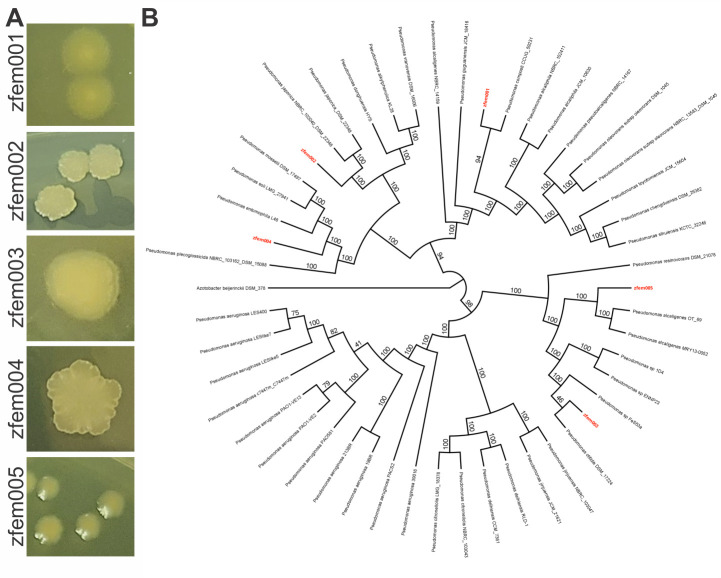 Fig 1
Fig 1| Isolate ID | PubMLST species ID | Genome size | GC content | Number of contigs | Number of reads | Assembly stats | N50 length |
|---|---|---|---|---|---|---|---|
|
| 5,150,040 | 62.4 | 12 | 10.8M | Assembled using 2,943,983 paired hits and 1,740 unpaired hits | 469,972 | |
|
| 6,799,339 | 64.3 | 57 | 12.6M | Assembled using 2,854,410 paired hits and 3,098 unpaired hits | 202,513 | |
|
| 6,825,556 | 67.1 | 25 | 13.8M | Assembled using 3,115,034 paired hits and 3,438 unpaired hits | 535,079 | |
|
| 5,828,281 | 64 | 50 | 13.8M | Assembled using 2,453,113 paired hits and 1,857 unpaired hits | 201,843 | |
|
| 6,927,531 | 66.2 | 27 | 10.8M | Assembled using 1,974,192 paired hits and 838 unpaired hits | 423,767 |
- —HHS | National Institutes of Health (NIH)
- —HHS | National Institutes of Health (NIH)
Peer Reviews
No public reviews on file for this paper yet. If you reviewed it on a platform where reviews are public (OpenReview, ICLR, NeurIPS, ICML), you can paste yours below so the community can read it here.
Videos
No videos yet. Explain this paper in a talk, walkthrough, or lecture? Add one.
Taxonomy
TopicsHealth, Nursing, Elderly Care
ANNOUNCEMENT
Larval zebrafish are increasingly used as a vertebrate model for intestinal host–microbe interactions due to their genetic tractability, optical transparency, and a physiology that shares many similarities with mammalian models (1). The endogenous microbiota and its interactions with larval and adult zebrafish have been extensively characterized (2, 3). These studies have shown that, although larval zebrafish are colonized early during development and form a stable gut microbiome, the composition of the microbiome varies between different facilities (4). In order to provide a resource for colonization studies on larval zebrafish, we have isolated five of the most abundant isolates from the intestinal tissues of larval zebrafish derived from the Center for Laboratory Animal Medicine and Care aquatics facility at UTHealth Science Center at Houston at 7 days post fertilization (dpf) and sequenced their genomes.
At 7 dpf, larval zebrafish were euthanized, and intestinal tissues were homogenized, diluted, and plated on lysogeny broth (LB) agar as described previously (5). Following growth on LB agar at 37°C for 20 h, individual colonies were picked and streak purified twice on LB agar, with an incubation at 37°C for 20 h each time (colony morphologies; see Fig. 1A). Prior to DNA isolation, individual colonies were used to inoculate LB, and cultures were grown at 37°C for 20 h, shaking at 185 rpm.
(A) Colony morphology of Pseudomonas isolates zfem001–005 grown on LB agar. (B) Phylogenetic tree was generated using autoMLST in de novo mode with concatenated alignments and 1,000 ultrafast bootstrap replicates. Branch labels show percent consensus bootstrap support. Tree is rooted in Azobacter beijerinckii DSM 378 (accession number NZ_FOFJ00000000.1).
Genomic DNA was extracted from all five isolates using the Omega E.Z.N.A. Bacterial DNA Kit and was sent to Novogene for sequencing on the Illumina HiSeq 4000 platform. Raw reads were trimmed to a quality score of 30, and reads under 50 bp were filtered out using BBDuk (v.38.84) with default parameters (6). Trimmed reads were subsampled using Geneious Assembler to bring assembled coverage depth to between 40× and 80× and then assembled using Geneious Assembler in Geneious Prime (v.2022.1.1) (https://www.geneious.com), with medium-low sensitivity settings. Contigs that were larger than 1,000 bp and consistent with the largest contigs in terms of coverage were extracted and used as a reference to validate all reads by mapping all reads to the reference in Geneious Assembler with settings to detect variants of any size. For detailed assembly statistics, see Table 1. Assemblies were then annotated using the National Center for Biotechnology Information (NCBI) Prokaryotic Genome Annotation Pipeline (v.6.6) (7) and default parameters. BLAST was used to search assemblies against the NCBI 16S ribosomal RNA sequence database to find closely related strains (8, 9). A tree was created using autoMLST in de novo mode with a concatenated alignment and 1,000 IQ-TREE Ultrafast Bootstrap replicates (10). The displayed taxa were chosen manually from the strains in the Pseudomonas genus that were among the 50 closest species identified by autoMLST. The phylogenetic tree (Fig. 1B) was plotted using Geneious Tree Viewer and rooted in Azobacter beijerinckii DSM 378 (accession number NZ_FOFJ00000000.1). Species designations (Table 1) were determined using PubMLST (v.1) (https://pubmlst.org/) (11).
TABLE 1: Pseudomonas isolates zfem001–005 properties and assembly statistics
<table><colgroup><col/><col/><col/><col/><col/><col/><col/><col/></colgroup><thead><tr><th align="left" colspan="1" rowspan="1">Isolate ID</th><th align="left" colspan="1" rowspan="1">PubMLST species ID</th><th align="left" colspan="1" rowspan="1">Genome size<break/>(bp)</th><th align="left" colspan="1" rowspan="1">GC content<break/>(%)</th><th align="left" colspan="1" rowspan="1">Number of contigs</th><th align="left" colspan="1" rowspan="1">Number of reads</th><th align="left" colspan="1" rowspan="1">Assembly stats</th><th align="left" colspan="1" rowspan="1">N50 length<break/>(bp)</th></tr></thead><tbody><tr><td align="left" colspan="1" rowspan="1"><italic>Pseudomona</italic>s zfem001</td><td align="left" colspan="1" rowspan="1"> <italic>Pseudomonas sediminis</italic> </td><td align="left" colspan="1" rowspan="1">5,150,040</td><td align="left" colspan="1" rowspan="1">62.4</td><td align="left" colspan="1" rowspan="1">12</td><td align="left" colspan="1" rowspan="1">10.8M</td><td align="left" colspan="1" rowspan="1">Assembled using 2,943,983 paired hits and 1,740 unpaired hits</td><td align="left" colspan="1" rowspan="1">469,972</td></tr><tr><td align="left" colspan="1" rowspan="1"><italic>Pseudomonas</italic> zfem002</td><td align="left" colspan="1" rowspan="1"> <italic>Pseudomonas japonica</italic> </td><td align="left" colspan="1" rowspan="1">6,799,339</td><td align="left" colspan="1" rowspan="1">64.3</td><td align="left" colspan="1" rowspan="1">57</td><td align="left" colspan="1" rowspan="1">12.6M</td><td align="left" colspan="1" rowspan="1">Assembled using 2,854,410 paired hits and 3,098 unpaired hits</td><td align="left" colspan="1" rowspan="1">202,513</td></tr><tr><td align="left" colspan="1" rowspan="1"><italic>Pseudomonas</italic> zfem003</td><td align="left" colspan="1" rowspan="1"> <italic>Pseudomonas otitidis</italic> </td><td align="left" colspan="1" rowspan="1">6,825,556</td><td align="left" colspan="1" rowspan="1">67.1</td><td align="left" colspan="1" rowspan="1">25</td><td align="left" colspan="1" rowspan="1">13.8M</td><td align="left" colspan="1" rowspan="1">Assembled using 3,115,034 paired hits and 3,438 unpaired hits</td><td align="left" colspan="1" rowspan="1">535,079</td></tr><tr><td align="left" colspan="1" rowspan="1"><italic>Pseudomonas</italic> zfem004</td><td align="left" colspan="1" rowspan="1"> <italic>Pseudomonas sichuanensis</italic> </td><td align="left" colspan="1" rowspan="1">5,828,281</td><td align="left" colspan="1" rowspan="1">64</td><td align="left" colspan="1" rowspan="1">50</td><td align="left" colspan="1" rowspan="1">13.8M</td><td align="left" colspan="1" rowspan="1">Assembled using 2,453,113 paired hits and 1,857 unpaired hits</td><td align="left" colspan="1" rowspan="1">201,843</td></tr><tr><td align="left" colspan="1" rowspan="1"><italic>Pseudomonas</italic> zfem005</td><td align="left" colspan="1" rowspan="1"> <italic>Pseudomonas tohonis</italic> </td><td align="left" colspan="1" rowspan="1">6,927,531</td><td align="left" colspan="1" rowspan="1">66.2</td><td align="left" colspan="1" rowspan="1">27</td><td align="left" colspan="1" rowspan="1">10.8M</td><td align="left" colspan="1" rowspan="1">Assembled using 1,974,192 paired hits and 838 unpaired hits</td><td align="left" colspan="1" rowspan="1">423,767</td></tr></tbody></table>The reference list from the paper itself. Each links out to its DOI / PubMed record.
- 1Wallace KN, Pack M. 2003. Unique and conserved aspects of gut development in zebrafish. Dev Biol 255:12–29. doi:10.1016/s 0012-1606(02)00034-912618131 · doi ↗ · pubmed ↗
- 2Rawls JF, Samuel BS, Gordon JI. 2004. Gnotobiotic zebrafish reveal evolutionarily conserved responses to the gut microbiota. Proc Natl Acad Sci USA 101:4596–4601. doi:10.1073/pnas.040070610115070763 PMC 384792 · doi ↗ · pubmed ↗
- 3Bates JM, Mittge E, Kuhlman J, Baden KN, Cheesman SE, Guillemin K. 2006. Distinct signals from the microbiota promote different aspects of zebrafish gut differentiation. Dev Biol 297:374–386. doi:10.1016/j.ydbio.2006.05.00616781702 · doi ↗ · pubmed ↗
- 4Roeselers G, Mittge EK, Stephens WZ, Parichy DM, Cavanaugh CM, Guillemin K, Rawls JF. 2011. Evidence for a core gut microbiota in the zebrafish. ISME J 5:1595–1608. doi:10.1038/ismej.2011.3821472014 PMC 3176511 · doi ↗ · pubmed ↗
- 5Stones DH, Fehr AGJ, Thompson L, Rocha J, Perez-Soto N, Madhavan VTP, Voelz K, Krachler AM. 2017. Zebrafish (Danio rerio) as a vertebrate model host to study colonization, pathogenesis, and transmission of foodborne Escherichia coli O 157. m Sphere 2:e 00365-17. doi:10.1128/m Sphere Direct.00365-1728959735 PMC 5607324 · doi ↗ · pubmed ↗
- 6Bushnell B. 2014. BB Map: A fast, accurate, splice-aware Aligner. United States: N. p. Web.
- 7Tatusova T, Di Cuccio M, Badretdin A, Chetvernin V, Nawrocki EP, Zaslavsky L, Lomsadze A, Pruitt KD, Borodovsky M, Ostell J. 2016. NCBI prokaryotic genome annotation pipeline. Nucleic Acids Res 44:6614–6624. doi:10.1093/nar/gkw 56927342282 PMC 5001611 · doi ↗ · pubmed ↗
- 8Camacho C, Coulouris G, Avagyan V, Ma N, Papadopoulos J, Bealer K, Madden TL. 2009. BLAST+: architecture and applications. BMC Bioinformat 10:421. doi:10.1186/1471-2105-10-421PMC 280385720003500 · doi ↗ · pubmed ↗