Bidirectional Evolution of SARS‐CoV‐2 Virus in Immunocompromised Hosts
Charmaine W. Y. Chew, Barnaby E. Young, Paul A. Tambyah, Shawn Vasoo, Conrad E. Z. Chan

Abstract
Genes, proteins, chemicals, diseases, species, mutations and cell lines named across the full text — each resolved to its canonical identifier and authoritative record.
Click any figure to enlarge with its caption.
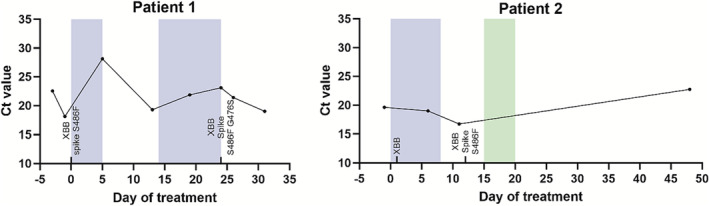 Figure 1
- —National Centre for Infectious Diseases
Peer Reviews
No public reviews on file for this paper yet. If you reviewed it on a platform where reviews are public (OpenReview, ICLR, NeurIPS, ICML), you can paste yours below so the community can read it here.
Videos
No videos yet. Explain this paper in a talk, walkthrough, or lecture? Add one.
Taxonomy
TopicsSARS-CoV-2 and COVID-19 Research · COVID-19 epidemiological studies · COVID-19 Clinical Research Studies
To the editor:
SARS‐CoV‐2 has accumulated significant mutations to evade both vaccine‐ and infection‐induced immunity. Some of the currently dominant Omicron subvariants are thought to have initially evolved in immunocompromised patients despite the lack of selection pressure from the host immune response or poor vaccine response [1]. Interestingly, some of these mutations such as K417N and F486S have been shown to reduce spike affinity for the cellular ACE2 receptor and lead to reduced fitness in vitro [2, 3]. Consistent with these findings, we have observed the loss of the mutation F486S in 0.29% of XBB sequences from Singapore submitted to GISAID between October and December 2022. This reversion of acquired mutations has not been previously reported to our knowledge. Clinical and laboratory data were available for two immunocompromised patients (a renal transplant recipient and another with relapsed lymphoma) with such reversions.
Receptor binding region sequences were obtained by Sanger sequencing from nasopharyngeal swabs using previously published primers [4], and viral load was determined by RT‐PCR using the Roche COBAS SARS CoV‐2 test kit and anti‐spike antibody serology using the Elecsys Anti‐SARS‐CoV‐2 S test kit. The dates of sampling, viral load, and duration of treatment are shown in Figure 1 and patient details in Table 1.
Both patients were identified to have the XBB subvariant, the dominant circulating strain in Singapore at that time. At initial sampling, the first patient's sample already exhibited reversion of F486S, which was also present at the second sampling 25 days later by which time a second spike mutation G476S had emerged. The second patient lacked the reversion on initial sampling but was found to have the reversion at the second sampling 12 days later without further mutational changes. While we cannot conclusively demonstrate that the first patient's reversion occurred within the host, the low frequency of this mutation in sequenced SARS‐CoV‐2 XBB genomes in Singapore collected between October and December 2022 [5] (five out of 1712, GISAID EPI_SET_231120fh) suggests that this might indeed have evolved in the immunocompromised host as was documented in the second patient.
Repeated infection with newer Omicron variants may result in an increase in variant‐specific but paradoxically a loss of cross‐variant immunity [6]. Our observations suggest that re‐emergence of variants resembling wild type could occur in hosts without pre‐Omicron immunity, which may lead to the higher case‐fatality rates associated with pre‐Omicron strains [7]. Our findings highlight the importance of continued genomic surveillance especially in immunocompromised hosts for variants with pre‐Omicron characteristics that may affect vaccination strategies for this population.
Author Contributions
Charmaine W.Y. Chew: Formal analysis; investigation. Barnaby E. Young: Funding acquisition; resources; writing—original draft. Paul A. Tambyah: Resources; writing—original draft; writing—review and editing. Shawn Vasoo: Funding acquisition; supervision; writing—original draft; writing—review and editing. Conrad E.Z. Chan: Formal analysis; funding acquisition; investigation; supervision; writing—original draft; writing—review and editing.
Ethics Statement
Ethics approval was obtained from the National Healthcare Group DSRB under the following study: 2012/00917—A Multi‐centered Prospective Study to Detect Novel Pathogens and Characterize Emerging Infections.
Conflicts of Interest
A/Prof. Young reports personal fees from AstraZeneca, Gilead, Pfizer, Sanofi‐Pasteur, and Moderna outside the submitted work. Prof. Tambyah reports personal fees from Moderna and Sanofi‐Pasteur outside the submitted work. Other authors declare no conflicts of interest.
Peer Review
The peer review history for this article is available at https://www.webofscience.com/api/gateway/wos/peer‐review/10.1111/irv.13266.
The reference list from the paper itself. Each links out to its DOI / PubMed record.
- 1E. M. Scherer , A. Babiker , M. W. Adelman , et al., “SARS‐Co V‐2 Evolution and Immune Escape in Immunocompromised Patients,” N Engl J Med 386, no. 25 (2022): 2436–2438.35675197 10.1056/NEJ Mc 2202861 PMC 9202319 · doi ↗ · pubmed ↗
- 2P. Qu , J. P. Evans , J. N. Faraone , et al., “Enhanced Neutralization Resistance of SARS‐Co V‐2 Omicron Subvariants BQ.1, BQ.1.1, BA.4.6, BF.7, and BA.2.75.2,” Cell Host Microbe 31 (2023): 9–17.e 3.36476380 10.1016/j.chom.2022.11.012PMC 9678813 · doi ↗ · pubmed ↗
- 3T. N. Starr , A. J. Greaney , C. M. Stewart , et al., “Deep Mutational Scans for ACE 2 Binding, RBD Expression, and Antibody Escape in the SARS‐Co V‐2 Omicron BA.1 and BA.2 Receptor‐Binding Domains,” P Lo S Pathog 18, no. 11 (2022): e 1010951.36399443 10.1371/journal.ppat.1010951 PMC 9674177 · doi ↗ · pubmed ↗
- 4N. E. Freed , M. Vlková , M. B. Faisal , and O. K. Silander , “Rapid and Inexpensive Whole‐Genome Sequencing of SARS‐Co V‐2 Using 1200 Bp Tiled Amplicons and Oxford Nanopore Rapid Barcoding,” Biol Methods Protoc 5, no. 1 (2020).10.1093/biomethods/bpaa 014PMC 745440533029559 · doi ↗ · pubmed ↗
- 5Shruti Khare , C. Gurry , L. Freitas , et al., “GISAID's Role in Pandemic Response,” China CDC Wkly 3, no. 49 (2021): 1049–1051.34934514 10.46234/ccdcw 2021.255PMC 8668406 · doi ↗ · pubmed ↗
- 6A. Yisimayi , W. Song , J. Wang , et al., “Repeated Omicron Exposures Override Ancestral SARS‐Co V‐2 Immune Imprinting,” bio Rxiv (2023), 10.1101/2023.05.01.538516.PMC 1076427537993710 · doi ↗ · pubmed ↗
- 7C. Wang , B. Liu , S. Zhang , et al., “Differences in Incidence and Fatality of COVID‐19 by SARS‐Co V‐2 Omicron Variant Versus Delta Variant in Relation to Vaccine Coverage: A World‐Wide Review,” J Med Virol 95, no. 1 (2023).10.1002/jmv.28118 PMC 953780236056540 · doi ↗ · pubmed ↗