Correlation between melphalan chemotherapy with longitudinal global strain indices of the left ventricle in multiple myeloma patients: A velocity vector imaging (VVI) echocardiography study
Liaosadat Mirsafaee, Mohammad Dehghani Firouzabadi, Sayeh Parkhideh, Hassan Vahidnezhad, Fatemeh Dehghani Firouzabadi, Maryam Arab, David M. Yousem, Mersedeh Karvandi

Abstract
Genes, proteins, chemicals, diseases, species, mutations and cell lines named across the full text — each resolved to its canonical identifier and authoritative record.
Click any figure to enlarge with its caption.
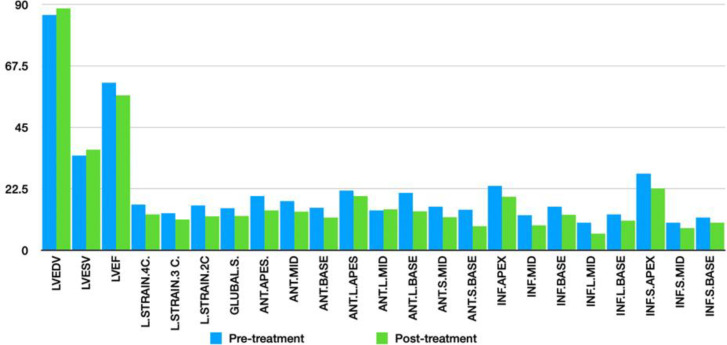 Figure 1
Peer Reviews
No public reviews on file for this paper yet. If you reviewed it on a platform where reviews are public (OpenReview, ICLR, NeurIPS, ICML), you can paste yours below so the community can read it here.
Videos
No videos yet. Explain this paper in a talk, walkthrough, or lecture? Add one.
Taxonomy
TopicsCardiovascular Function and Risk Factors · Fungal Plant Pathogen Control · Multiple Myeloma Research and Treatments
Letter to the editor,
Multiple myeloma (MM) is characterized by the neoplastic proliferation of plasma cells, leading to the production of monoclonal immunoglobulins. High-dose chemotherapy with autologous stem cell transplant has been used in the treatment of patients with MM (1). Melphalan (L-phenylalanine nitrogen mustard) is one of the most effective chemotherapeutic drugs in the treatment of MM (2). The side effects of melphalan include anemia, nausea, vomiting, allergic reactions, oral ulcers, nephrotoxicity, and arrhythmia at high doses (3). The effect of this drug on cardiac mechanics and heart damage is not well established, as previous studies have only focused on the electrocardiographic and metabolic effects of this drug.
Velocity vector imaging (VVI) is a relatively new echocardiographic technique based on two-dimensional grayscale imaging (angle-dependent), which can provide more information about cardiac function than tissue Doppler imaging (4). Strain echocardiography is also a new non-invasive technique for the evaluation of global and segmental cardiac function. It measures the percentage change in myocardial length from a relaxed to a contractile state and assesses different spatial parts of contractile function in three directions, both globally and regionally. It is also used for the quantitative evaluation of intracellular desynchrony and different components of myocardial function, including longitudinal myocardial shortening, which is not otherwise easy to measure (5, 6). To evaluate the role of melphalan in myocardial function among patients with MM, we performed VVI on 18 MM patients undergoing melphalan therapy. We used VVI to measure 16 segments of the left ventricle (LV) in three consecutive cardiac cycles to determine the global longitudinal strain.
The results showed that the left ventricular ejection fraction and global longitudinal strain significantly decreased after melphalan therapy (p<0.001). There was also a remarkable decrease in the contractile function of all LV segments, except for the anterolateral myocardial wall (p<0.001 for all) (table 1, figure 1). The left ventricular function was affected in different heart segments, but there was no significant difference in the left ventricular end-diastolic volume or left ventricular end-systolic volume before and after three weeks of melphalan therapy (P=0.318 and P=0.15, respectively).
Overall, for the first time, in this prospective observational study, we found a significant reduction in the LV function and LV ejection fraction after three weeks of single-agent melphalan treatment using VVI echocardiography. Further studies should be conducted on a larger set of patients to detect melphalan-induced heart damage and cardiotoxic effects. Corroboration of our findings by using other parameters, such as troponin, brain natriuretic peptide, and endothelin to increase the sensitivity in detecting heart damage would help advice patients when contemplating melphalan administration.
The reference list from the paper itself. Each links out to its DOI / PubMed record.
- 1Jewell S Xiang Z Kunthur A Mehta P Multiple myeloma: updates on diagnosis and management Fed Pract 20153249 s 56s 30766130 PMC 6375429 · pubmed ↗
- 2Genadieva-Stavric S Cavallo F Palumbo A New approaches to management of multiple myeloma Curr Treat Options Oncol 201415157702457820310.1007/s 11864-014-0276-6 · doi ↗ · pubmed ↗
- 3Withrow SJ Vail DM Page R Cancer Chemotherapy Withrow and Mac Ewen's Small Animal Clinical Oncology-E-Book 20135 th ed Saint Louis Elsevier Health Sciences, W.B. Saunders 12779
- 4Chen J Cao T Duan Y Yuan L Wang Z Velocity vector imaging in assessing myocardial systolic function of hypertensive patients with left ventricular hypertrophy Can J Cardiol 200723957611793257110.1016/s 0828-282x(07)70857-7PMC 2651418 · doi ↗ · pubmed ↗
- 5Smiseth OA Torp H Opdahl A Haugaa KH Urheim S Myocardial strain imaging: how useful is it in clinical decision making? Eur Heart J 20163711962072650816810.1093/eurheartj/ehv 529PMC 4830908 · doi ↗ · pubmed ↗
- 6Amzulescu MS De Craene M Langet H Myocardial strain imaging: review of general principles, validation, and sources of discrepancies Eur Heart J Cardiovasc Imaging 201920605193090313910.1093/ehjci/jez 041PMC 6529912 · doi ↗ · pubmed ↗