Role of General Anesthesia and Rapid On-site Evaluation in the Diagnosis of Lung Cancer with EBUS-TBNA
Yuhe HU, Yuying LI

TL;DR
This study examines whether general anesthesia and rapid on-site evaluation improve the accuracy of diagnosing lung cancer using EBUS-TBNA.
Contribution
The study evaluates the impact of general anesthesia and ROSE on EBUS-TBNA outcomes for lung cancer diagnosis.
Findings
General anesthesia with or without ROSE achieved similar diagnostic accuracy compared to local anesthesia.
Combining general anesthesia with ROSE reduced the number of lymph node punctures needed.
No serious complications or anesthesia-related adverse reactions were observed in any group.
Abstract
背景与目的 肺癌是常见的呼吸系统恶性肿瘤。超声引导下经支气管针吸活检(endobronchial ultrasound-guided transbronchial needle aspiration, EBUS-TBNA)是诊断肺癌和评估分期的重要工具。EBUS-TBNA大多在局部麻醉或清醒镇静下进行,而在全身麻醉下行EBUS-TBNA以及同时应用快速现场评价(rapid on-site evaluation, ROSE)能否进一步提高诊断效能目前仍未可知,本研究拟探索全身麻醉及ROSE在EBUS-TBNA诊断肺癌中的价值。方法 回顾性分析164例于2018年1月至2022年12月于西南医科大学附属医院呼吸与危重医学科就诊患者的资料,所有患者术前均疑诊为肺癌并行EBUS-TBNA,根据是否行全身麻醉及ROSE将患者分为局麻组(n=54)、全麻组(n=67)和全麻ROSE组(n=43),分析各组的穿刺情况以及在疾病诊断方面的差异。结果 局麻组的淋巴结穿刺针数高于全麻ROSE组(P<0.01)。三组患者的疾病总诊断率分别为87.04%、89.55%和90.70%,恶性肿瘤的诊断率分别为88.24%、88.89%和94.74%,均无统计学差异(P>0.05)。三组中没有患者出现严重并发症及麻醉相关不良反应。结论 与局部麻醉联合静脉镇痛镇静相比,全身麻醉下实施EBUS-TBNA无论是否联合ROSE均可得到同样准确的结果,全身麻醉联合ROSE可以减少淋巴结穿刺针数。 General conditions and puncture conditions of the three groups Distribution of puncture in the three groups Diagnosis of the three groups
Genes, proteins, chemicals, diseases, species, mutations and cell lines named across the full text — each resolved to its canonical identifier and authoritative record.
Click any figure to enlarge with its caption.
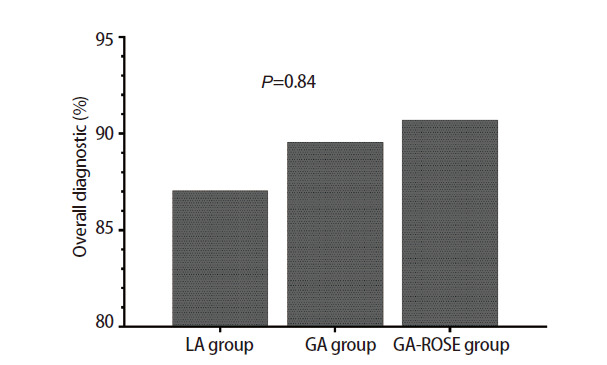 Figure 1
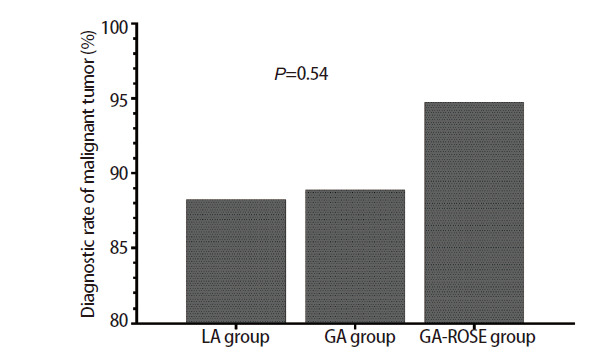 Figure 2
Peer Reviews
No public reviews on file for this paper yet. If you reviewed it on a platform where reviews are public (OpenReview, ICLR, NeurIPS, ICML), you can paste yours below so the community can read it here.
Videos
No videos yet. Explain this paper in a talk, walkthrough, or lecture? Add one.
Taxonomy
TopicsLung Cancer Diagnosis and Treatment · Airway Management and Intubation Techniques · Tracheal and airway disorders