A long-read sequencing strategy with overlapping linkers on adjacent fragments (OLAF-Seq) for targeted resequencing and enrichment
Lahari Uppuluri, Christina Huan Shi, Dharma Varapula, Eleanor Young, Rachel L. Ehrlich, Yilin Wang, Danielle Piazza, Joshua Chang Mell, Kevin Y. Yip, Ming Xiao

TL;DR
OLAF-Seq is a new sequencing method that uses CRISPR to fragment DNA and link adjacent pieces, enabling efficient and detailed analysis of targeted genomic regions.
Contribution
OLAF-Seq introduces a CRISPR-based strategy for targeted long-read sequencing with physical linkage information between fragments.
Findings
OLAF-Seq enables targeted enrichment of genomic regions with long-read sequencing platforms like PacBio and Oxford Nanopore.
The method successfully sequences cancer-related genes, including exons and introns, with improved haplotype assembly.
Linker regions in OLAF-Seq provide physical linkage information, aiding genome assembly and phasing.
Abstract
In this report, we present OLAF-Seq, a novel strategy to construct a long-read sequencing library such that adjacent fragments are linked with end-terminal duplications. We use the CRISPR-Cas9 nickase enzyme and a pool of multiple sgRNAs to perform non-random fragmentation of targeted long DNA molecules (> 300kb) into smaller library-sized fragments (about 20 kbp) in a manner so as to retain physical linkage information (up to 1000 bp) between adjacent fragments. DNA molecules targeted for fragmentation are preferentially ligated with adaptors for sequencing, so this method can enrich targeted regions while taking advantage of the long-read sequencing platforms. This enables the sequencing of target regions with significantly lower total coverage, and the genome sequence within linker regions provides information for assembly and phasing. We demonstrated the validity and efficacy of the…
Genes, proteins, chemicals, diseases, species, mutations and cell lines named across the full text — each resolved to its canonical identifier and authoritative record.
Click any figure to enlarge with its caption.
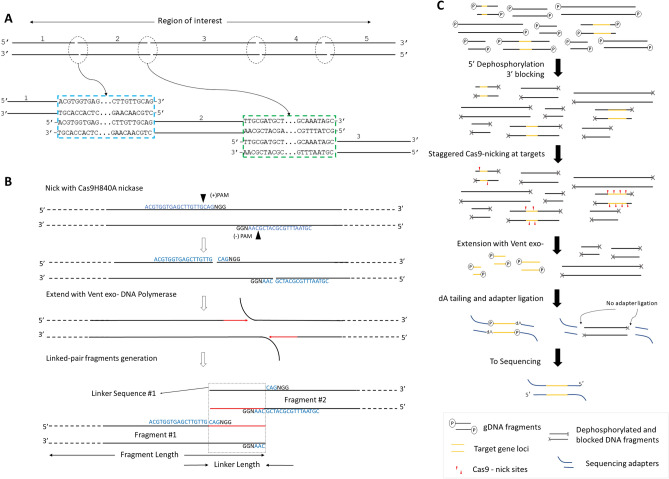 Figure 1
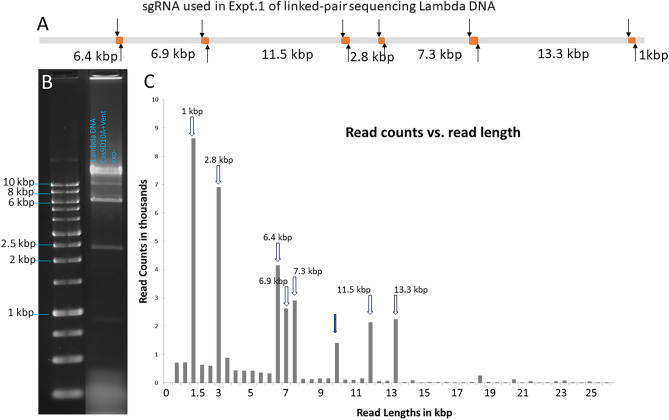 Figure 2
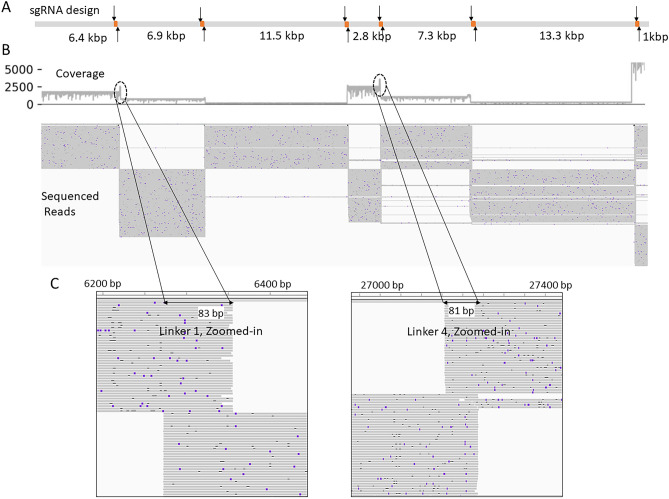 Figure 3
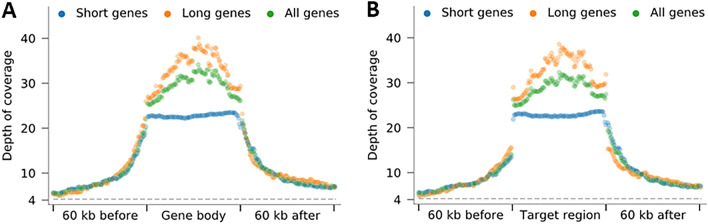 Figure 4
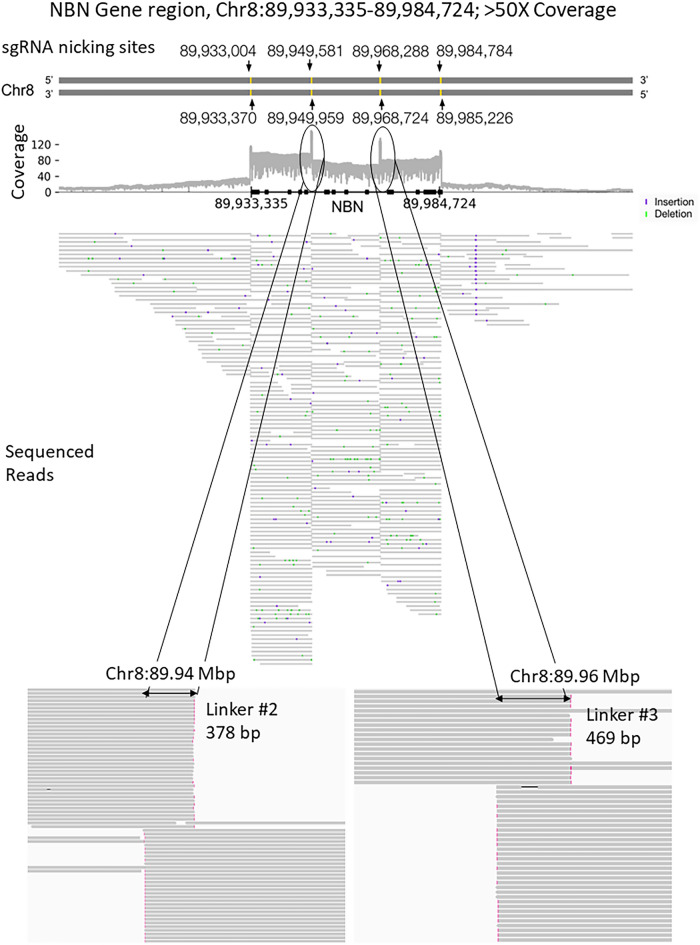 Figure 5
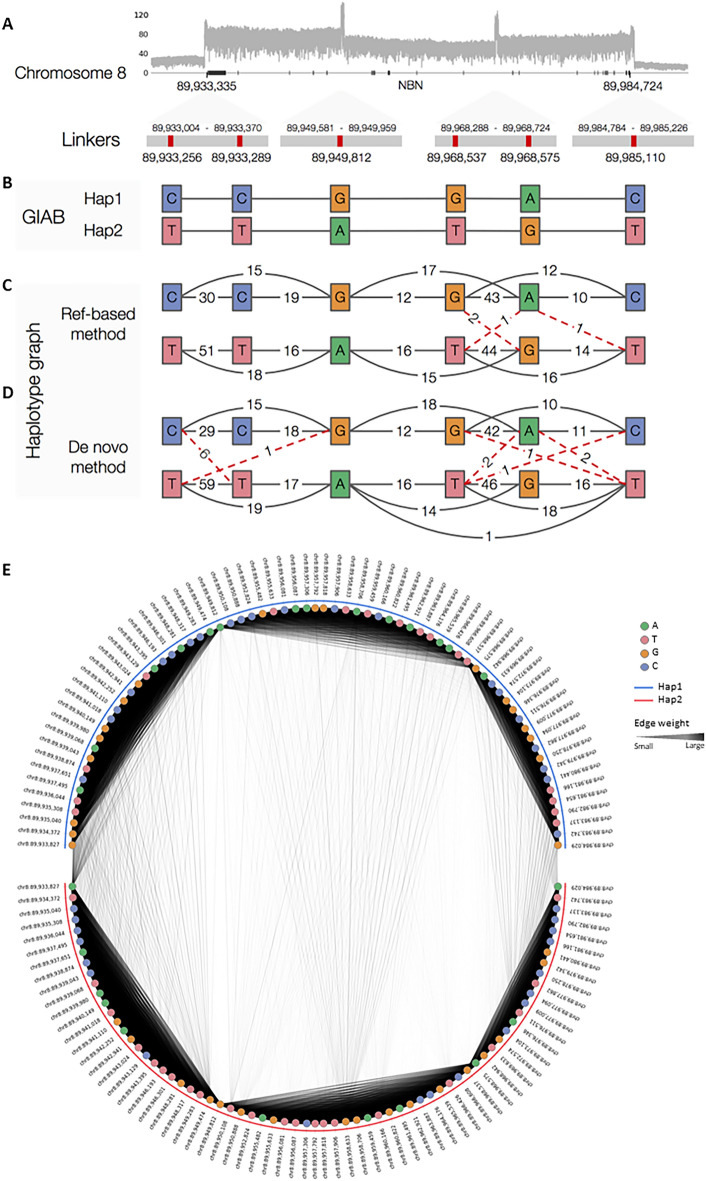 Figure 6
Peer Reviews
No public reviews on file for this paper yet. If you reviewed it on a platform where reviews are public (OpenReview, ICLR, NeurIPS, ICML), you can paste yours below so the community can read it here.
Videos
No videos yet. Explain this paper in a talk, walkthrough, or lecture? Add one.
Taxonomy
TopicsCRISPR and Genetic Engineering · Genomics and Phylogenetic Studies · RNA and protein synthesis mechanisms