Comments about comments: peer review and the amazing editorial board of Brain Communications
Tara L Spires-Jones

TL;DR
The paper discusses the diverse editorial board of Brain Communications and broader issues in the peer review process.
Contribution
Highlights the global diversity of the editorial board and reflects on peer review challenges.
Findings
The editorial board includes members from eight countries across four continents.
The paper raises awareness about the peer review system's importance and challenges.
Abstract
Our editor discusses our editorial board members, who come from eight countries on four continents, and wider issues of the peer review system. Graphical Abstract
Genes, proteins, chemicals, diseases, species, mutations and cell lines named across the full text — each resolved to its canonical identifier and authoritative record.
Click any figure to enlarge with its caption.
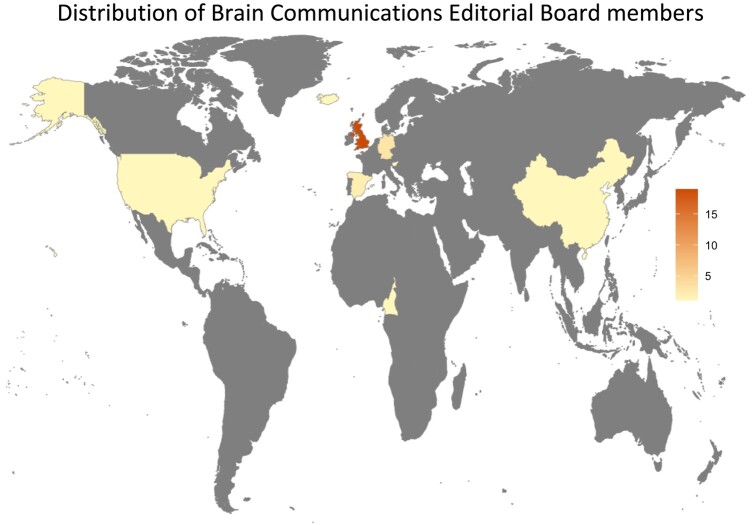 Figure 1
Peer Reviews
No public reviews on file for this paper yet. If you reviewed it on a platform where reviews are public (OpenReview, ICLR, NeurIPS, ICML), you can paste yours below so the community can read it here.
Videos
No videos yet. Explain this paper in a talk, walkthrough, or lecture? Add one.
Taxonomy
TopicsAcademic Publishing and Open Access · Academic Writing and Publishing · scientometrics and bibliometrics research
Welcome to Volume 6, issue 2 of Brain Communications. Fans of the journal may remember one of our early editorials outlining the work flow of papers submitted to us.^1^ Our associate editors play a key role in this process, donating their time and expertise to facilitate peer review of your submissions. Towards the end of 2023, submissions to our journal were rising to such an extent that we decided to invite more associate editors into our editorial board. In this editorial, I’d like to welcome the new members of the team and thank all editorial board members for their work on the journal. You can find the full list of our editors on our website (https://academic.oup.com/braincomms/pages/Editorial_Board). In addition to new members with expertise in areas popular with our authors (movement disorders, machine learning, mechanisms of neurodegeneration, genetics, molecular epidemiology, epilepsy, etc.), we are delighted to welcome associate editors based in many different parts of the world. Our board now has members from the UK, Germany, Spain, the USA, China, Cameroon, Slovenia, Iceland and France (see map in the associated Graphical Abstract).
The role of the academic editorial team is to invite peer reviewers with relevant expertise and make the decisions about whether to accept or reject papers. In our team, we work together to be sure these decisions are in line with our ethos to enhance rigour and reproducibility in translational neuroscience papers. Our scientific editorial team, composed of people with PhDs or MScs in neuroscience, checks each manuscript to be sure it complies with our policies on rigour, and as editor in chief, I check decisions to be sure we are not rejecting papers solely based on lack of novelty since we encourage replication studies.
Many in academia have been discussing a ‘peer review crisis’ because of difficulty journals like ours have in finding enough suitable experts willing to review each paper. And others are disgruntled at the system of peer review, which relies on academics doing the unpaid work of peer reviewing papers for journals that often make large profit margins.^2^ This frustration at the peer review system is prevalent on social media and in commentaries, but in surveys of scientists that I can find, the vast majority of people who responded think that peer review is an important part of the research ecosystem both for improving the work in papers and in feeling part of the research community.^3-5^ Undoubtedly, there are problems with the peer review system including the potential to introduce bias into publishing, which is hotly debated and poorly understood.^6^ The practice of scientists reviewing each other’s work dates back to the 18th century when the Royal Society started distributing reports to its members to ask them to veto publishing anything that could damage the reputation of the society. I may be an old-fashioned academic, but my view is that peer review still plays an important role in scientific communication. There is some evidence that peer review enhances the quality of reporting compared to preprints,^7^ and I think that peer review is an important part of community building and pushing our field forward.
At Brain Communications, we are trying to curate robust papers in the translational neuroscience space and facilitate constructive peer review. Several surveys and commentaries I’ve come across have indicated involving more early career researchers in the peer review process is important for the future of scientific publishing.^2,4,5^ We are doing our small part to facilitate this at Brain Communications through our reviewer academy. Everyone is welcome to watch and share the online training session run by our associate editor, Professor David Belin, who discussed with our reviewer academy members how to review papers constructively (https://www.youtube.com/watch?v=v0f_cc3m5ZM).
The cover image for this issue is courtesy of Danilo Negro and is associated with the scientific commentary by Negro and Opazo.^8^ It shows a 3D reconstruction of dendritic spines (red) from a live EGFP-labelled cortical neuron in a human brain slice culture imaged at 7 days in vitro. Segmentation and rendering were performed with 3dSpAn and ITK-SNAP. The human brain slice culture was generated by the Durrant lab and imaged in the Opazo lab using two-photon microscopy (University of Edinburgh).
The reference list from the paper itself. Each links out to its DOI / PubMed record.
- 1Spires-Jones TL . Editorial. Brain Commun. 2020;2(1):fcz 051. 10.1093/braincomms/fcz 051PMC 742537032954316 · doi ↗ · pubmed ↗
- 2Dance A . Stop the peer-review treadmill. I want to get off. Nature. 2023;614(7948):581–583.36781962 10.1038/d 41586-023-00403-8 · doi ↗ · pubmed ↗
- 3Recognising the contribution of Nature Research journal referees : Of Schemes and Memes Blog. Accessed January 23, 2024. https://blogs.nature.com/ofschemesandmemes/2019/04/16/recognising-the-contribution-of-nature-research-journal-referees
- 4Peer review survey: reporting your experiences | Royal Society. Accessed January 23, 2024. https://royalsociety.org/blog/2021/09/peer-review-survey/
- 5Peer Review Survey Insights. IOP Publishing. Accessed January 23, 2024. https://ioppublishing.org/peer-review-survey-insights/
- 6Tennant JP, Ross-Hellauer T. The limitations to our understanding of peer review. Res Integr Peer Rev. 2020;5(1):6.32368354 10.1186/s 41073-020-00092-1PMC 7191707 · doi ↗ · pubmed ↗
- 7Carneiro CFD, Queiroz VGS, Moulin TC, et al Comparing quality of reporting between preprints and peer-reviewed articles in the biomedical literature. Res Integr Peer Rev. 2020;5(1):16.33292815 10.1186/s 41073-020-00101-3PMC 7706207 · doi ↗ · pubmed ↗
- 8Negro D, Opazo P. Cognitive resilience in Alzheimer’s disease: from large-scale brain networks to synapses. Brain Commun. 2024;6:fcae 050.10.1093/braincomms/fcae 050PMC 1090398138425748 · doi ↗ · pubmed ↗