Linking patient-specific basal MET phosphorylation levels to liver health
Fabian Fröhlich

TL;DR
This paper shows how combining proteomic data with mathematical models can predict patient outcomes after liver surgery based on their MET phosphorylation levels.
Contribution
The study introduces a novel approach linking patient-specific MET phosphorylation levels with liver health outcomes using systems medicine.
Findings
Proteomic data and mathematical models were used to infer patient-specific parameters.
These parameters predict outcomes following liver surgery based on basal MET phosphorylation levels.
Abstract
Systems medicine aims at enhancing patient outcomes by integrating molecular profiles and computational methods. In their recent study, Klingmüller and colleagues (Burbano de Lara et al, 2024) integrated proteomic data with mathematical models of signal transduction to infer patient-specific parameters that predict patient outcomes following liver surgery. Integrative systems medicine approaches can help predicting clinical outcomes. In their recent study, Klingmüller and colleagues (Burbano de Lara et al, 2024) integrate proteomic data with dynamic pathway modelling to infer patient-specific parameters that predict patient outcomes after liver surgery.
Genes, proteins, chemicals, diseases, species, mutations and cell lines named across the full text — each resolved to its canonical identifier and authoritative record.
Click any figure to enlarge with its caption.
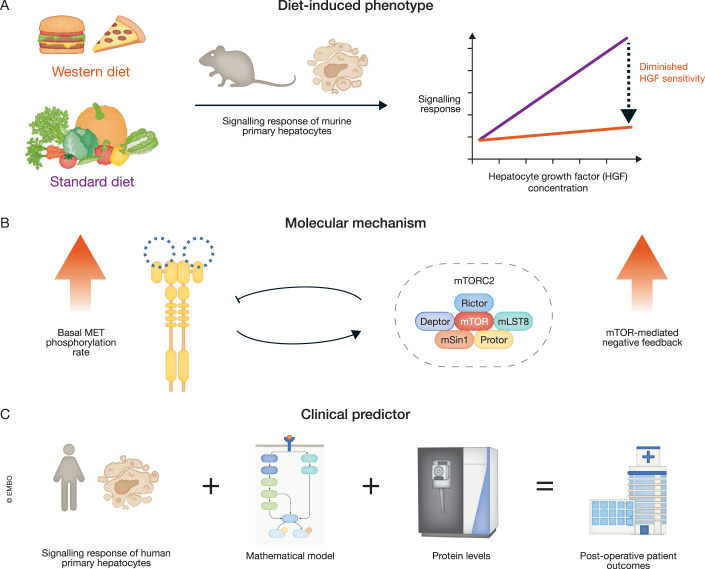 Figure 1
 Figure 2
Peer Reviews
No public reviews on file for this paper yet. If you reviewed it on a platform where reviews are public (OpenReview, ICLR, NeurIPS, ICML), you can paste yours below so the community can read it here.
Videos
No videos yet. Explain this paper in a talk, walkthrough, or lecture? Add one.
Taxonomy
TopicsLiver Disease Diagnosis and Treatment · Diet and metabolism studies · Mitochondrial Function and Pathology