Prevalence and clinical correlates of hyperhomocysteinemia in Chinese urban population with hypertension
Yayun Xu, Haixing Feng, Liping Zhang, Yanlei Li, Feng Chi, Lijie Ren

TL;DR
This study found that nearly one-third of hypertensive individuals in a Chinese urban population had high homocysteine levels, which are linked to lifestyle and genetic factors.
Contribution
The study provides new insights into the prevalence and risk factors for hyperhomocysteinemia in a hypertensive Chinese population.
Findings
The prevalence of hyperhomocysteinemia among hypertensive individuals was 31.3%.
Male gender and the MTHFR TT genotype were significant risk factors for hyperhomocysteinemia.
Lower folic acid levels and poor dietary habits were associated with higher homocysteine levels.
Abstract
The coexistence of hypertension and elevated homocysteine (Hcy) levels has a mutually reinforcing impact on the susceptibility to cardio-cerebrovascular disease. The aim was to assess the prevalence, clinical correlation, and demographic characteristics of hyperhomocysteinemia (HHcy) within the Chinese urban population with hypertension. A cohort of 473 individuals with hypertension were selected from four communities in Shenzhen, China. Demographic attributes, clinical profiles, and lifestyle behaviors were gathered and compared between individuals with and without HHcy. A logistic regression model was employed to examine potential factors associated with the prevalence of HHcy. Correlation between Hcy levels and clinical characteristics was assessed through multiple linear regression analysis. The prevalence of HHcy in the population with hypertension was 31.3%. In comparison to…
Genes, proteins, chemicals, diseases, species, mutations and cell lines named across the full text — each resolved to its canonical identifier and authoritative record.
Click any figure to enlarge with its caption.
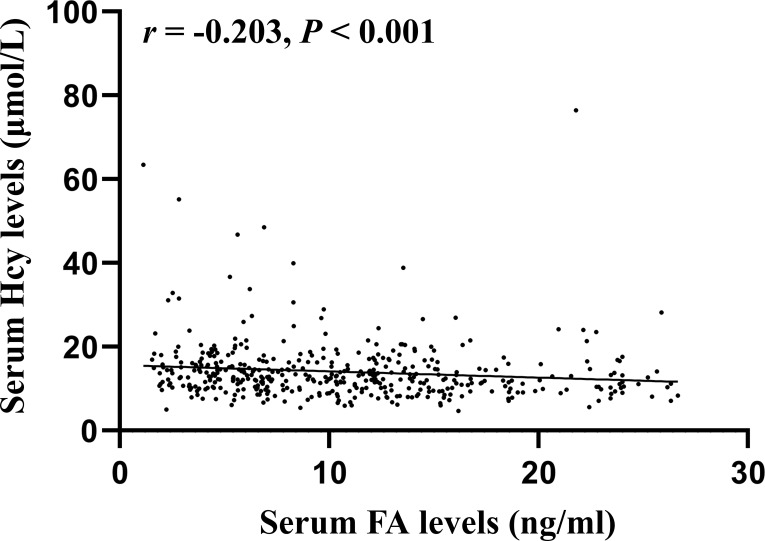 Figure 1
Peer Reviews
No public reviews on file for this paper yet. If you reviewed it on a platform where reviews are public (OpenReview, ICLR, NeurIPS, ICML), you can paste yours below so the community can read it here.
Videos
No videos yet. Explain this paper in a talk, walkthrough, or lecture? Add one.
Taxonomy
TopicsFolate and B Vitamins Research · Esophageal and GI Pathology · Nutrition and Health in Aging