A self-made three-arm clip for closure of a large wound after endoscopic full-thickness resection
Gang Zhao, Furong Ma, Shisheng Cao, Daibao Zhou, Xianxin Liao, Yao Tang, Can Cai

Abstract
Genes, proteins, chemicals, diseases, species, mutations and cell lines named across the full text — each resolved to its canonical identifier and authoritative record.
Click any figure to enlarge with its caption.
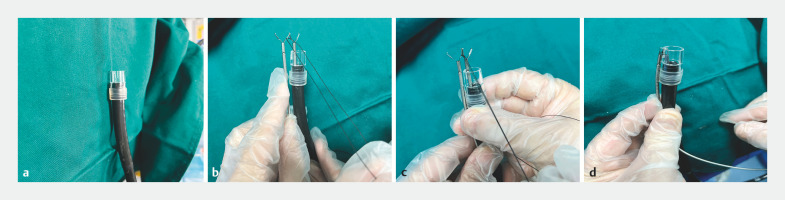 Fig. 1
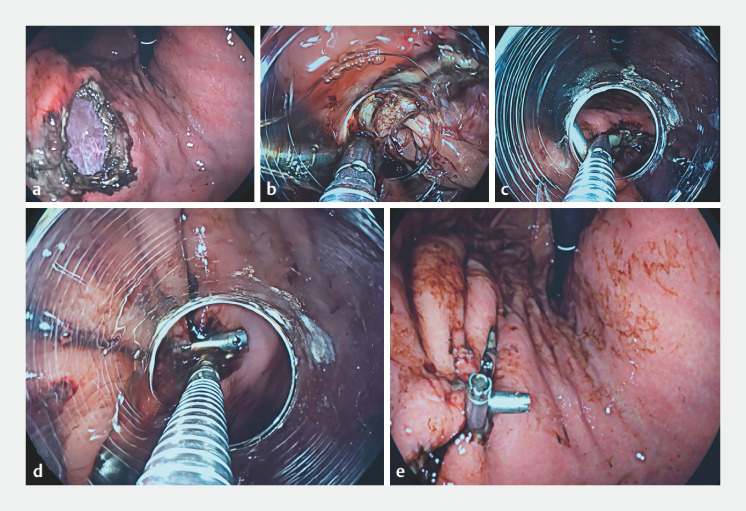 Fig. 2
Peer Reviews
No public reviews on file for this paper yet. If you reviewed it on a platform where reviews are public (OpenReview, ICLR, NeurIPS, ICML), you can paste yours below so the community can read it here.
Videos
No videos yet. Explain this paper in a talk, walkthrough, or lecture? Add one.
Taxonomy
TopicsEsophageal and GI Pathology · Gastric Cancer Management and Outcomes · Gastrointestinal Tumor Research and Treatment
Effective wound closure is key for a successful endoscopic full-thickness resection (EFTR). The currently available titanium clips can only be used to close wounds of <2 cm 1 , the over-the-scope (OTS) clip device requires a series of complex operations 2 , and, although the novel through-the-scope twin endoclip (TTS-TC) device is simple and rapid in operation, it is expensive 3 . Based on the principle of the TTS-TC, a three-arm clip (TAC), which is economical, easy to use, and suitable for the closure of large mucosal or submucosal wounds (>3 cm), was made by our team by binding two titanium clips together.
A 68-year-old man was found on gastroscopy to have a submucosal protrusive lesion in the posterior wall of the upper gastric body. Endoscopic ultrasound confirmed that the lesion was originating from the muscularis propria. EFTR was performed to resect the submucosal tumor, leaving a wound of about 3.5 × 3.0 cm. Herein, we present the successful closure of this large wound with our self-made TAC, using the following steps. First, a transparent cap with a groove was created and place on the tip of the endoscope ( Fig. 1 a ). Second, two titanium clips were placed inside and outside of the transparent cap ( Fig. 1 b ). The two clips were opened, with one jaw of each clip tied together with surgical suture ( Fig. 1 c ). The bound clips were accurately placed on either side of the groove in the cap ( Fig. 1 d ). After the wound had been fully exposed ( Fig. 2 a ), the TAC was delivered to the site of the wound with the help of an assistant ( Fig. 2 b ). With the use of this technique, the large wound on the posterior wall of the upper gastric body was successfully turned into two smaller wounds ( Fig. 2 c–e ). The decreased wound sizes following use of the TAC meant traditional clips could subsequently be conveniently used to completely close the wound ( Video 1 ).
The steps involved in production of a self-made three-arm clip were: a a transparent cap with a groove was placed on the tip of the endoscope; b a titanium clip passed through the endoscope working channel was positioned inside the cap and a second clip was positioned outside the cap; c the two clips were opened, with one jaw of each clip tied together with surgical suture; d the two bound clips were accurately placed on either side of the groove in the cap.
Endoscopic images showing: a a large wound on the posterior wall of the upper gastric body following endoscopic full-thickness resection; b the self-made three-arm clip (TAC) being delivered to the site of the wound; c the tissue on one side of the wound clamped using the outside clip of the TAC; d the clamped tissue pulled across to the opposite side of the wound and the inside clip of the TAC used to clamp the tissue on this side; e the tissues on either side of the wound clamped together, thereby turning a large wound into two small wounds.
A self-made three-arm clip is used to successfully close a large wound on the posterior wall of the upper gastric body following endoscopic full-thickness resection.Video 1
Endoscopy_UCTN_Code_TTT_1AO_2AI
The reference list from the paper itself. Each links out to its DOI / PubMed record.
- 1Hayashi I Yonezawa TM Kuwabara T The study on staunch clip for the treatment by endoscopy Gastrointest Endosc 19751792101
- 2Singhal S Changela K Papafragkakis H Over the scope clip: technique and expanding clinical applications J Clin Gastroenterol 20134774975610.1097/MCG.0b 013e 318296 ecb 923751852 · doi ↗ · pubmed ↗
- 3Qiang Z Zhen W Yang BA novel through-the-scope twin endoclip for a large mucosal closure in a live pig model Endoscopy 201951 E 372E 37331261434 10.1055/a-0948-5252 · doi ↗ · pubmed ↗