Ferromagnetism on an atom-thick & extended 2D metal-organic coordination network
Jorge Lobo-Checa, Leyre Hernández-López, Mikhail M. Otrokov, Ignacio Piquero-Zulaica, Adriana E. Candia, Pierluigi Gargiani, David Serrate, Fernando Delgado, Manuel Valvidares, Jorge Cerdá, Andrés Arnau, Fernando Bartolomé

TL;DR
Researchers created a 2D metal-organic network showing ferromagnetism with high magnetic properties and a Curie temperature of 35K.
Contribution
Demonstrated experimentally feasible 2D ferromagnetism in atom-thin metal-organic coordination networks.
Findings
Achieved ferromagnetism with coercive fields over 2 Tesla and a Curie temperature of ~35 K.
Magnetic properties arise from exchange interactions mediated by molecular linkers.
Only ~5% of the monolayer consists of Fe atoms, yet extended cooperative magnetism is observed.
Abstract
Ferromagnetism is the collective alignment of atomic spins that retain a net magnetic moment below the Curie temperature, even in the absence of external magnetic fields. Reducing this fundamental property into strictly two-dimensions was proposed in metal-organic coordination networks, but thus far has eluded experimental realization. In this work, we demonstrate that extended, cooperative ferromagnetism is feasible in an atomically thin two-dimensional metal-organic coordination network, despite only ≈ 5% of the monolayer being composed of Fe atoms. The resulting ferromagnetic state exhibits an out-of-plane easy-axis square-like hysteresis loop with large coercive fields over 2 Tesla, significant magnetic anisotropy, and persists up to TC ≈ 35 K. These properties are driven by exchange interactions mainly mediated by the molecular linkers. Our findings resolve a two decade search for…
Genes, proteins, chemicals, diseases, species, mutations and cell lines named across the full text — each resolved to its canonical identifier and authoritative record.
Click any figure to enlarge with its caption.
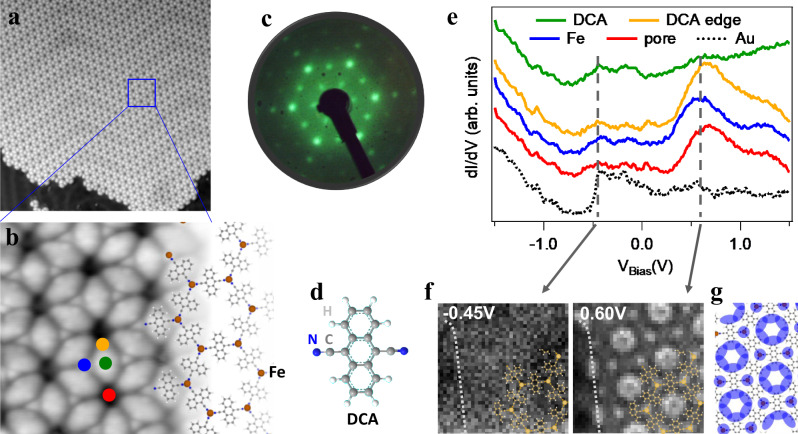 Figure 1
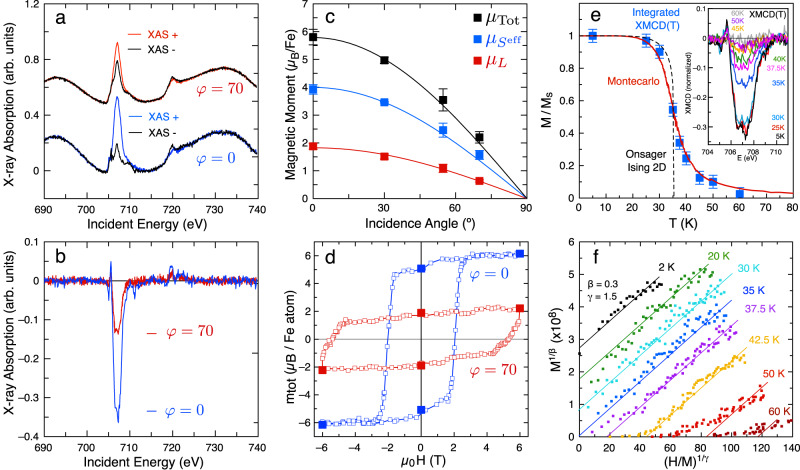 Figure 2
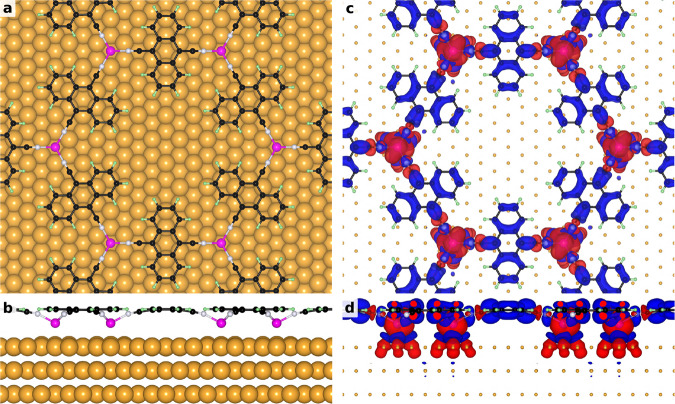 Figure 3
Peer Reviews
No public reviews on file for this paper yet. If you reviewed it on a platform where reviews are public (OpenReview, ICLR, NeurIPS, ICML), you can paste yours below so the community can read it here.
Videos
No videos yet. Explain this paper in a talk, walkthrough, or lecture? Add one.
Taxonomy
TopicsEconomic Growth and Fiscal Policies · Agriculture and Agroindustry Studies